Chapter 7 AMBA 3 AHB-Lite Bus Architecture Overview
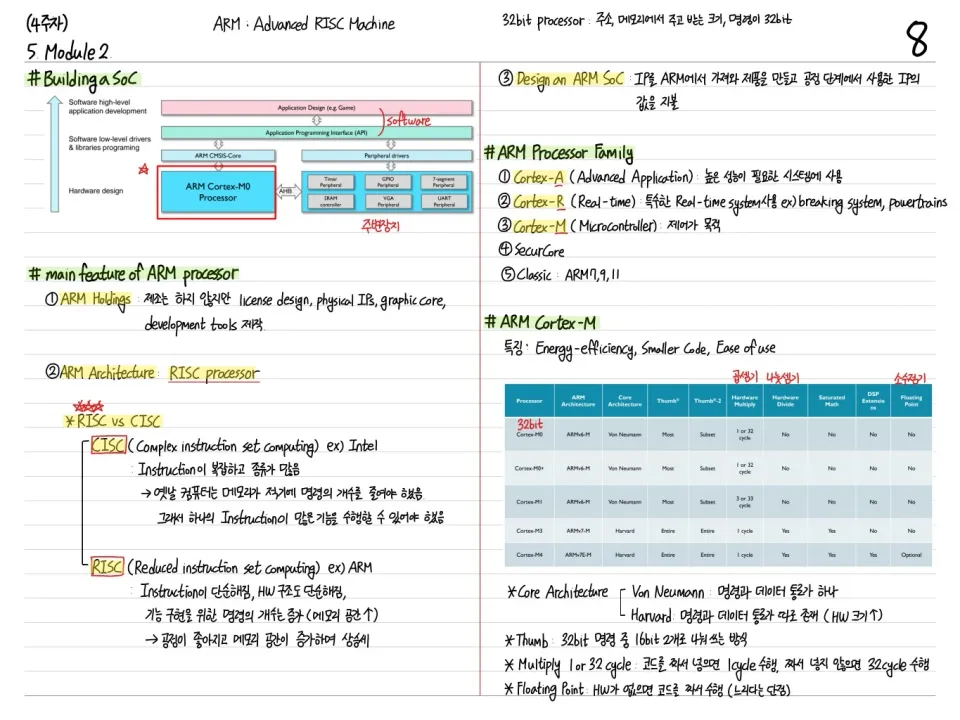
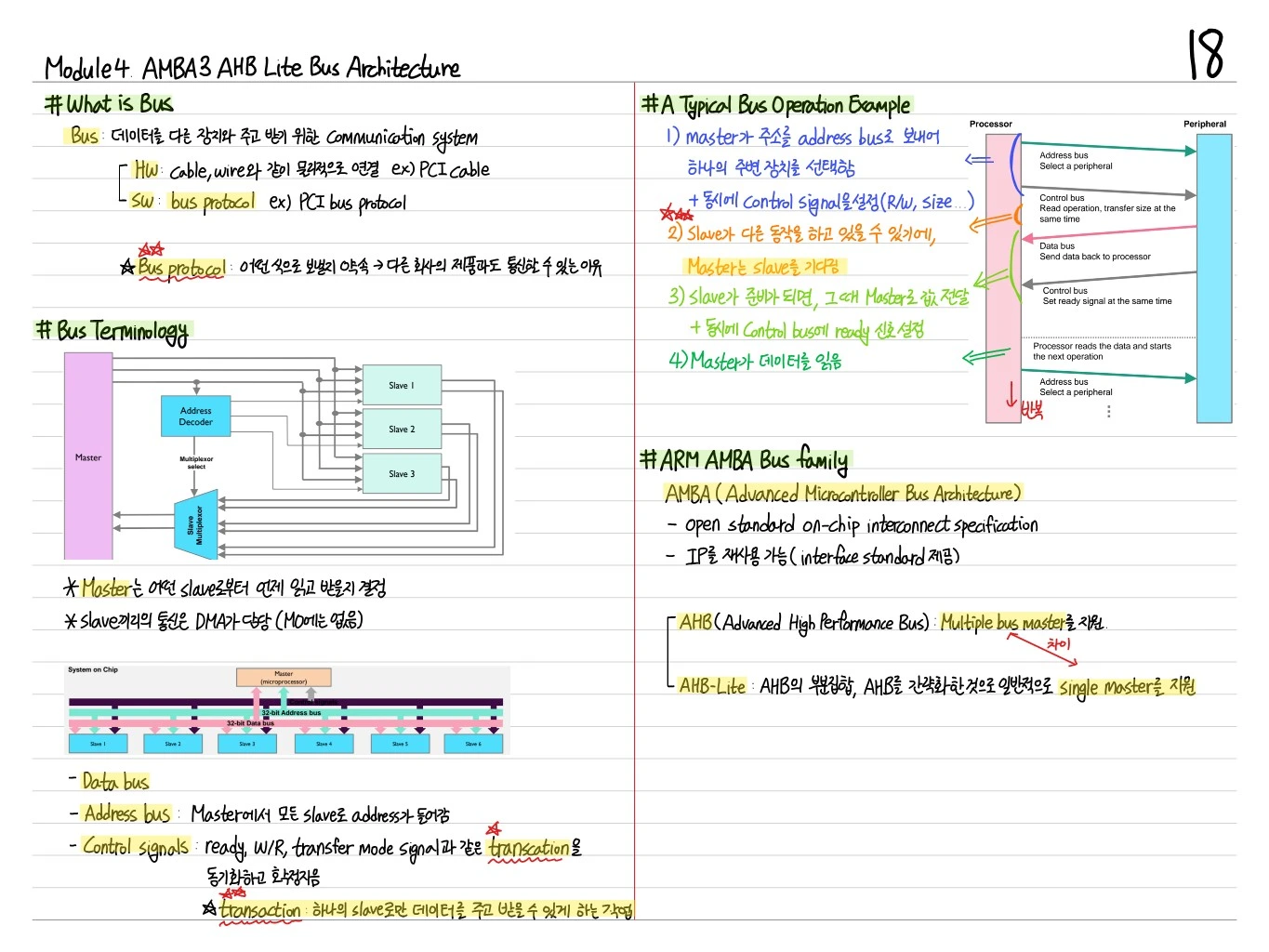
AHB-Lite is the single-master version of the ARM AMBA (Advanced Microcontroller Bus Architecture) 3.0 standard. It is the standard system bus for Cortex-M0/M3 MCUs.
AMBA 3 AHB-Lite Features
- Single-master bus: the original AHB was multi-master, but Lite has a single master (no arbiter)
- Pipelined transactions: the address phase and data phase overlap → ↑ throughput
- Supports burst transfers (INCR, WRAP)
- No split transactions (in the Lite version)
Signal Description
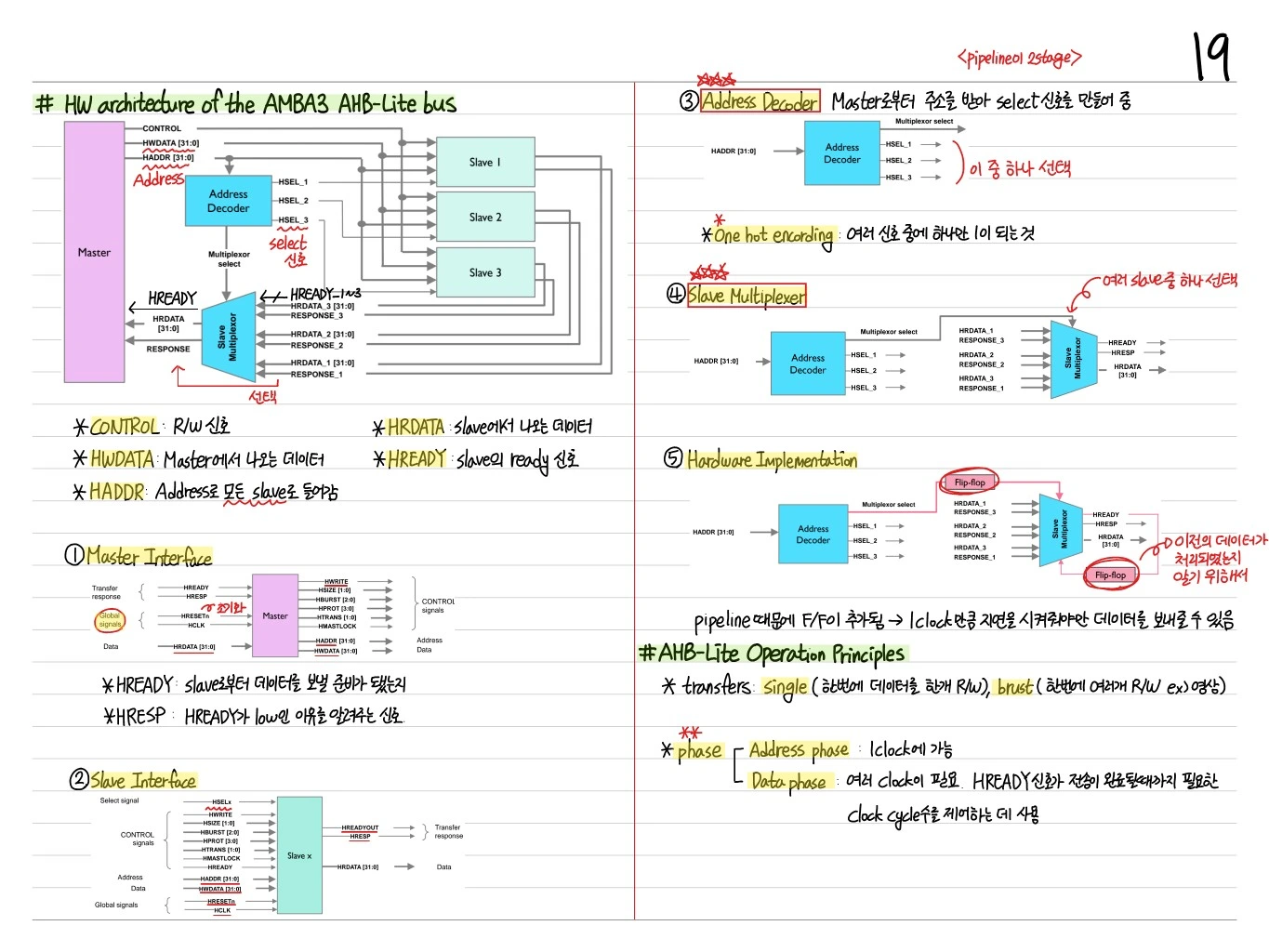
Master Output
- HCLK: bus clock
- HRESETn: active-low reset
- HADDR[31:0]: address
- HWRITE: 1=write, 0=read
- HSIZE[2:0]: transfer size (byte/halfword/word)
- HBURST[2:0]: burst type (SINGLE, INCR, WRAP4, INCR4, …)
- HPROT[3:0]: protection/cache attribute
- HTRANS[1:0]: transfer type (IDLE, BUSY, NONSEQ, SEQ)
- HWDATA[31:0]: write data
- HMASTLOCK: locked transaction
Slave Output
- HRDATA[31:0]: read data
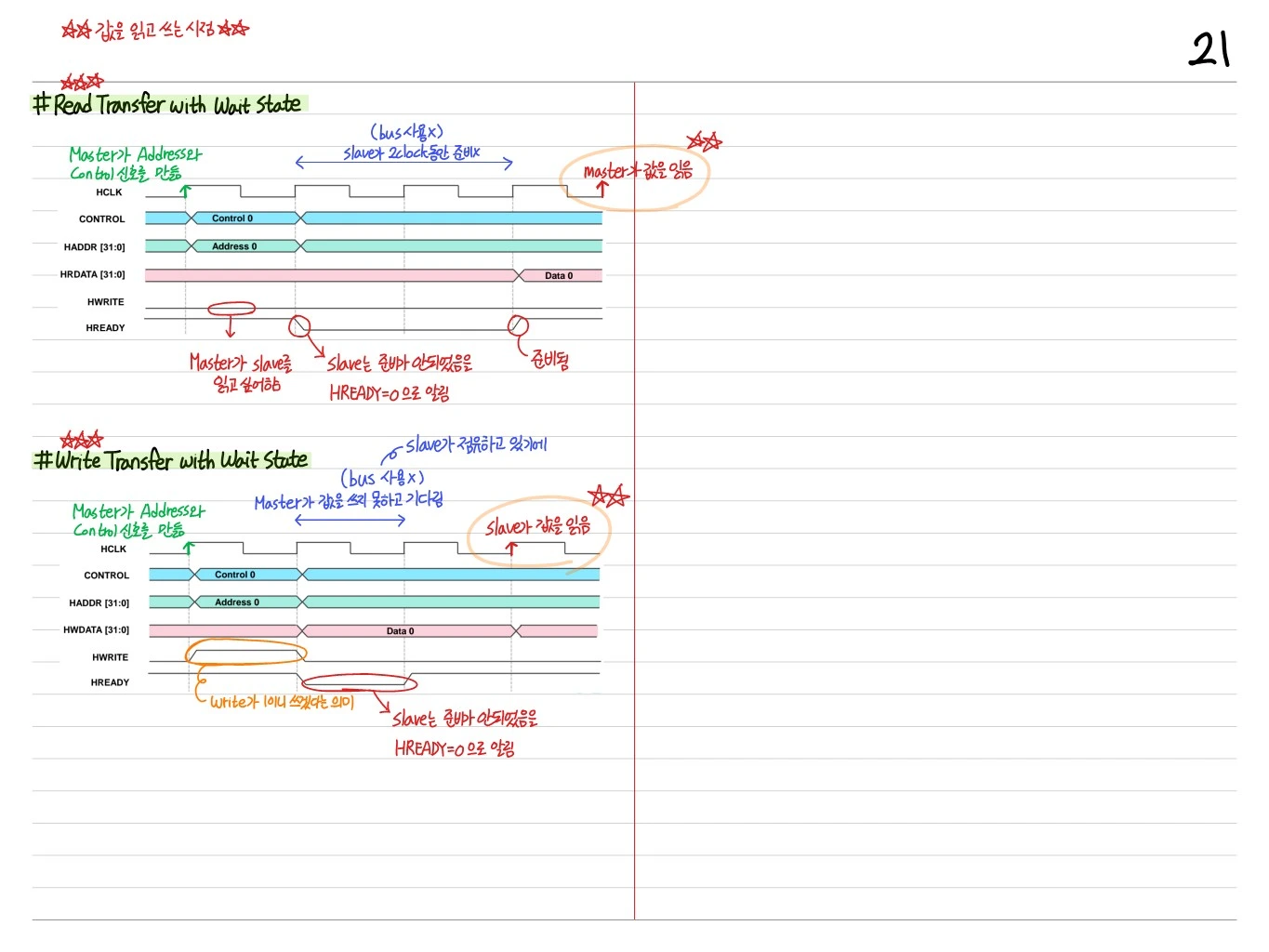
- HREADY: slave ready (wait state)
- HRESP: response (OKAY, ERROR)
AHB-Lite Transaction
A basic transaction takes 2 cycles: an address phase and a data phase:
     T0        T1        T2
HCLK __/\__/\__/\__/\__
HADDR ___[Addr]________
HWRITE __[____1_____]____
HTRANS ___[NONSEQ]__[IDLE]_
HWDATA __________[Data]__
HREADY ___________/‾‾‾\_- T1 (Address phase): the master drives the address and control
- T2 (Data phase): the slave drives or accepts the data and signals completion with HREADY
Wait State
If the slave is not ready, it holds HREADY=0 → the data phase is extended.
Burst Transfer
Transfers several consecutive words as one NONSEQ + several SEQ:
Burst Type (HBURST)
- SINGLE: single transfer
- INCR: unspecified length increment
- WRAP4: 4-beat wrapping (cache line)
- INCR4: 4-beat incrementing
- WRAP8, INCR8, WRAP16, INCR16: fixed lengths
HTRANS
- IDLE: no transfer
- BUSY: pause in the middle of a burst
- NONSEQ: start of a burst or a single transfer
- SEQ: subsequent transfer within a burst (address increments)
AHB-Lite System Organization
                [AHB Master]
                  │ AHB
                  ▼
         ┌─── [Decoder] ─── HSELx
         │                     │
        [MUX]               [AHB Slave 1]
         │                  [AHB Slave 2]
         │                  [AHB Slave 3]
         ▼
(HRDATA, HREADY, HRESP)- Decoder: decodes HADDR and asserts the HSEL of the matching slave
- MUX: routes the selected slave's HRDATA, HREADY, and HRESP to the master
HSELx & Address Decode
Each slave is assigned its own address range. The decoder selects HSEL from the upper bits of HADDR:
if (HADDR[31:20] == 0x400)
    HSEL_UART = 1;
else if (HADDR[31:20] == 0x401)
    HSEL_GPIO = 1;
AHB to APB Bridge
Connects AHB-Lite to the low-speed APB. The bridge acts as an AHB master and communicates with the APB slaves. The typical structure of a Cortex-M0 SoC:
[Cortex-M0 Core]
      │ AHB-Lite
      ▼
 [AHB Interconnect]
  │ │ │
  │ │ └── SRAM
  │ └───── Flash
  └─────── AHB→APB Bridge
             │ APB
             ├── UART
             ├── Timer
             ├── GPIO
             └── SPI/I2C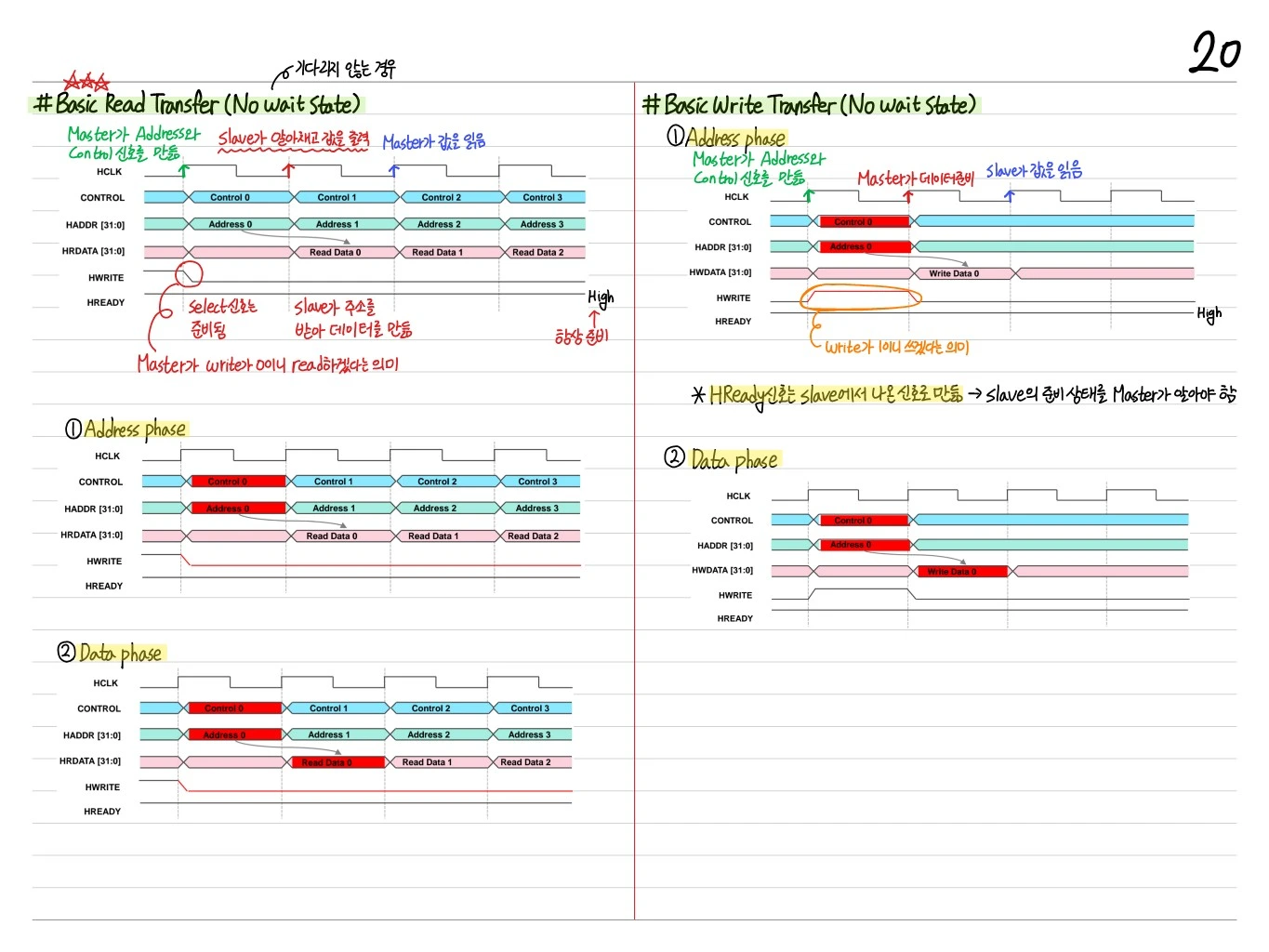
HPROT (Protection Signals)
Indicates cacheability/bufferability, user/privileged, and data/opcode:
- HPROT[0]: opcode fetch (0) / data access (1)
- HPROT[1]: user (0) / privileged (1)
- HPROT[2]: non-bufferable (0) / bufferable (1)
- HPROT[3]: non-cacheable (0) / cacheable (1)
HRESP
- OKAY (0): normal completion
- ERROR (1): slave error — the master receives the error response as a 2-cycle sequence
Summary
| Element | Key point |
|---|---|
| AHB-Lite | Single-master version of AHB |
| Pipelined | 2-stage address/data overlap |
| Burst | Cache line fill with INCR, WRAP |
| HREADY | Wait state control |
| Decoder + MUX | Routing to multiple slaves |
| Bridge to APB | Peripheral connection |
AHB-Lite is the default bus of Cortex-M0/M3 SoCs. It is simple yet provides enough bandwidth, which makes it a good fit for low-power embedded systems.