Chapter 2 Adder Overview
The adder is the foundation of all arithmetic and the core of a processor datapath. These notes start with the half adder and full adder and go through high-speed adder structures such as the carry chain, carry lookahead, and carry select.
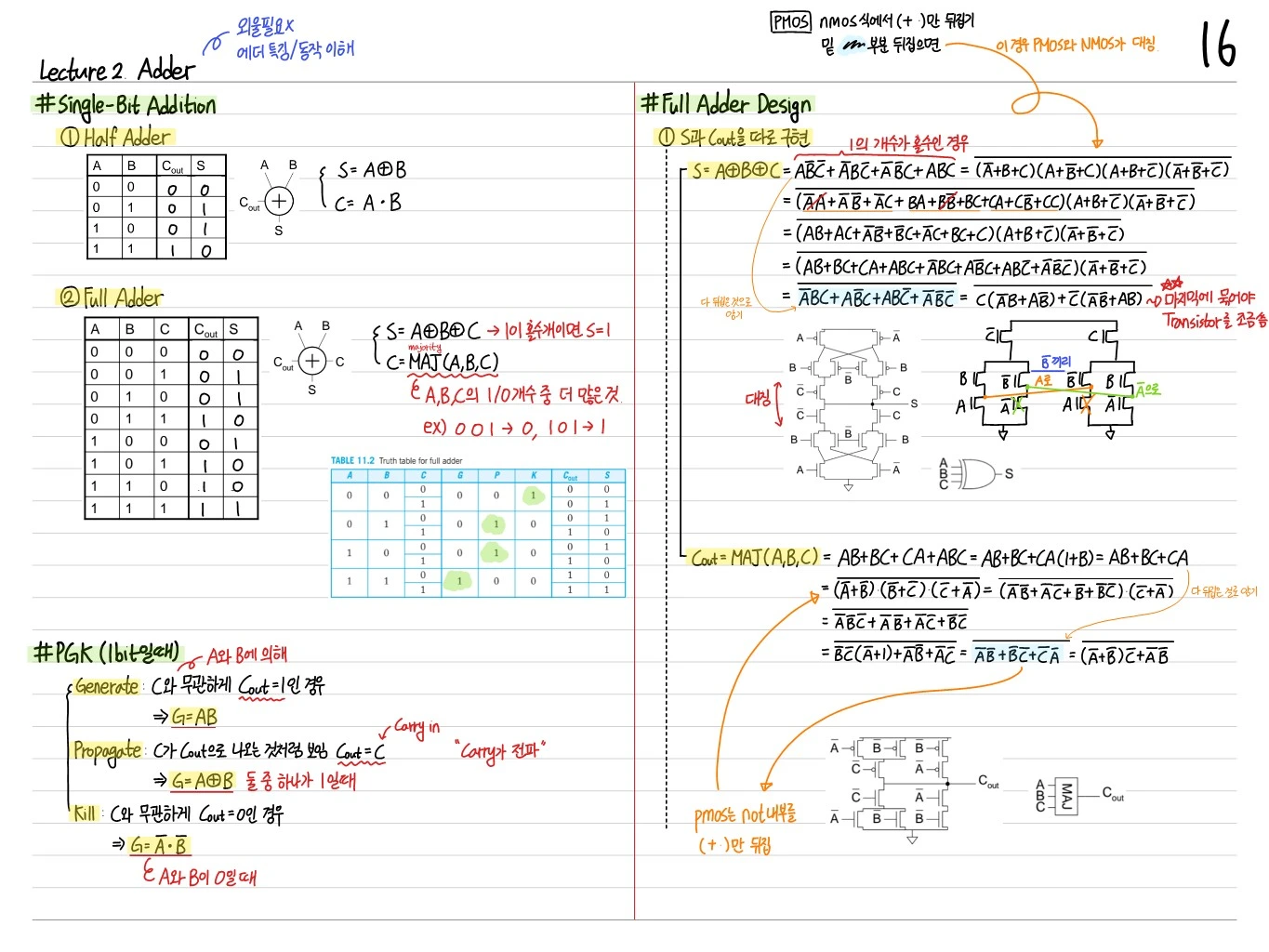
Half Adder
Two 1-bit inputs A, B → sum S and carry C:
| A | B | S | C |
|---|---|---|---|
| 0 | 0 | 0 | 0 |
| 0 | 1 | 1 | 0 |
| 1 | 0 | 1 | 0 |
| 1 | 1 | 0 | 1 |
Full Adder
Three 1-bit inputs A, B, Cin → S, Cout:
| A | B | Cin | S | Cout |
|---|---|---|---|---|
| 0 | 0 | 0 | 0 | 0 |
| 0 | 0 | 1 | 1 | 0 |
| 0 | 1 | 0 | 1 | 0 |
| 0 | 1 | 1 | 0 | 1 |
| 1 | 0 | 0 | 1 | 0 |
| 1 | 0 | 1 | 0 | 1 |
| 1 | 1 | 0 | 0 | 1 |
| 1 | 1 | 1 | 1 | 1 |
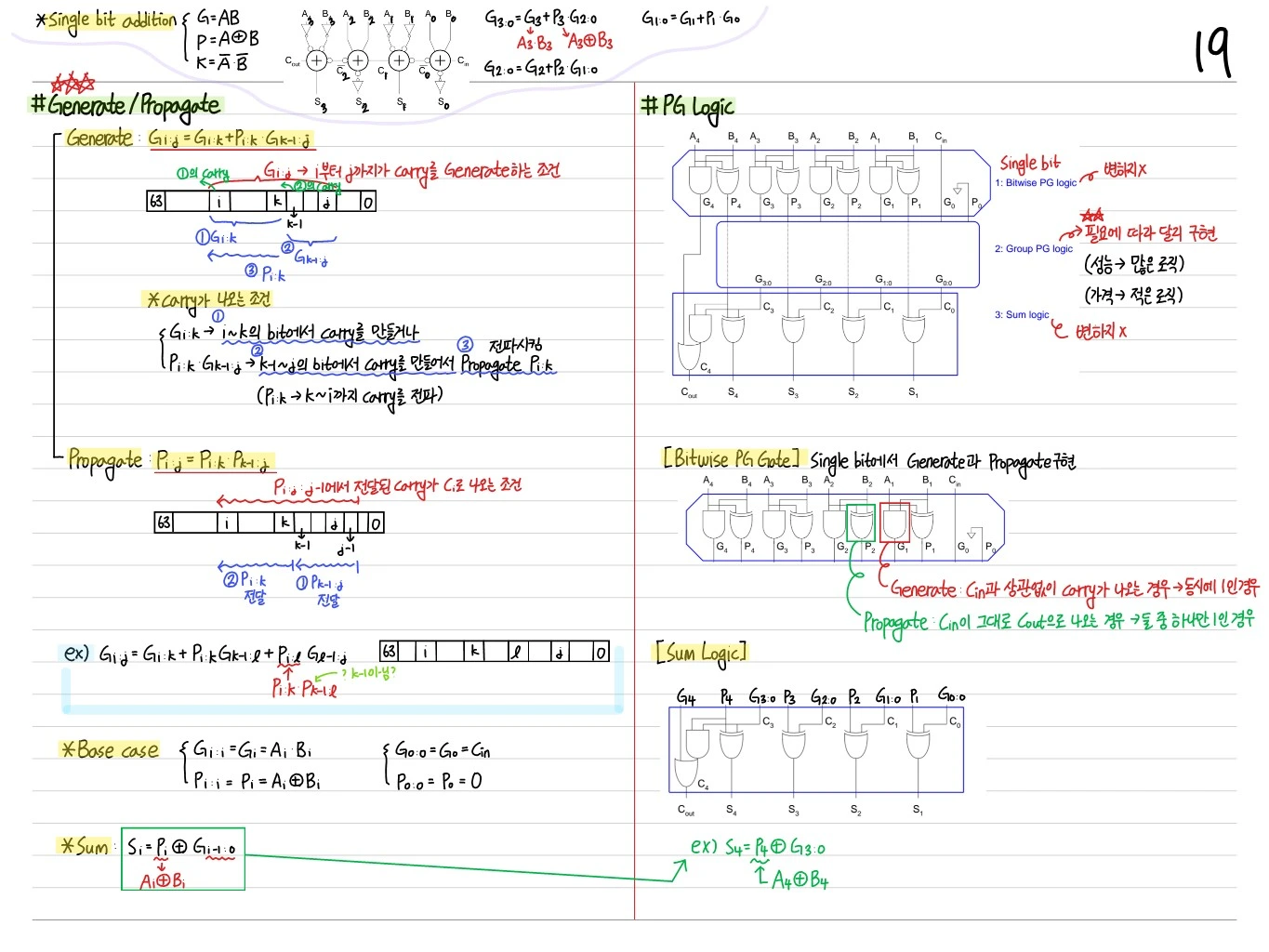
Propagate & Generate
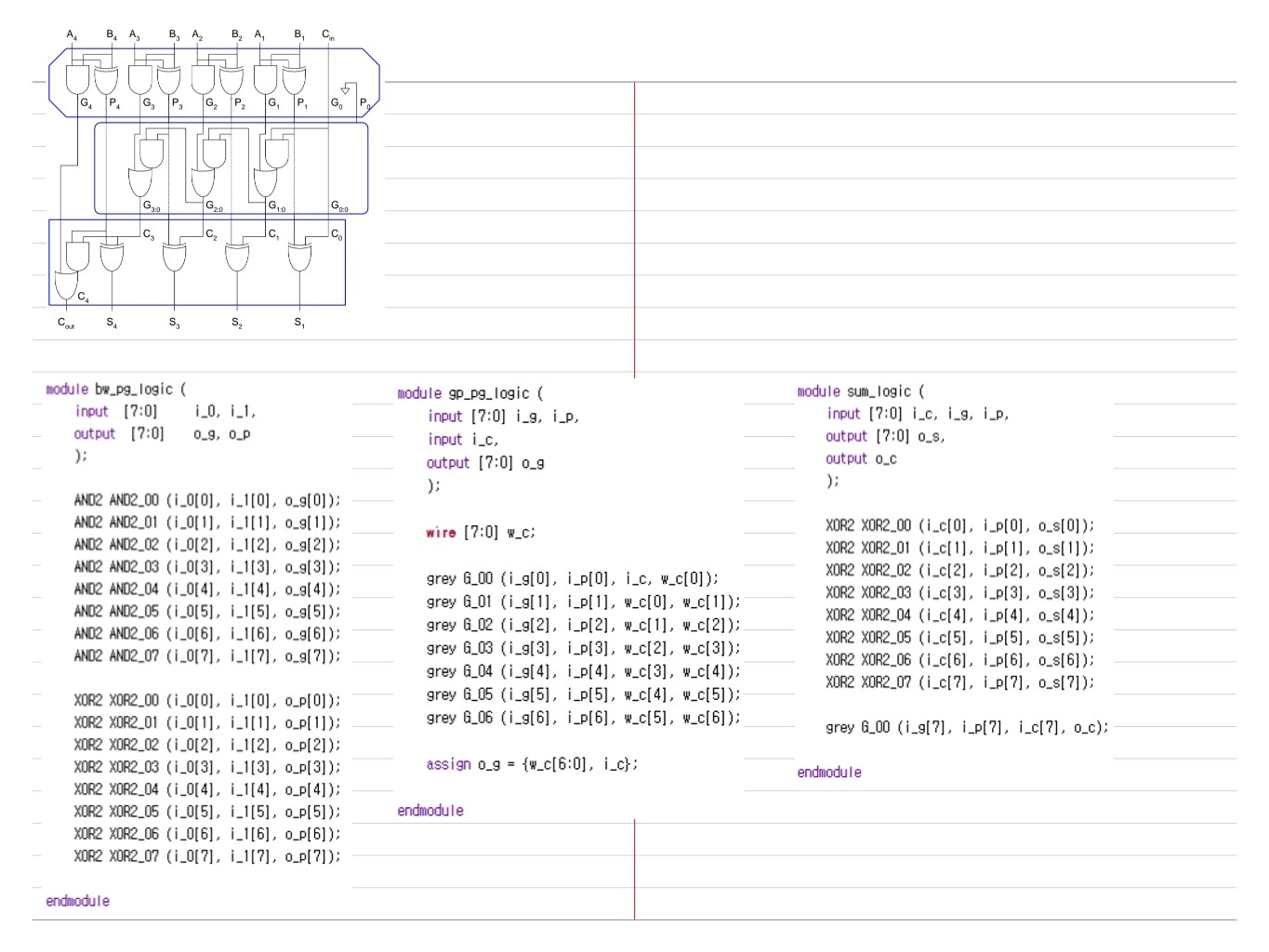
The basic concepts behind carry lookahead:
- Generate: (always produces a carry)
- Propagate: (passes the carry through)
- Cout =
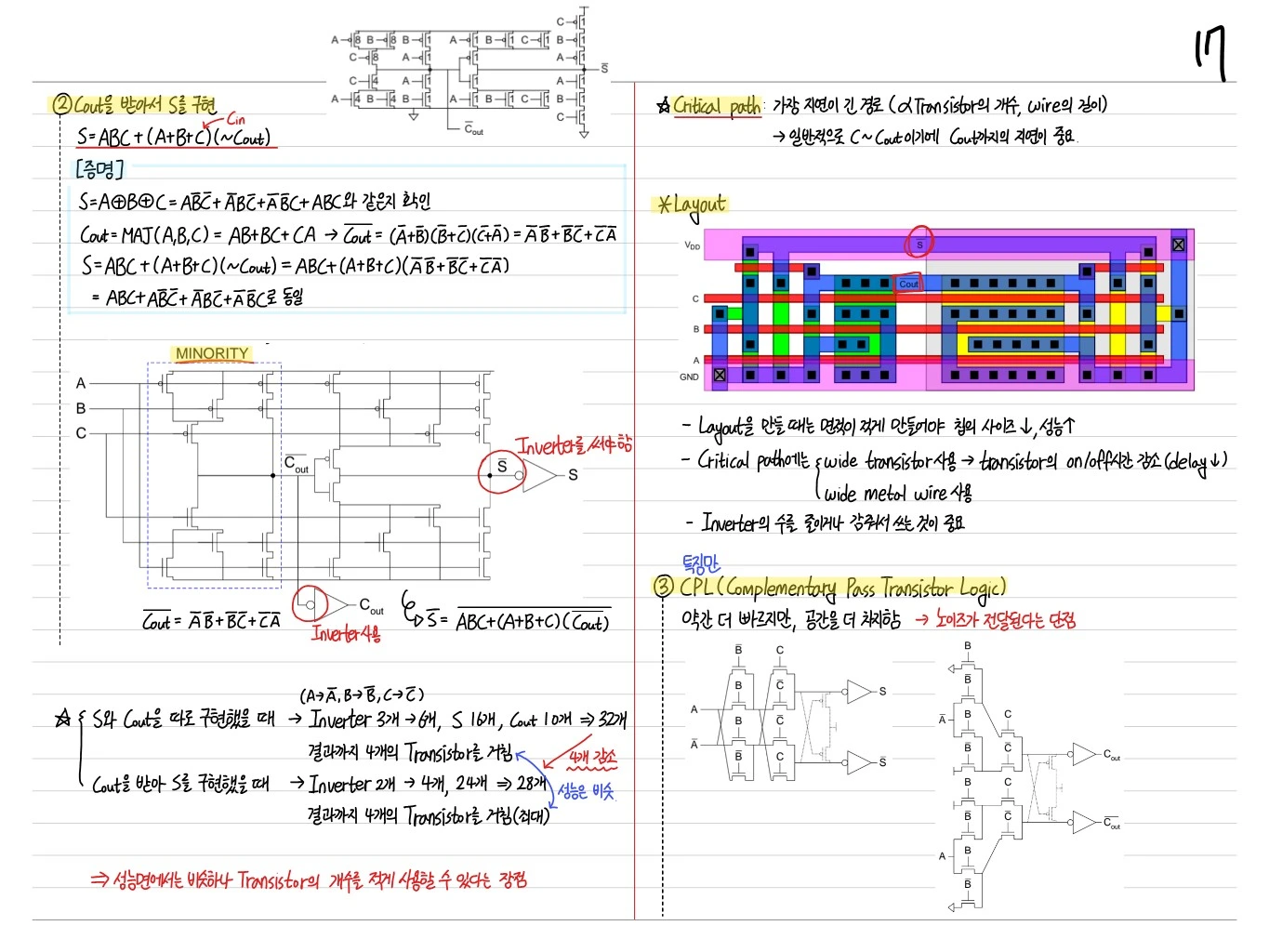
Full Adder Design — Transistor Level
- Cout: → a 5–6 transistor structure
- S: XOR-based → 10–12 transistors
- Inverting logic: use only NAND/NOR to optimize area and delay
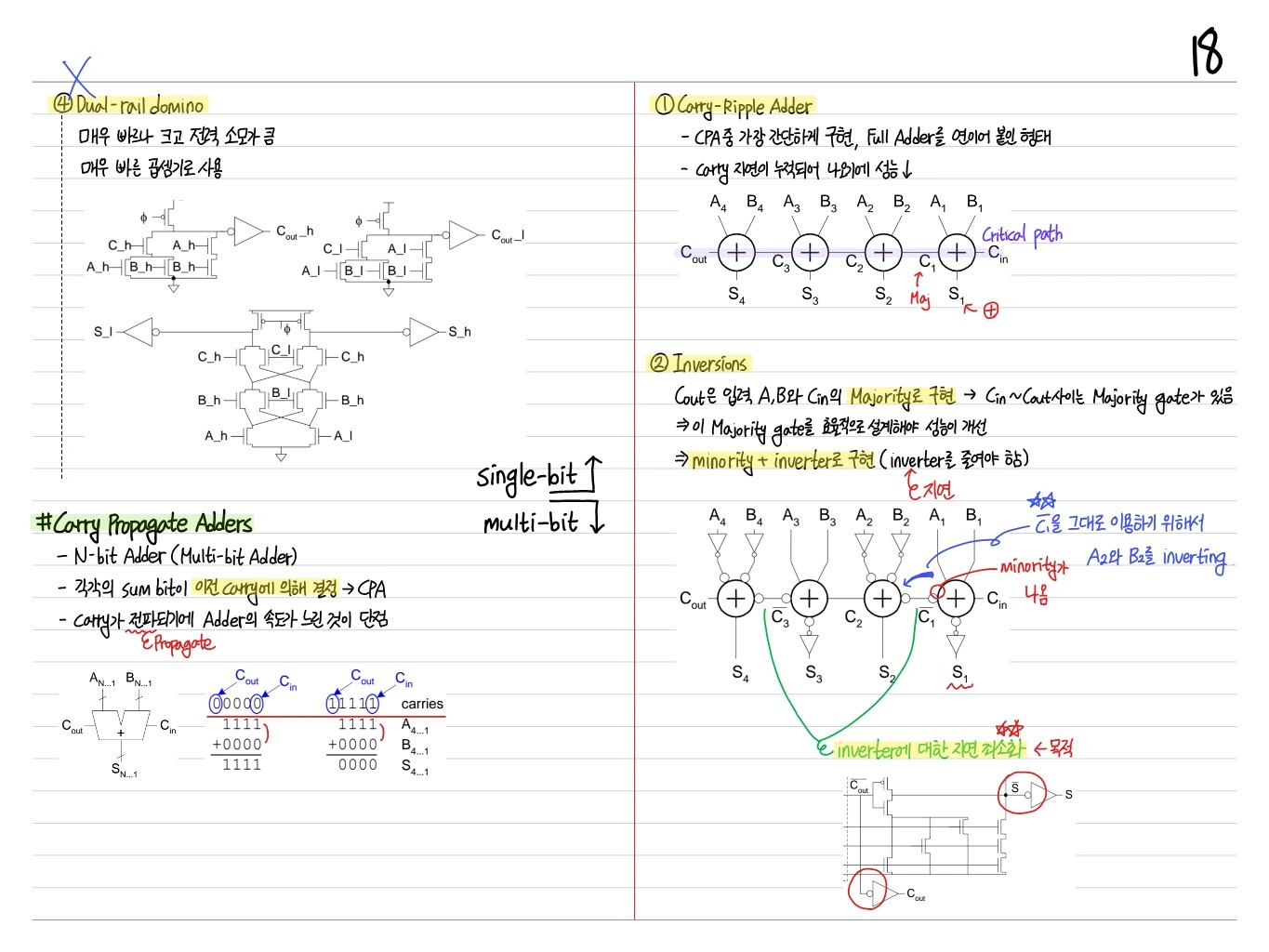
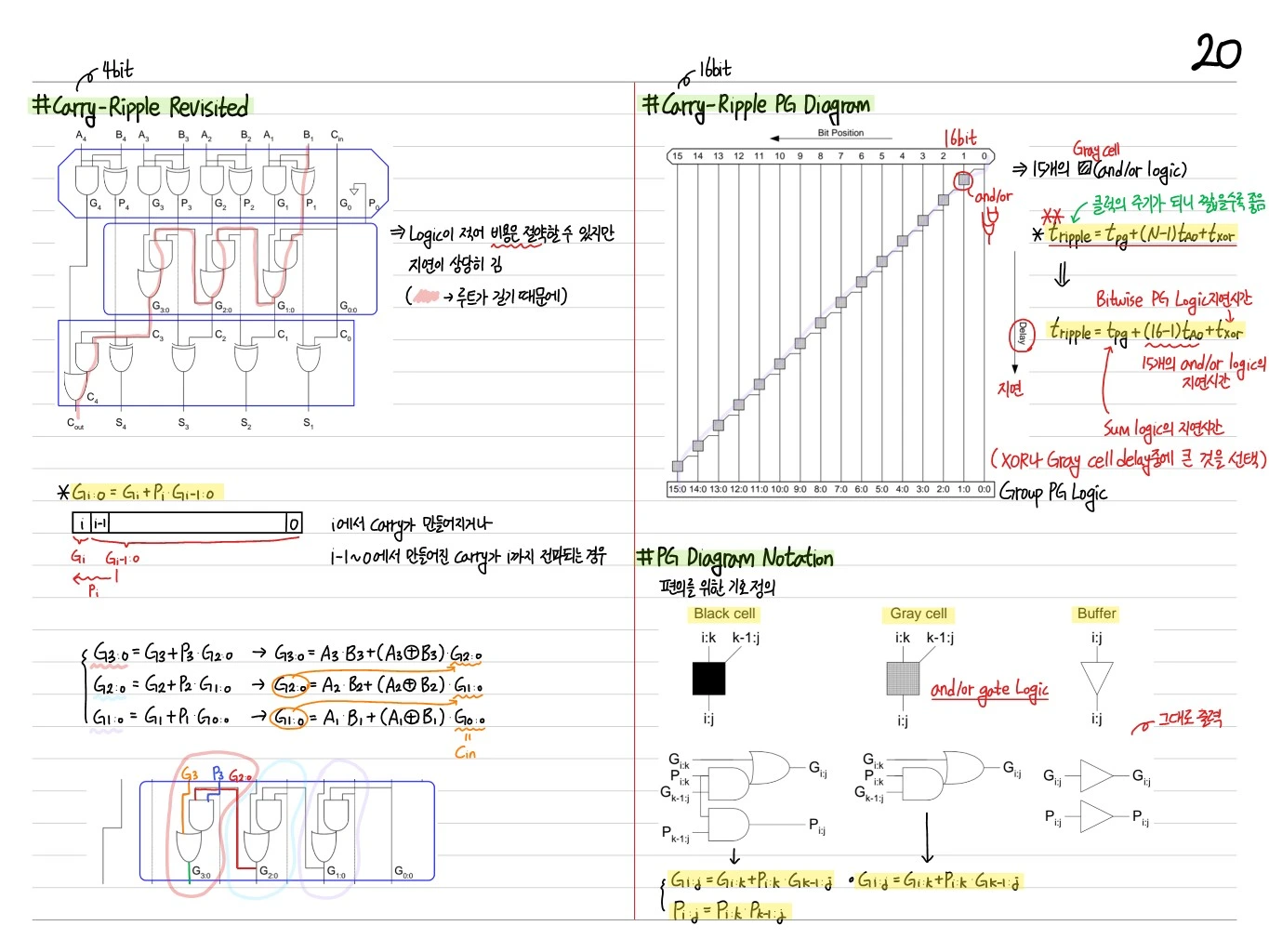
Ripple Carry Adder (RCA)
n full adders connected in sequence:
  A0,B0      A1,B1      A2,B2
    │          │          │
 [FA0]─C1→[FA1]─C2→[FA2]─C3→
    │          │          │
   S0         S1         S2
Delay
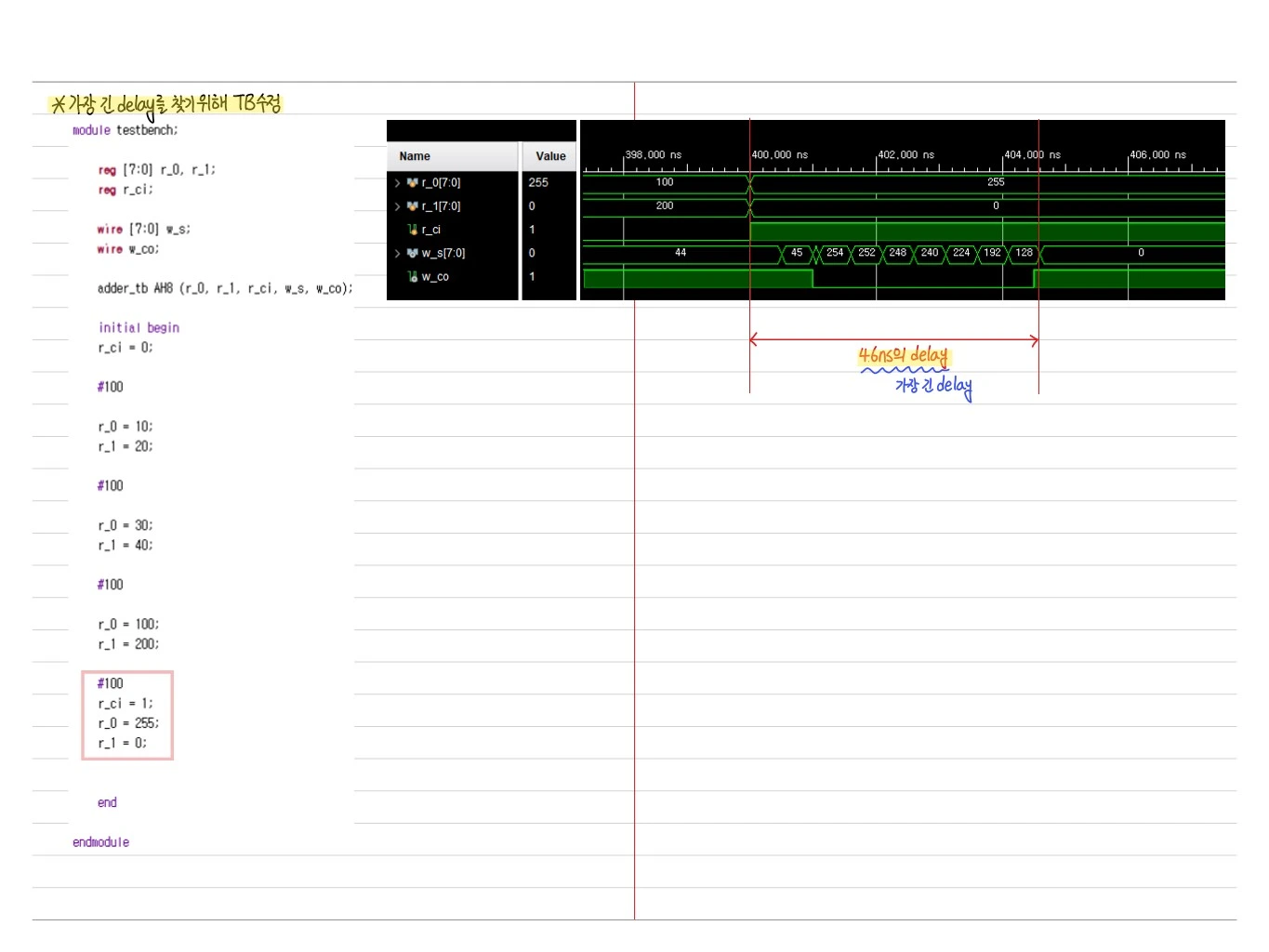
- Carry propagation: passes through all bits → O(n) delay
- Worst case: → very slow at 32 bits
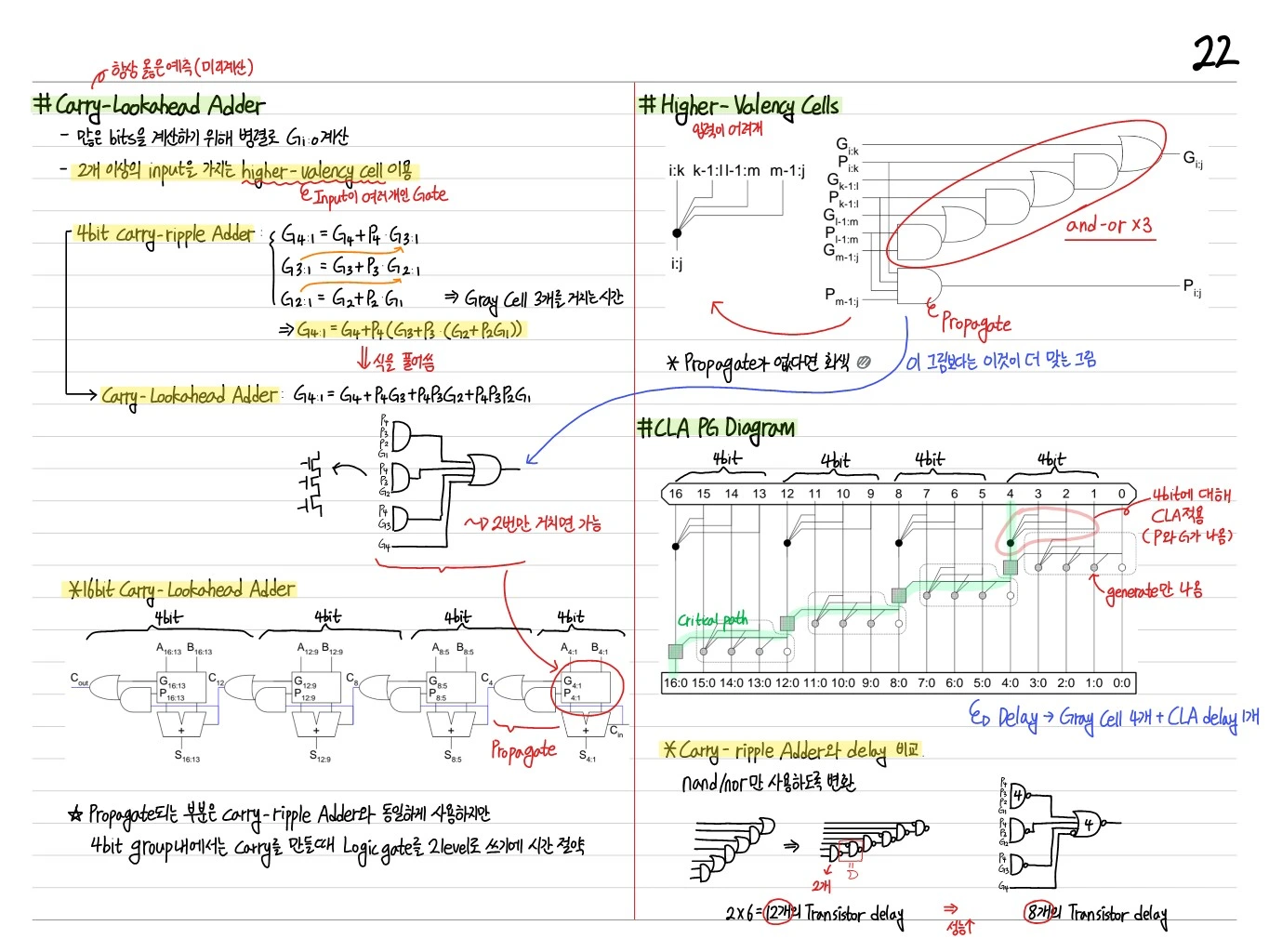
Carry Lookahead Adder (CLA)
Precomputes the carry of every bit in parallel:
Expanded:
→ Each carry can be computed with O(log n) delay.
Block Carry Lookahead
Groups the CLA into 4-bit blocks and computes the carries between blocks with lookahead as well. A hierarchical CLA.
- Hierarchy of 4-bit groups → 16-bit CLA → 64-bit CLA
- Log time at each level → overall
Manchester Carry Chain
Implements the carry chain with CMOS pass transistors:
- Propagate passes the carry along through a pass transistor
- Generate creates it directly through a pull-down
Carry Skip Adder
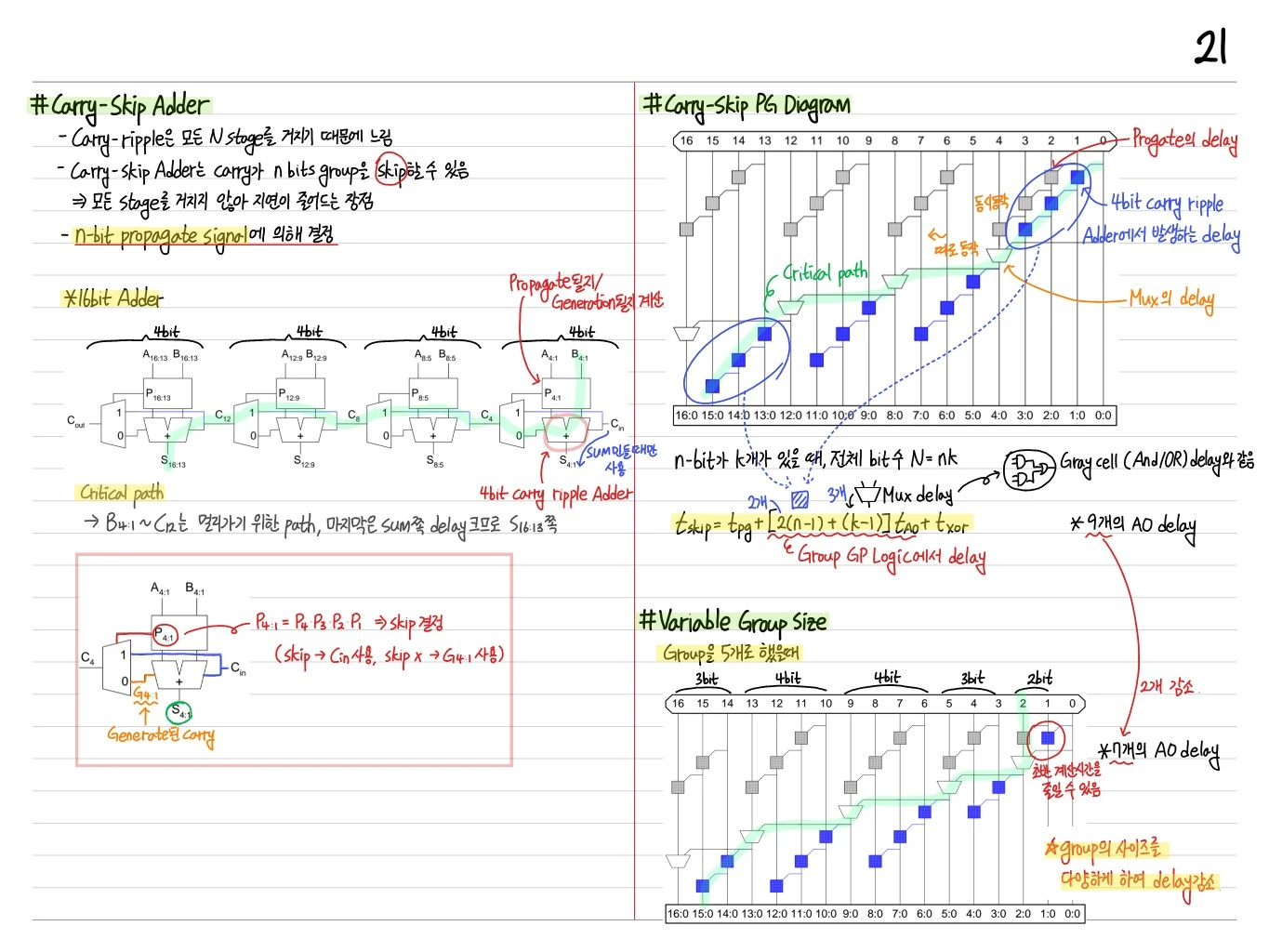
Splits the RCA into k-bit blocks; if every bit in a block has propagate=1, the carry skips (bypasses) the whole block:
- Within a block: ripple
- At block boundaries: skip through a MUX
Performance: delay, area-efficient.
Carry Select Adder
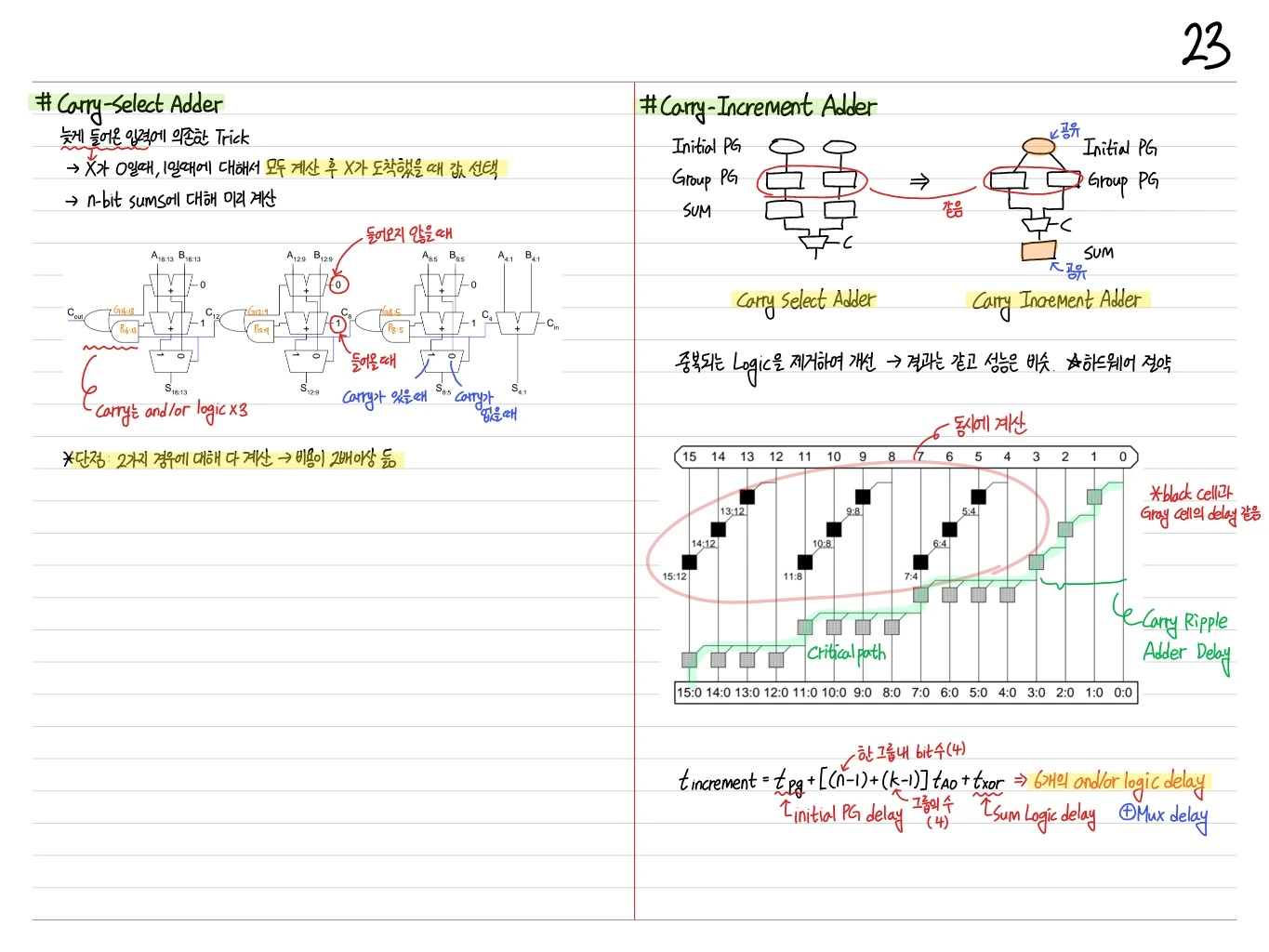
Computes each block for both Cin=0 and Cin=1 at the same time → when the actual Cin arrives, a MUX selects the result.
- ↑ area, but ↓ delay
- Common in 32-bit adders
Conditional Sum Adder
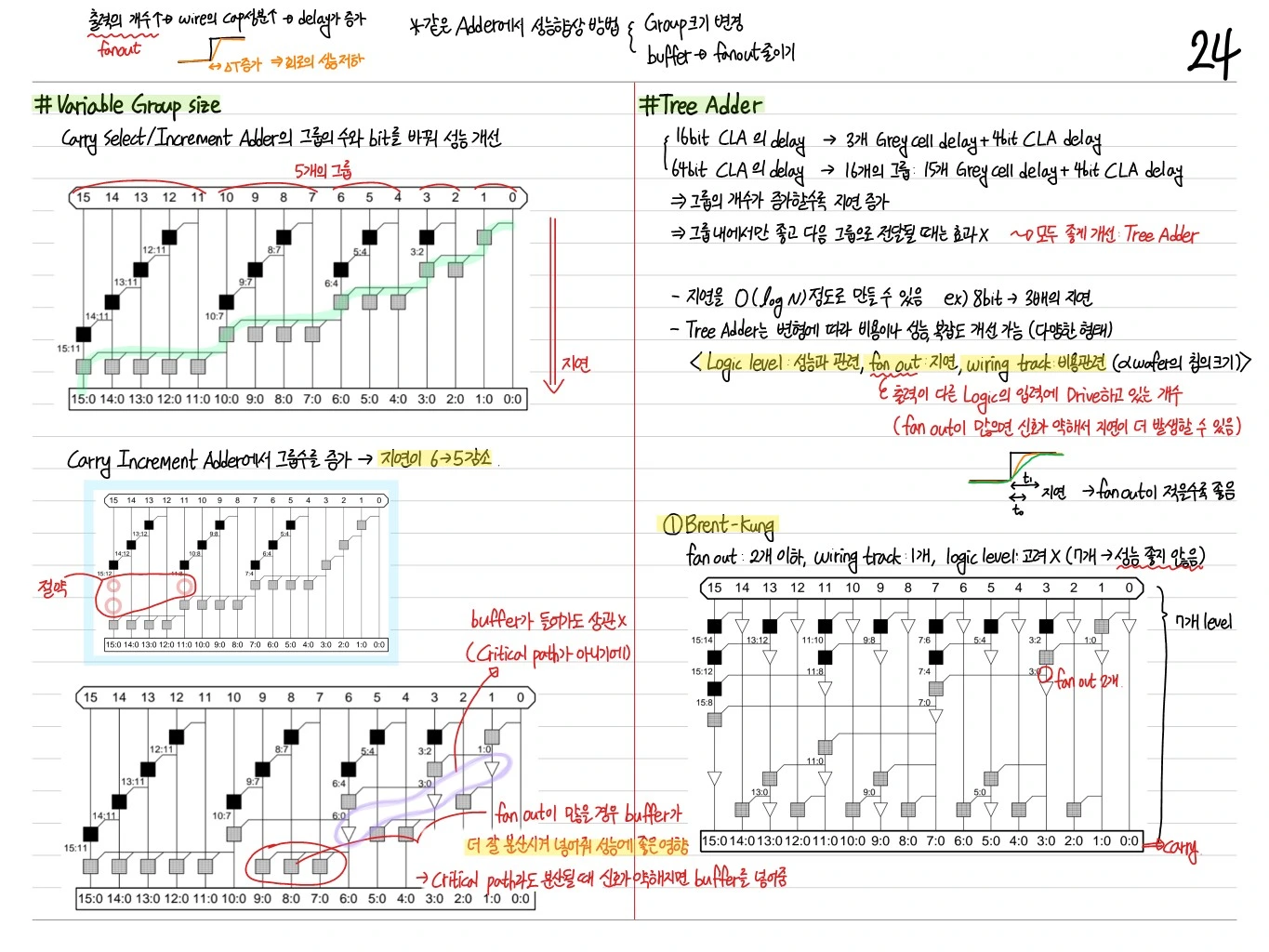
A recursive version of carry select. Upper blocks are also selected recursively. Delay .
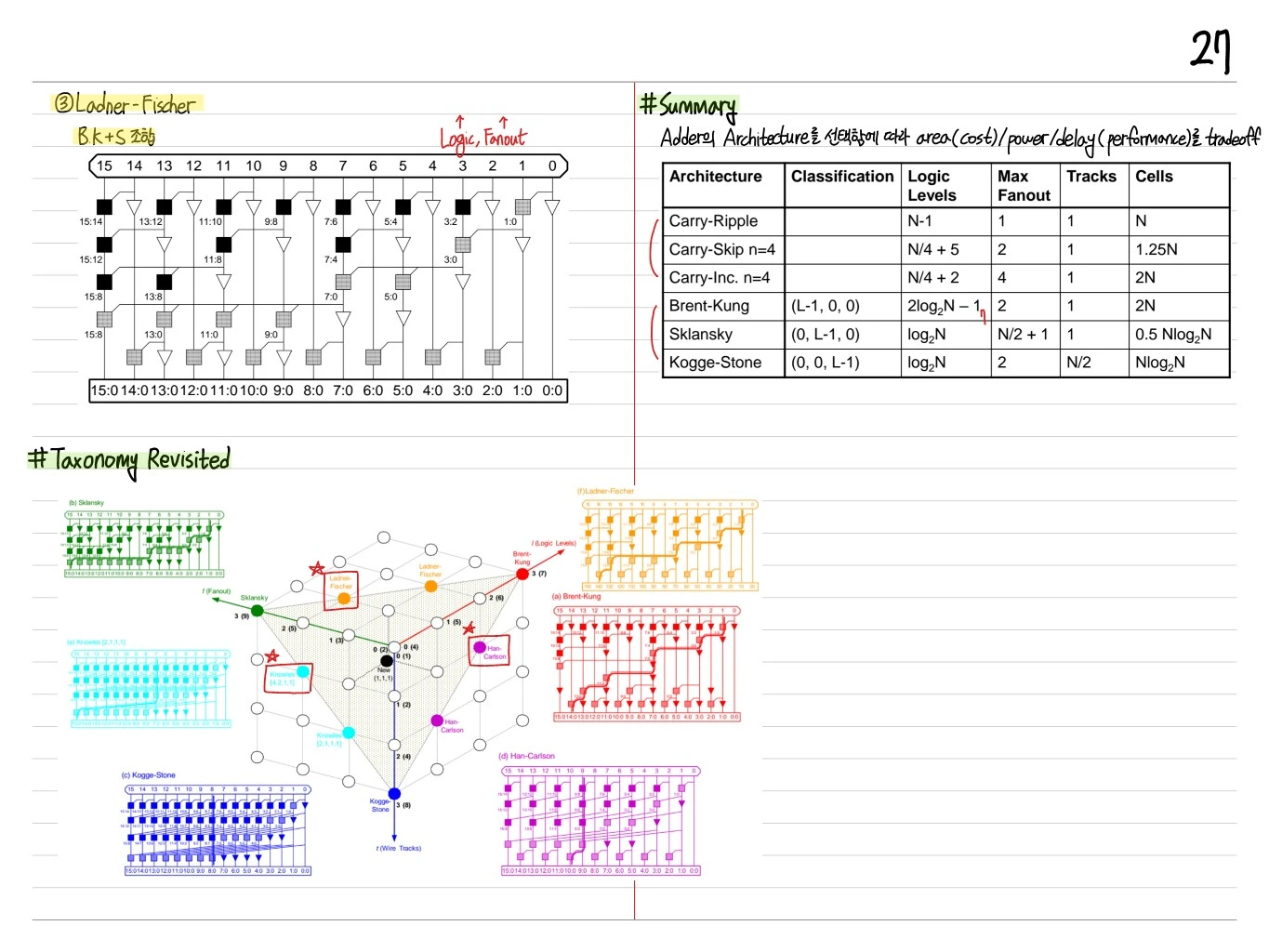
Brent-Kung / Kogge-Stone Prefix Adder
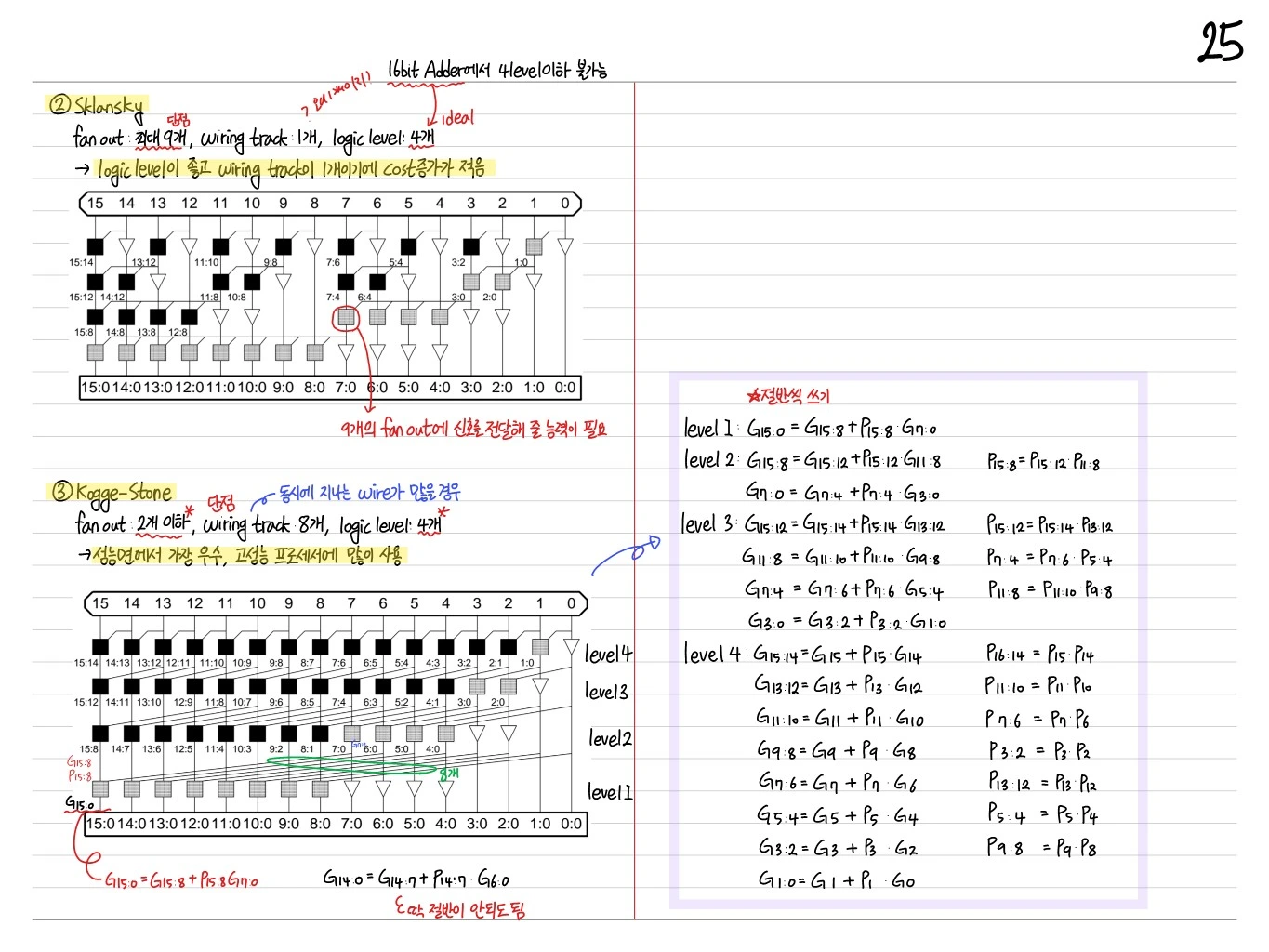
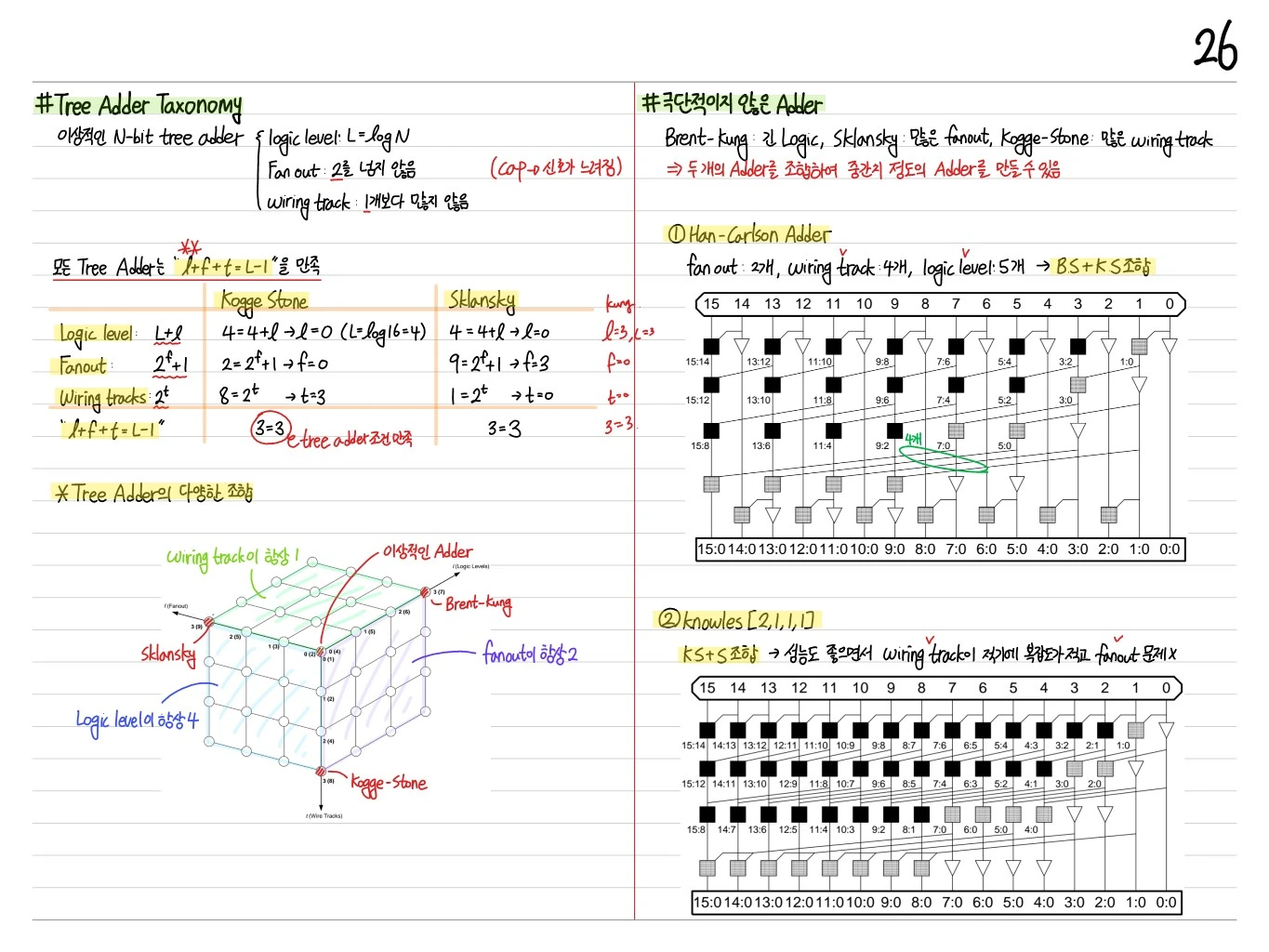
Uses a prefix tree to compute all carries in parallel. A parallel prefix adder.
- Brent-Kung: depth = 2log n, small area
- Kogge-Stone: depth = log n, large area, fastest
- Ladner-Fischer, Han-Carlson: intermediate tradeoffs
Most high-performance datapath adders in CPUs are Kogge-Stone or a variant.
Pipelined Adder
Pipelines a long n-bit adder over several stages. ↑ throughput, ↑ latency.
Subtraction (Two's Complement)
(two's complement). Implemented with an adder + XOR gates + Cin=1.
Multi-Operand Addition
Adding three or more numbers: a CSA (carry save adder) tree reduces the partial sums at each bit position, followed by a final CPA.
Saturation Arithmetic
On overflow, the result saturates: it is clamped to the MAX or MIN value. Important in DSP/multimedia.
Floating-Point Adder
- Align exponents (shift to match the larger value)
- Add mantissas
- Normalize the result (shift, adjust exponent)
- Round
Each stage is complex, so a pipelined FP adder is a must.
Summary
| Adder | Delay | Area | Characteristics |
|---|---|---|---|
| RCA | O(n) | Small | Simple |
| CLA | O(log n) | Medium | Standard high-speed |
| Carry Skip | O(√n) | Small | Balanced |
| Carry Select | O(√n) | Large | Speculative computation |
| Kogge-Stone | O(log n) | Very large | Fastest |
The adder's delay determines the datapath performance of a processor. Most ALUs in modern CPUs use a parallel prefix adder (a Kogge-Stone variant) + pipelining.