Key points in three lines
- RV64I widens the registers to 64 bits and adds 12 instructions (
ld,sd,lwu, and 9 W instructions). A W instruction computes using only the lower 32 bits and then copies bit 31 into the upper 32 bits. On QEMU,0x7fffffff + 1became0x0000000080000000withaddand0xffffffff80000000withaddw. - The purpose of this rule is a convention: "a 32-bit value always sits in a register in sign-extended form." That is why C's
int→longconversion, comparisons, and logical operations need no extra instructions, and only addition and shifts have W versions. luialso sign-extends its result, so 64-bit constants are expensive. Expanding 5,000 random 64-bit constants withlitook an average of 7.887 instructions, 8 at most. A 32-bit constant always took 2. All 34 execution and encoding results matched the reference model.
Parts 2 through 4 covered all 40 RV32I instructions. Part 5 is RV64I, the same ISA widened to 64 bits. Nearly every application processor that runs Linux is RV64, so if I later build an RV64GC core, the rules in this post will show up all over the datapath. The RV64I chapter of the specification (Chapter 4) only describes how it differs from RV32I. This post does the same: what gets wider, what gets added, and why it was designed that way.
The experiments ran bare-metal on the virt board of qemu-system-riscv64 (11.1.3). I compiled with riscv64-elf-gcc 16.2 using -march=rv64i -mabi=lp64.
1. What Gets Wider and What Gets Added
XLEN becomes 64. Registers x1–x31 and pc are 64 bits, and so is the address space. RV32I instructions keep their names and encodings, but they operate on 64 bits. For example, add is a 64-bit addition and slt is a 64-bit comparison.
There are 12 new instructions.
| Kind | Instructions | What they do |
|---|---|---|
| 64-bit memory | ld, sd |
8-byte load and store |
| 32-bit load | lwu |
Zero-extends 4 bytes (lw sign-extends) |
| W immediate | addiw, slliw, srliw, sraiw |
Compute in 32 bits, then sign-extend |
| W register | addw, subw, sllw, srlw, sraw |
Compute in 32 bits, then sign-extend |
W instructions use two opcodes that RV32I did not have (OP-IMM-32 0011011, OP-32 0111011). ld and sd use funct3 011, and lwu uses 110. Part 4's rule, "funct3[1:0] is the size, funct3[2] means zero-extend," carries straight over. Size 11 simply became 8 bytes.
What deserves attention are the instructions that don't exist. There is no andw, orw, or xorw, no sltw, and no branch like beqw. The reason lies in the convention in section 2.
2. W Instructions and the "Keep It Sign-Extended" Convention
The specification defines W instructions this way: ignore the upper 32 bits of the inputs, compute a 32-bit result from the lower 32 bits, sign-extend it to 64 bits, and write it to rd. Bits 63 through 31 of the result all end up equal.
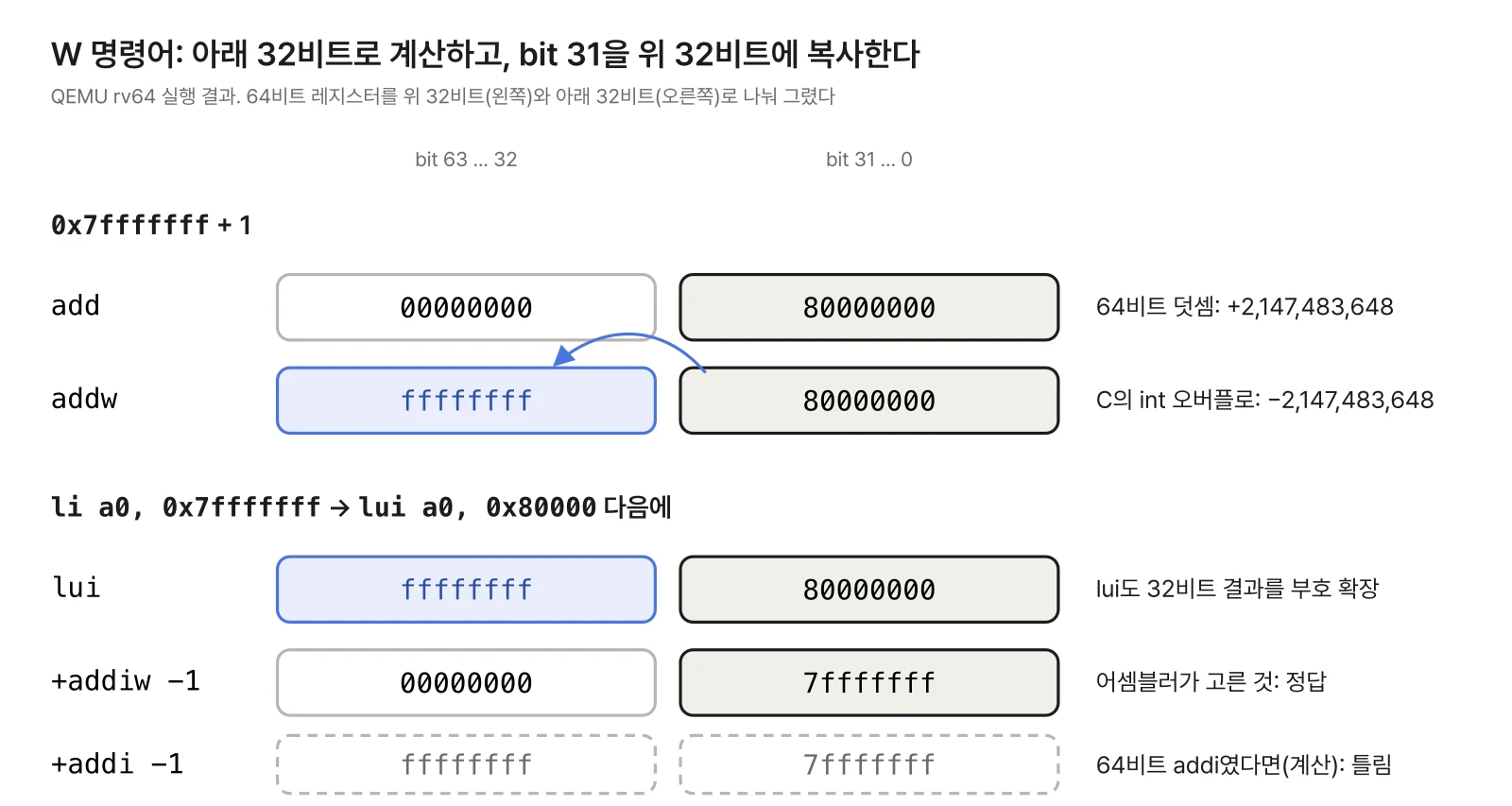
Here are the actual results run on QEMU.
op     rs1               rs2  result
add    000000007fffffff  1    0000000080000000
addw   000000007fffffff  1    ffffffff80000000
addw   1234567800000001  1    0000000000000002
subw   0000000000000000  1    ffffffffffffffff
addiw  1234567880000000  0    ffffffff80000000
If you think in terms of C's int, addw gives the right answer. For an int, 0x7fffffff + 1 wraps around in 32 bits to −2,147,483,648, and in a 64-bit register that value looks like 0xffffffff80000000. The third line shows that addw ignores garbage (0x12345678) in the upper 32 bits. addiw rd, rs, 0 becomes an instruction that only sign-extends the lower 32 bits, and it has its own pseudo-instruction name, sext.w.
Why Sign Extension
The key is in the specification's commentary. The compiler and calling convention always keep 32-bit values in 64-bit registers in sign-extended form. Even unsigned 32-bit integers (unsigned) have bit 31 copied upward. This one convention makes a lot of things free.
int→longconversion: the value is already sign-extended, so no instruction is needed.- Conversion between
intandunsigned: the register looks the same, so no instruction is needed. - Comparisons and branches: comparing two sign-extended 32-bit values with 64-bit
slt/bltgives the same answer. The same goes for unsigned comparisons (sltu/bltu), because the upper 32 bits are filled by the same rule, so ordering is preserved. - Logical operations:
and/or/xoron sign-extended values produce a sign-extended result.
Addition, subtraction, and shifts, on the other hand, push bits that overflow 32 bits above bit 31 and break the convention. So only these have W versions. In the specification's words, the W instructions add only the few needed to get reasonable performance on 32-bit values.
I confirmed this with actual compiler output (-O2).
| C function | RV64 instructions |
|---|---|
int add(int a, int b) |
addw a0,a0,a1 |
unsigned add(unsigned, unsigned) |
addw a0,a0,a1 |
long i2l(int a) |
None (just ret) |
int lt(int a, int b) |
slt a0,a0,a1 (plain 64-bit comparison) |
unsigned long u2ul(unsigned a) |
slli a0,a0,32 + srli a0,a0,32 |
The last row is the cost of this convention. Turning an unsigned into a 64-bit unsigned long means clearing the upper 32 bits to 0, and RV64I has no instruction for that, so it takes two shifts. The same thing happens when indexing an array with an unsigned index (slli 32 + srli 29 does the zero extension and the ×8 at once). The Zba extension includes zext.w (= add.uw rd, rs, zero) to cut this cost.
Why utoa10 from Part 1 Grew on RV64
In part 1, utoa10 (converting an unsigned 32-bit value to a decimal string) got larger on RV64. This time I recompiled it without the C extension, as rv32im and rv64im, and counted instructions: 33 versus 39. The difference came from three places.
- The constant
0xcccccccd, used to replace division with multiplication: 2 instructions on RV32 (lui+addi), 4 on RV64. This value has bit 31 set, so it cannot be built as a sign-extended 32-bit constant (section 4). - Zero-extending
uint32_t vbefore feeding it into a 64-bit multiply: 2 instructions (slli+srli). With Zba enabled this became a singlezext.w, bringing the count down to 38. - The remaining 2 came from differences in register allocation and loop shape.
On the other hand, 32-bit operations like n++, v - q*10, and '0' + r finished with 6 W instructions (2 addiw, 2 slliw, addw, subw), the same count as on RV32. Without W instructions, each of these operations would have needed an extra sign extension (sext.w) (my estimate). W instructions keep the growth of RV32 code ported to RV64 to about this much.
3. Shift Amounts: 6 Bits and 5 Bits
A 64-bit shift must be able to shift by 0–63, so the shift amount becomes 6 bits. W shifts shift a 32-bit value, so they stay at 5 bits.
op     rs1               amt result
sllw   0000000000000001  31  ffffffff80000000
sllw   0000000000000001  32  0000000000000001
sll    0000000000000001  32  0000000100000000
sll    0000000000000001  64  0000000000000001
srliw  ffffffff80000000  4   0000000008000000
srli   ffffffff80000000  4   0ffffffff8000000
sraiw  ffffffff80000000  4   fffffffff8000000
Shifting 1 left by 31 with sllw sets bit 31, so everything above it fills with 1s. Shifting by 32 only looks at the lower 5 bits (0), so the value stays 1. sll looks at 6 bits, so 32 really means 32, and 64 means 0. Comparing the three right-shift lines makes the meaning of W clear. srliw shifts only the lower 32 bits 0x80000000, filling with 0 (0x08000000), and since bit 31 of the result is 0, the upper half is 0 too. The 64-bit srli drags the 1s from the upper 32 bits down along with it.
In the encoding, the position that was "reserved if inst[25]=1" on RV32 becomes shamt[5] in RV64's slli, srli, and srai (part 2). Conversely, encodings of slliw, srliw, and sraiw with imm[5] set to 1 are reserved. If a decoder supports both RV32 and RV64, the meaning of this one bit changes with XLEN.
4. Loads, Sign Extension in lui/auipc, and 64-Bit Constants
I placed the word 0x80000000 in memory, followed by the word 0x00000001, and read them back. lw gave ffffffff80000000, lwu gave 0000000080000000, and ld combined the two words into 0000000180000000.
lui and auipc also change on RV64. They sign-extend to 64 bits the 32-bit value formed by shifting the 20-bit immediate left by 12.
| Instruction | Result | Explanation |
|---|---|---|
lui 0x80000 |
ffffffff80000000 |
Bit 31 is 1 → upper bits are 1 |
lui 0x7ffff |
000000007ffff000 |
Bit 31 is 0 → upper bits are 0 |
auipc 0xfffff |
pc − 0x1000 |
pc 0x80000398 → 0x7ffff398 |
auipc 0x80000 |
pc − 2 GiB | pc 0x800003b8 → 0x000003b8 |
Because auipc sign-extends, pc-relative addressing on RV64 still reaches ±2 GiB in each direction. The fourth row pointed exactly to 0x3b8, 2 GiB below 0x800003b8.
li 0x7fffffff and addiw
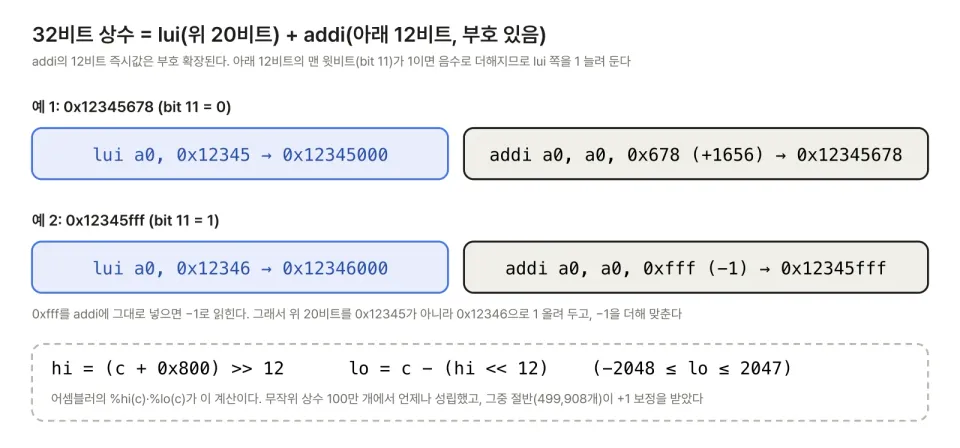
On RV64, building 0x7fffffff works differently from RV32 in part 3. The assembler chose lui a0, 0x80000 and addiw a0, a0, -1. lui produces 0xffffffff80000000, and addiw adds −1 in 32 bits, wrapping around to 0x7fffffff, then sign-extends. Bit 31 is 0, so the upper half becomes 0, giving the correct 0x000000007fffffff. Using a 64-bit addi here would have produced 0xffffffff7fffffff. That is why RV64 constant generation needs addiw.
For the same reason, a positive value with bit 31 set, such as 0x80000000, cannot be built with a single lui. The assembler built it with addiw a0, zero, 1 and slli a0, a0, 31.
How Many Instructions Does a 64-Bit Constant Take
I collected what li expanded into (-march=rv64i, no C).
0x7ff                addi
0x800                lui + addiw
0x7fffffff           lui + addiw
0x80000000           addiw + slli
0xffffffff           addiw + slli + addi
0xcccccccd           lui + addiw + slli + addi
0x8000000000000000   addiw + slli
0x123456789abcdef0   lui + addiw + (slli + addi) x3
The rule goes like this. Values within the signed 32-bit range finish with lui + addiw (2 at most), as in part 3. For anything else, the upper part is built first, then "shift left by about 12 bits and add the next 12 bits" is repeated. If the low end has many zeros, a single shift finishes it; values with every bit populated go up to 8 instructions.
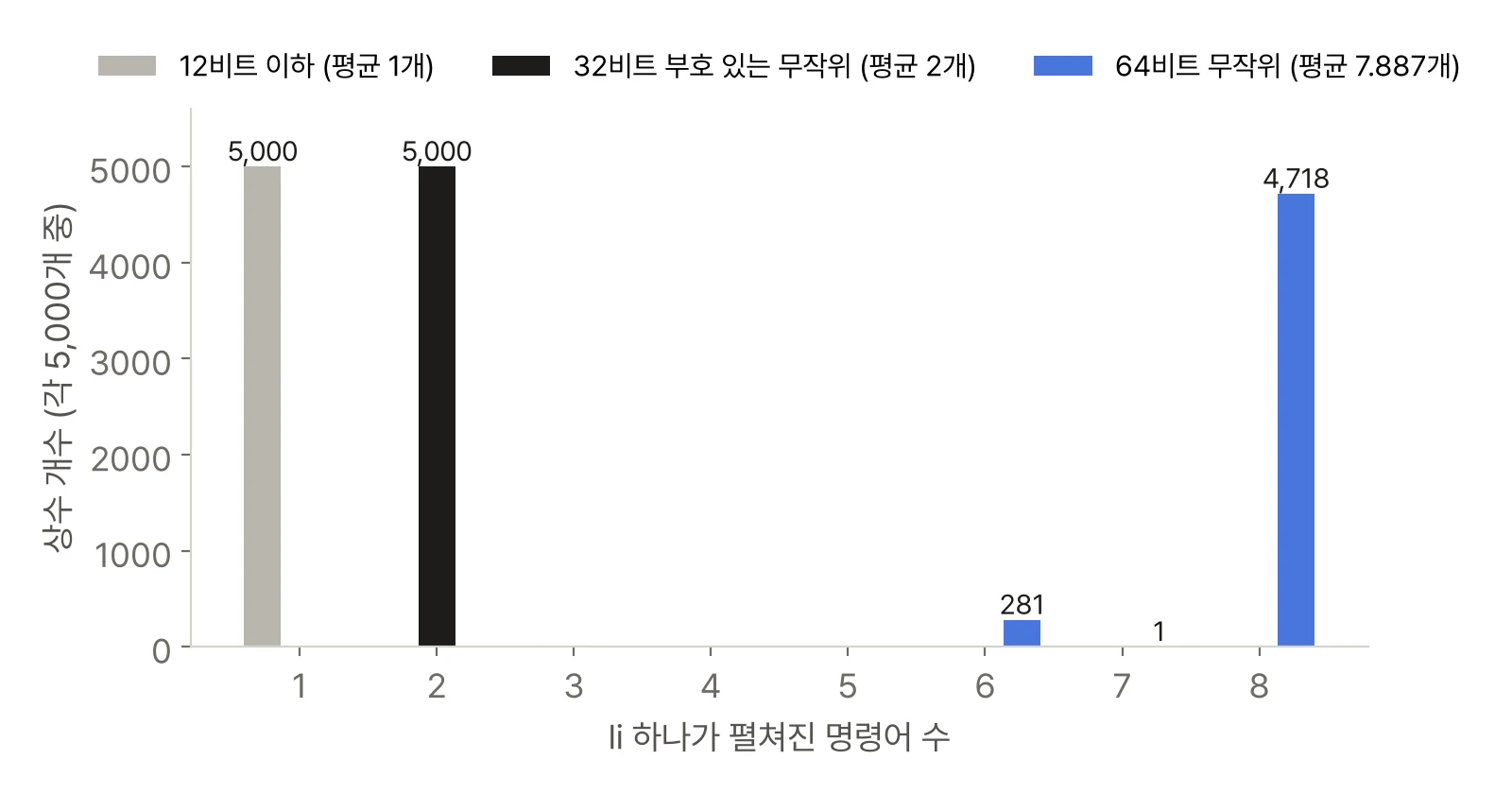
I drew 5,000 random values for each kind of constant and assembled them. Every value of 12 bits or less took 1 instruction, and every signed 32-bit value took 2. Of the random 64-bit values, 4,718 took 8, 281 took 6, and 1 took 7, for an average of 7.887. I re-executed the expanded instructions in Python and confirmed that all 15,000 produced the original constant.
The compiler takes a different approach. GCC -O2 built 0x123456789abcdef0 by constructing the upper and lower halves separately in two registers, then combining them with slli 35 and add. That is 7 instructions, but the two chains don't wait on each other, so they finish quickly on a superscalar core. For 0x1234567812345678, where the upper and lower 32 bits are identical, it built the half once and finished in 4 instructions with slli 32 + add. Still, 64-bit constants are expensive, so large values used often, such as addresses, are better produced as auipc-relative addresses or loaded from a constant pool in memory.
5. Experiment: QEMU Results Checked Against a Reference Model
I ran each W instruction one at a time through inline assembly and printed the 64-bit result.
#define R(op, a, b) ({ uint64_t r_;            \
  __asm__ volatile(op " %0,%1,%2"              \
                   : "=r"(r_) : "r"(a), "r"(b)); r_; })

volatile uint64_t big = 0x7fffffff, one = 1;
show("add",  big, one, R("add",  big, one));
show("addw", big, one, R("addw", big, one));
run.sh picks qemu-system-riscv64 when -march starts with rv64. The reference model is a few lines of Python. A W operation is "compute from the lower 32 bits → truncate to 32 bits → sign-extend."
sx = lambda v, b: ((v & ((1 << b) - 1))
                   ^ (1 << (b - 1))) - (1 << (b - 1))
w = lambda v: sx(v, 32) & M64      # 32-bit result → 64-bit
REF['addw'] = lambda a, b: w(a + b)
REF['srlw'] = lambda a, b: w((a & M32) >> (b & 31))
REF['lui'] = lambda a, b: sx(a << 12, 32) & M64| Test | Count | Matched |
|---|---|---|
QEMU execution (W, shifts, loads, lui, auipc) |
21 | 21 |
Re-running the 10 li examples to get the original value |
10 | 10 |
| 3 batches of random constants (5,000 each) | 3 | 3 |
34 in total, all matched. Had I first written the srlw reference model as w(a >> (b & 31)), the upper 32 bits would have shifted down into the result and it would have been wrong. You have to translate the specification's "ignore the upper 32 bits of the inputs" literally and apply a & M32 first. The same holds for hardware.
6. Design Checklist: The RV64 Datapath
| Item | Rule |
|---|---|
| W result | Copy bit 31 of the lower 32-bit result into bits 63:32 |
| W inputs | Ignore bits 63:32 of rs1 and rs2. In particular, srlw/sraw shift only the lower 32 bits |
| Shift amount | rs2[5:0] for 64-bit, rs2[4:0] for W |
| Immediate shifts | For slli and friends, inst[25] = shamt[5]. For slliw and friends, imm[5]=1 is reserved |
lui/auipc |
Sign-extend the 32-bit value. auipc then adds it to the 64-bit pc |
lw/lwu/ld |
Sign-extend / zero-extend / as is. funct3 010 / 110 / 011 |
| Missing W | Logical ops, comparisons, and branches use the 64-bit versions as is |
| ALU structure | Handle W with one mux that sign-extends the lower 32 bits of the 64-bit adder result (a common choice) |
| W shifter | sraw must use bit 31 as the sign. A common approach is to sign- or zero-extend the input before feeding it to the 64-bit shifter |
| RV32 mode | If an RV64 core supports a 32-bit mode via mstatus.UXL and similar, additional result sign-extension rules apply (optional feature) |
Let me unpack the ALU structure row. For addw, you can do the full 64-bit addition and then pick just the lower 32 bits of the result and sign-extend them, because garbage in the upper 32 bits of the inputs doesn't change the sum of the lower 32 bits. Shifts are different. For srlw/sraw, the upper 32 bits must not shift down into the result, so the input must be zero-extended (srlw) or sign-extended (sraw) before it goes into the shifter. The srliw result 0x0000000008000000 from section 3 is the correct answer for this handling.
Summary
- RV64I widens XLEN to 64 and adds
ld,sd,lwu, and 9 W instructions. W instructions ignore the upper 32 bits of their inputs and sign-extend the 32-bit result (0x7fffffff + 1→addw0xffffffff80000000). - Thanks to the convention that 32-bit values are always kept sign-extended,
int→longconversion, comparisons, and logical operations need no instructions. Onlyunsigned→unsigned longcosts a zero extension (slli+srli, or Zba'szext.w). - The shift amount is 6 bits for 64-bit shifts and 5 bits for W.
lui/auipcsign-extend a 32-bit value, soli 0x7fffffffneedsaddiw. - 64-bit constants averaged 7.887 instructions with
li(5,000 random), and 32-bit constants always took 2. The growth of part 1'sutoa10from 33 to 39 instructions on RV64 was also due to constant generation and zero extension.
Next post: Part 6 covers assembly and the ABI. By compiling real C functions, it traces what register names like a0–a7 and s0–s11 promise under the calling convention, and how stack frames, prologues, and epilogues come about. It also uses readelf and objdump to look at what happens with more than 8 arguments and when returning a struct, the differences between ABI names like ilp32 and lp64d, how pseudo-instructions like call, tail, and la expand, and ELF relocations and linker relaxation.
References
- The RISC-V Instruction Set Manual, Volume I: Unprivileged Architecture, Version 20240411. Chapter 4 RV64I (4.2 Integer Computational Instructions, 4.3 Load and Store Instructions), 2.3 Immediate Encoding Variants. https://github.com/riscv/riscv-isa-manual
- RISC-V Bit-Manipulation ISA-extensions (Zba's
add.uwandzext.w), Version 1.0.0 - RISC-V Assembly Programmer's Manual (
li,sext.w). https://github.com/riscv-non-isa/riscv-asm-manual - RISC-V ELF psABI (sign-extension rule for LP64 integer arguments). https://github.com/riscv-non-isa/riscv-elf-psabi-doc
- D. Patterson, A. Waterman, The RISC-V Reader: An Open Architecture Atlas, 2017. Chapter 9 RV64