Key points in three lines
- The hardware treats
x1~x31identically, but software assigns names and roles through a convention called the psABI. Arguments go ina0~a7, return values ina0·a1,s0~s11must be preserved by the function, andspis always 16-byte aligned. The frame of a real C function,work(), was 80 bytes, andspwas0x800043b0. - Arguments from the 9th onward go on the stack at
0(sp)·4(sp), and a 16-byte struct comes back through a hidden pointer (a0) on RV32.ilp32·ilp32f·ilp32d·lp64dpass the samedoubleargument differently, as an integer register pair, a single integer register, or an FP register, and the linker refused to link a mix. call·lain an object file areauipcpairs with blanks (relocations). The linker fills in the distance and shrinks the pair when the target is close (relaxation)..textof the same program shrank from 800 bytes to 712 bytes. I cross-checked 18 execution and disassembly results in Python, and all matched.
Parts 2 to 5 looked at instructions one by one. But when verifying a core, you more often need to read things like "why does this function lower sp by 80 here" or "what is this value in a0" than any single instruction. To chase a bug with the simulation waveform and the disassembly side by side, you have to know how the compiler uses registers and the stack. Part 6 covers that convention: assembly syntax, the ABI (application binary interface), and how ELF files get linked.
The experiments use RV32I (-march=rv32i -mabi=ilp32 -O1) by default, with RV32IMAFD and RV64IMAFD for the ABI comparison. Everything runs on QEMU 11.1.3 virt, and the tools are riscv64-elf-gcc·objdump·readelf 16.2.
1. Register Names and Roles
The ABI names seen in part 2 take on meaning here. The integer calling convention of the RISC-V psABI (the ELF psABI specification) is as follows.
| Register | Name | Preserved across calls? | Use |
|---|---|---|---|
x0 |
zero |
— | Always 0 |
x1 |
ra |
No | Return address |
x2 |
sp |
Yes | Stack pointer |
x3, x4 |
gp, tp |
— | Global and thread pointers |
x5~x7, x28~x31 |
t0~t6 |
No | Temporaries |
x8 |
s0 / fp |
Yes | Saved value, frame pointer |
x9, x18~x27 |
s1~s11 |
Yes | Saved values |
x10~x17 |
a0~a7 |
No | Arguments; a0·a1 are return values |
"Preserved (callee-saved)" means a function that wants to use the register must save its original value and restore it before returning. "Not preserved (caller-saved)" means the called function may overwrite it freely, so the caller must save it if it needs it. Note that ra is not preserved. The moment a function makes a call, jal overwrites ra, so a function that calls other functions saves its own ra on the stack.
gp and tp are not available for general allocation. gp is the global pointer used for linker relaxation (Section 5), and tp points to thread-local storage. The register numbering has a reason too. The argument and saved registers are clustered in x8~x15, and those eight are exactly the registers that 16-bit C-extension instructions can name with 3 bits (part 11).
2. Stack Frames: Following a Real Function
Start with the rules. The stack grows from high addresses to low addresses. On function entry, sp must be 16-byte aligned (psABI). So the frame size a function allocates is also a multiple of 16.
Here is the test function. It calls another function inside a loop, so x and i must survive across calls; it has a local array; and it calls a function with 10 arguments.
int work(int x) {
  int buf[4];
  for (int i = 0; i < 4; i++)
    buf[i] = mkpair(x + i).b;
  return sum10(buf[0], buf[1], buf[2], buf[3],
               x, x, x, x, 1, 2);
}
Here are the prologue and epilogue GCC generated.
work:
  addi sp,sp,-80      # 80-byte frame
  sw   ra,76(sp)      # return address
  sw   s0,72(sp)      # 5 saved registers to be used
  sw   s1,68(sp)
  sw   s2,64(sp)
  sw   s3,60(sp)
  sw   s4,56(sp)
  ...                 # body
  lw   ra,76(sp)      # epilogue: restore in reverse
  lw   s0,72(sp)
  ...
  addi sp,sp,80
  ret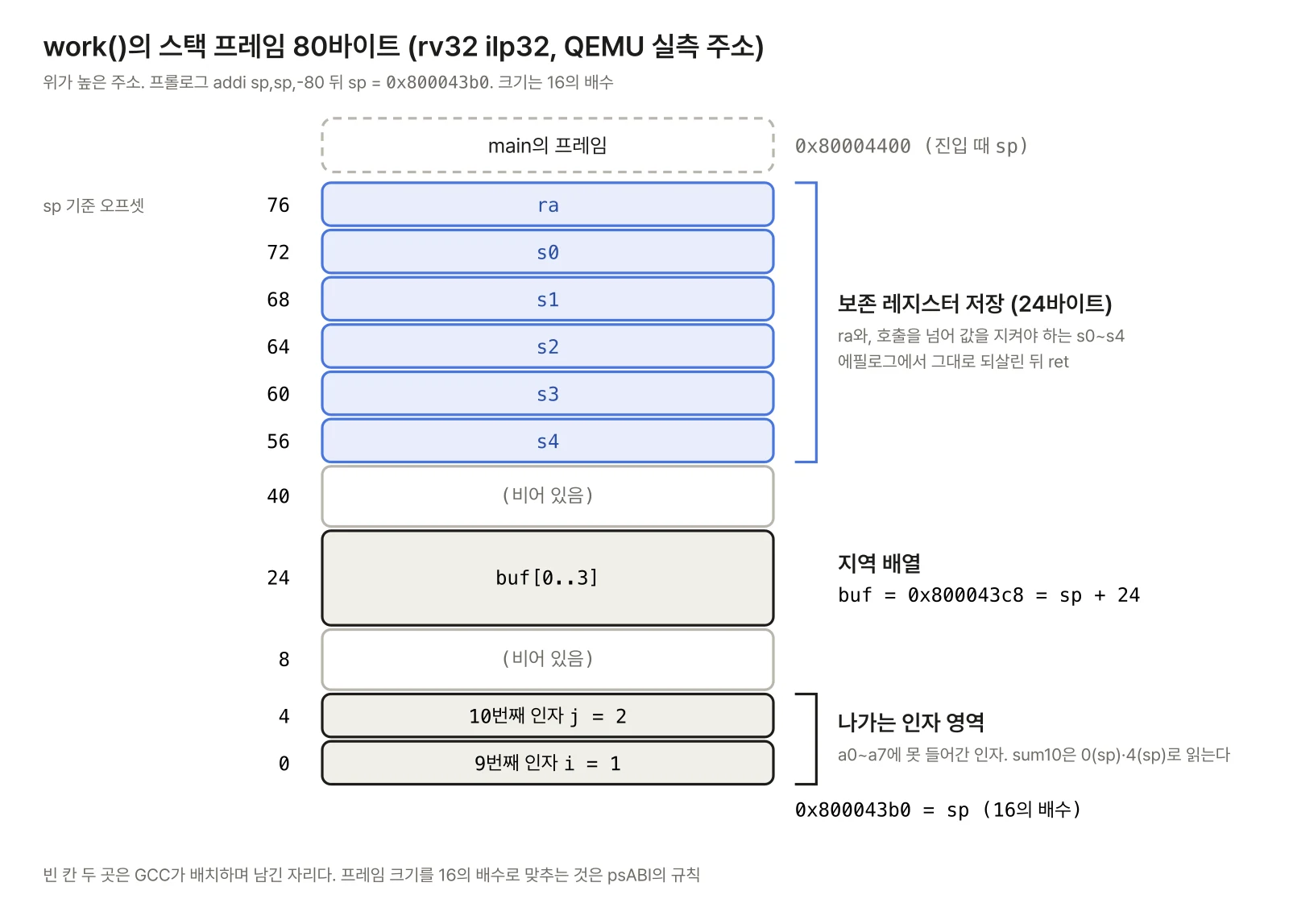
I ran it on QEMU and printed the real addresses. When main called work, sp was 0x80004400; inside work it was 0x800043b0 (80 lower). Both are multiples of 16. The address of buf was 0x800043c8, which is sp + 24. The compiler kept x and the loop variable in s1·s2, and the start and end addresses of buf in s3·s4. These values survive even when the mkpair call overwrites the a and t registers. The price is saving five registers in the prologue.
With the frame pointer enabled (-fno-omit-frame-pointer), the prologue gains an addi s0,sp,80. s0 (=fp) then points to the sp at function entry, so a debugger can walk back up the call chain by following fp. By default (-O1 and above), fp is not used, and s0 is just another saved register.
3. Many Arguments, and Returning Structs
Nine or more arguments. Only 8 integer arguments, a0 through a7, go in registers. The rest are placed by the caller at the bottom of its own frame, in order starting at 0(sp). Those are the two bottom slots in the figure above. work did sw a5,0(sp) (i=1) and sw a5,4(sp) (j=2) and then called sum10. sum10 has no frame, so its sp is the caller's sp, and it read them with lw a5,0(sp)·lw a5,4(sp). The result of sum10(1, …, 10), 0x000a0924, matched 1+…+8 + (9≪8) + (10≪16) = 657,700 computed in Python.
Returning structs. The psABI rule depends on size.
| Return value | RV32 (ilp32) | RV64 (lp64) |
|---|---|---|
struct {int a, b;} 8 bytes |
a0·a1 |
Packed into a0 alone |
struct {int v[4];} 16 bytes |
Hidden pointer | a0·a1 |
struct {float x, y;} |
a0·a1 |
Packed into a0 alone |
Same, with ilp32f·lp64d |
fa0·fa1 |
fa0·fa1 |
Values up to 2×XLEN come back in two registers. Anything larger is handled by having the caller set aside memory and pass its address in a0 as a hidden first argument. On RV32, 16 bytes exceeds 2×XLEN (8 bytes). So mkquad(100) writes to where a0 points, as in sw a1,0(a0), sw a4,4(a0) …, and the original first argument x is pushed to a1. The caller, main, passed a slot inside its own frame with addi a0,sp,24. On RV64, the same 16 bytes is exactly 2×XLEN, so it came back in a0·a1, two fields packed into each (combining two 32-bit values with slli·or). At run time, mkpair(40) returned (40, 41) and mkquad(100).v[3] was 103.
4. ABI Names: ilp32, ilp32f, lp64d
A -mabi name has two parts. The first part is the size of C types. ilp32 means int, long, and pointer are 32 bits; lp64 means long and pointer are 64 bits (int is 32 bits). Checking with the compiler, sizeof(long) and sizeof(void *) were 4 under ilp32 and 8 under lp64. The trailing letter says where floating-point arguments are passed. With none, they go in integer registers (soft-float ABI); f puts up to float in FP registers; d puts up to double in FP registers.
I compiled the same function, double mix(double x, float y, int z), for the same hardware with an FPU (rv32imafd, rv64imafd), changing only the ABI.
| ABI | x (double) |
y (float) |
z (int) |
|---|---|---|---|
ilp32 |
a0·a1 |
a2 |
a3 |
ilp32f |
a0·a1 |
fa0 |
a2 |
ilp32d |
fa0 |
fa1 |
a0 |
lp64 |
a0 |
a1 |
a2 |
lp64d |
fa0 |
fa1 |
a0 |
The instruction count of mix was 13 for ilp32, 12 for ilp32f, 4 for ilp32d, 7 for lp64, and 4 for lp64d.
Under ilp32, a double arrives in two integer registers even when there is an FPU. The function writes it to the stack, reads it back with fld to move it into an FP register, and returns the result the same way. The computation is a single fmadd.d, yet it took 13 instructions. ilp32d and lp64d take 4. Integer and FP registers are numbered separately: under ilp32d, z is the first integer argument, so it goes in a0.
The ABI is recorded in the object file header (e_flags in the ELF header). readelf -h showed 0x0 for ilp32·lp64, 0x2, single-float ABI for ilp32f, and 0x4, double-float ABI for ilp32d·lp64d. The linker will not mix files with different values. Linking an ilp32 object together with an ilp32d object stopped with this error.
can't link double-float modules
with soft-float modules
If one side believes the same double is in a0·a1 and the other believes it is in fa0, the value gets passed incorrectly. The standard combination used by Linux distributions is rv64gc + lp64d.
5. Pseudo-Instructions and ELF Relocations
How Pseudo-Instructions Expand
I collected pseudo-instructions in an assembly file and looked at the real instructions with alias-free disassembly (objdump -M no-aliases).
nop            addi zero,zero,0
li  a0,0x12345678
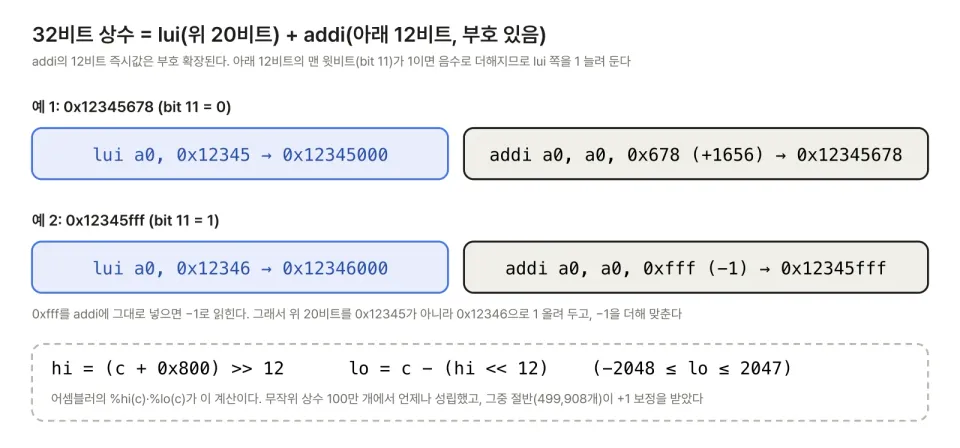
               lui a0,0x12345 + addi a0,a0,1656
la  a1,buf     auipc a1,0 + addi a1,a1,0  (relocation)
mv  a3,a0      addi a3,a0,0
not a4,a0      xori a4,a0,-1
neg a5,a0      sub a5,zero,a0
seqz a6,a0     sltiu a6,a0,1
beqz a0,L      beq a0,zero,L
bgt a0,a1,L    blt a1,a0,L
ble a0,a1,L    bge a1,a0,L
j   L          jal zero,L
call g         auipc ra,0 + jalr ra,0(ra)
tail g         auipc t1,0 + jalr zero,0(t1)
jr  a0         jalr zero,0(a0)
jalr a0        jalr ra,0(a0)
ret            jalr zero,0(ra)
Note that tail uses t1. A tail call must not touch ra (it has to pass along the caller's return address unchanged), so it builds the address in a temporary register. Outside position-independent code (-fPIC), la is the same auipc + addi as lla. Under PIC, it becomes auipc + lw, which reads the address from the global offset table (GOT).
Relocations: Blanks Left by the Assembler
The immediate of auipc a1,0 is 0 because the assembler does not know the final address of buf. Instead it leaves a relocation record that says "fill in this slot this way at link time." I counted the relocations in the abi.c object file by type.
| Relocation | medlow | medany | What it fills |
|---|---|---|---|
R_RISCV_HI20 / LO12_I |
14 / 15 | — | Upper/lower parts of an absolute address (lui + addi) |
R_RISCV_PCREL_HI20 / LO12_I |
— | 15 / 15 | PC-relative distance (auipc + addi) |
R_RISCV_CALL_PLT |
19 | 19 | auipc + jalr call pair |
R_RISCV_BRANCH |
4 | 4 | 13-bit branch distance |
R_RISCV_RELAX |
48 | 49 | "May be shortened" marker |
The code model (-mcmodel) chooses how addresses are built. medlow builds absolute addresses within ±2 GiB of address 0 with lui; medany builds addresses within ±2 GiB of the current pc with auipc. The linker reads these records and does the %hi·%lo and %pcrel_hi·%pcrel_lo arithmetic from part 3 for you.
PCREL_LO12_I has a trap. This relocation points not at g_small but at the location of its paired auipc (the local label .L0). The low 12 bits are the lower part of "the distance from the auipc's pc to the target," so the reference must be the address of the auipc, not the addi.
Linker Relaxation: Shrink When in Reach
A pair marked with R_RISCV_RELAX may be rewritten shorter by the linker. Once it knows the actual distance, the linker turns a call into a single jal if the target is within ±1 MiB, and if an address is within ±2 KiB of gp, it deletes the auipc and turns the pair into a single gp-relative access.
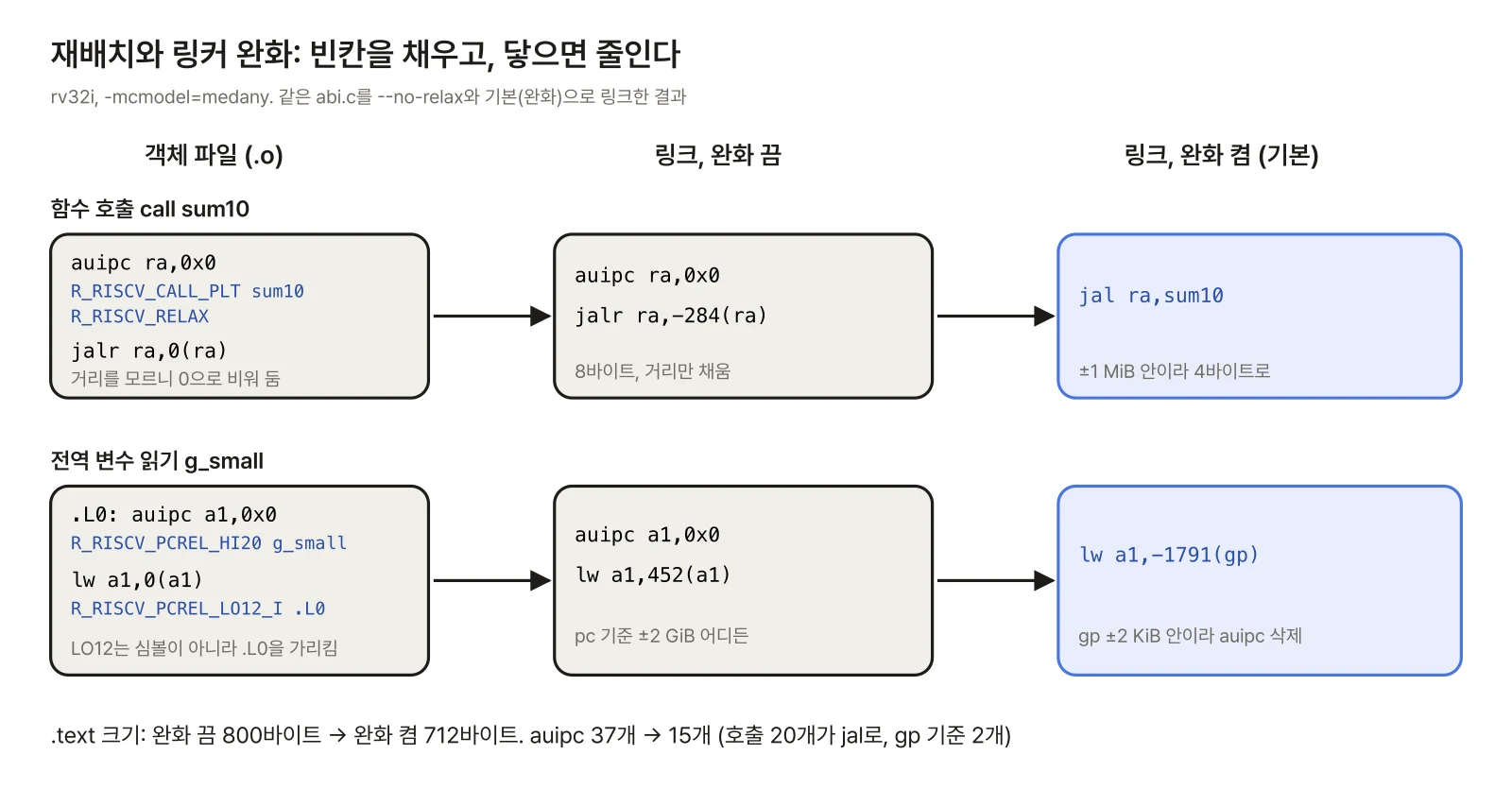
To see gp relaxation, the linker script must define __global_pointer$ and the startup code must set gp. The shared startup code lacks this, so in this part's folder I wrote a separate linker script, adding __global_pointer$ the same way as the GNU ld default script, plus startup code. The la gp, __global_pointer$ in the startup code is wrapped in .option norelax, because relaxing the instruction that sets up gp into a gp-relative access would make it reference itself.
I built with medany and compared --no-relax against the default (relaxed). .text shrank from 800 bytes to 712 bytes, auipc went from 37 to 15, and jal ra went from 0 to 20.
All 20 calls became jal, and the read and the address computation of the small global variable g_small became lw a1,-1791(gp)·addi a1,gp,-1791. The 88 bytes saved are exactly 22 instructions (4 bytes each). Building with medlow gave a similar reduction, from 804 bytes to 720 bytes. The 256-byte g_big was 2,047 bytes from gp, numerically within range, yet its auipc remained. The linker appears to leave a margin for alignment when deciding (my guess).
Relaxation matters to hardware designers for a reason: the disassembly of the source or object file differs from the instructions in the ELF actually loaded into memory. When matching against a simulation log, always disassemble the linked ELF.
Sections
The sections of the linked ELF were .text (code, 0x80000000), .rodata (string constants), .data (256 bytes of initialized globals), .sdata (4 bytes of small globals), plus .riscv.attributes·.symtab and others that are not loaded into memory. .riscv.attributes holds the canonical ISA name seen in part 1 (Tag_RISCV_arch). .sdata·.sbss exist to gather small globals near gp so the relaxation above works well.
6. Hands-On: Cross-Checking Execution and Disassembly
check.py does the build, the QEMU run, and the objdump/readelf collection in one go. The key check reconstructs addresses directly from the machine code of the linked ELF. It finds an auipc followed immediately by an addi·lw, computes pc + (imm20 ≪ 12) + imm12, computes gp + imm12 for gp-relative accesses, and checks that they match the addresses in the symbol table.
for (a, w, _), (a2, w2, _) in zip(I, I[1:]):
    # auipc rd + (addi|lw) rd: reconstruct pc-relative address
    if w & 0x7f == 0x17 and a2 == a + 4 \
       and (w2 >> 15) & 31 == (w >> 7) & 31:
        got.append(a + sx(w & 0xfffff000, 32)
                   + sx(w2 >> 20, 12))
    # rs1 == gp(x3): reconstruct gp-relative address
    if w & 0x7f in (0x13, 0x03) and (w >> 15) & 31 == 3:
got.append(gp + sx(w >> 20, 12))| Test | Count | Matched |
|---|---|---|
Run-time values (10 arguments, struct return, work) |
5 | 5 |
16-byte alignment of sp and frames, location of buf |
4 | 4 |
| Global addresses printed by QEMU = symbol table | 2 | 2 |
| Addresses reconstructed from machine code (relaxation on/off) | 2 | 2 |
ABI: type sizes, hidden pointer, link refusal, fp |
5 | 5 |
18 in total, all matched. The machine-code reconstruction check also means the linker correctly applied the +1 adjustment for %pcrel_hi·%pcrel_lo (part 3) and the gp relaxation.
7. Design Checklist: Using the ABI from the Hardware Side
The ABI is a software convention, but people who verify and debug cores read it every day.
| Item | Rule |
|---|---|
| Register file | The hardware treats x1~x31 identically. ABI names are just the disassembler's notation |
| Return address | ra is the pc+4 written by jal/jalr. The predictor's RAS hints are x1·x5 (part 4) |
| Stack alignment | sp is 16-byte aligned on function entry. A misalignment in simulation signals stack corruption |
| Trap handler | Interrupts can arrive anywhere, so even caller-saved registers must all be saved |
gp setup |
Boot code sets gp first under .option norelax. Otherwise relaxed global accesses go to the wrong address |
| Linked ELF | Relaxation makes the instructions differ from the .o. Compare logs against the linked ELF |
| ABI check | Flags from readelf -h (0x0·0x2·0x4, plus 0x1 for RVC) and Tag_RISCV_arch from -A |
| Aliases off | objdump -M no-aliases shows the instructions the decoder actually receives |
| Environment calls | SBI puts the extension ID in a7, the function ID in a6, arguments in a0~a5, and returns in a0·a1 (part 36) |
tp·gp |
The compiler does not use them for ordinary values. Only runtime code changes these two |
The trap handler row connects to the hands-on in part 4. The handler in part 4 was built with GCC's interrupt("machine") attribute, and its disassembly showed the prologue saving 17 registers: ra, t0~t6, a0~a7, and s0. An ordinary function does not save the t and a registers. A trap cuts in somewhere other than a function call boundary, and the interrupted code may be holding values in those registers.
Summary
a0~a7are arguments (a0·a1are return values),s0~s11andspare preserved, andt,a, andraare not. The realwork()allocated an 80-byte frame that savedraands0~s4, andspwas a multiple of 16.- Arguments from the 9th onward go at the caller's
0(sp)onward, and structs larger than 2×XLEN come back through memory provided by the caller (a0). The same 16-byte struct was returned in memory on RV32 and ina0·a1on RV64. - An ABI name encodes type sizes (
ilp32·lp64) and FP argument registers (f·d). The samemix()took 13 instructions underilp32and 4 underilp32d, and linking different FP ABIs was refused. call·lain an object file areauipcpairs with relocations. The linker fills in the distance and, when in reach, shrinks them tojalor agp-relative access..textwent from 800 bytes to 712 bytes.
Next: Part 7 looks at the M extension. Running on QEMU, I check what mul·mulh·mulhu·mulhsu and the div·rem family compute, what value division by zero returns without raising an exception, and how the overflow of dividing the most negative number by −1 is defined. I also revisit how utoa10 calling __udivsi3 in part 1 changes with the M extension.
References
- RISC-V ELF psABI Specification (integer and FP calling conventions, struct passing, stack alignment, ELF e_flags, relocations and relaxation). https://github.com/riscv-non-isa/riscv-elf-psabi-doc
- RISC-V Assembly Programmer's Manual (pseudo-instructions,
.option norelax,%pcrel_hi·%pcrel_lo). https://github.com/riscv-non-isa/riscv-asm-manual - The RISC-V Instruction Set Manual, Volume I: Unprivileged Architecture, Version 20240411. 2.1 Programmers' Model, 2.5 Control Transfer Instructions (
x1·x5link registers) - RISC-V Supervisor Binary Interface Specification (SBI calling convention). https://github.com/riscv-non-isa/riscv-sbi-doc
- D. Patterson, A. Waterman, The RISC-V Reader: An Open Architecture Atlas, 2017. Chapter 3, RISC-V Assembly Language
- GCC RISC-V options (
-mabi,-mcmodel,-mno-relax). https://gcc.gnu.org/onlinedocs/gcc/RISC-V-Options.html