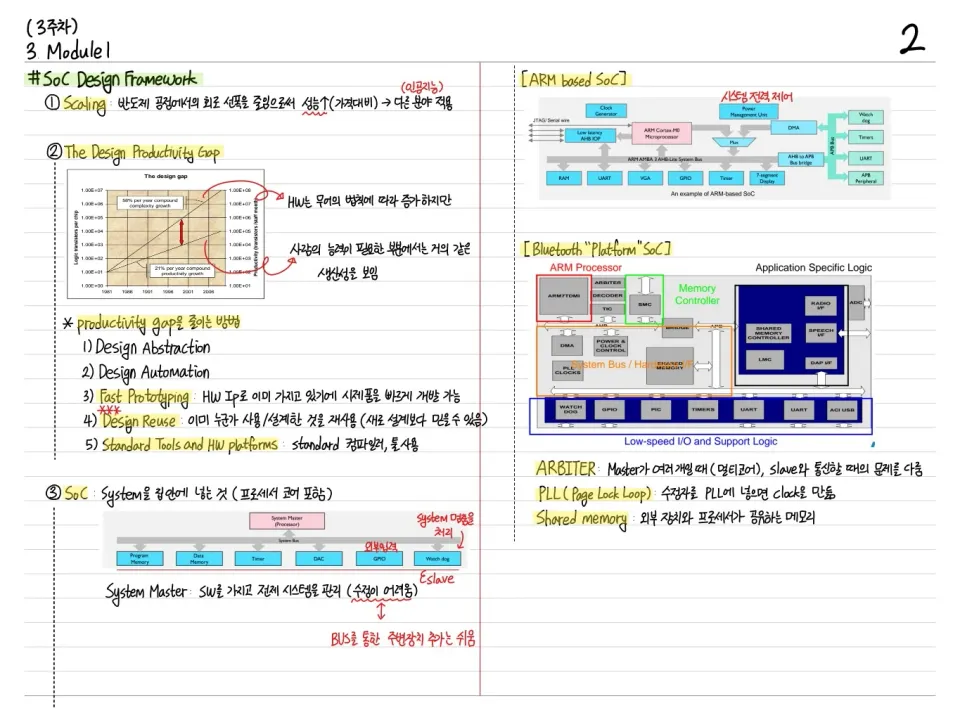
Chapter 8: Interrupt Mechanism Overview
An interrupt is a mechanism that halts the processor's normal flow of execution, runs a specific handler routine, and then returns. It is essential for reacting immediately to asynchronous events such as peripherals, timers, and faults.
Interrupt vs Exception
- Interrupt: Asynchronous (raised by external events or peripherals)
- Exception: Synchronous (raised during instruction execution, e.g. SVC, faults)
- ARM handles both uniformly as exceptions
NVIC (Nested Vectored Interrupt Controller)
The heart of the Cortex-M: the NVIC handles interrupts.
Key Features
- Vectored interrupts: A dedicated vector for each IRQ (automatic branching)
- Nested interrupts: A higher-priority IRQ preempts a lower one (preemption)
- Priority levels: Programmer-configurable (M0: 4 levels, M3: 8~256)
- Dynamic priority: Can be changed at runtime
- Masking: PRIMASK, FAULTMASK, BASEPRI
Vector Table
Located at memory address 0x00000000. Stores the handler address of each exception:
| Offset | Vector | Exception |
|---|---|---|
| 0x00 | Initial SP | — |
| 0x04 | Reset | Reset |
| 0x08 | NMI | Non-maskable |
| 0x0C | HardFault | Fault escalation |
| ... | ... | ... |
| 0x2C | SVCall | SVC instruction |
| 0x38 | PendSV | Pended Service |
| 0x3C | SysTick | System timer |
| 0x40 ~ | IRQ0 ~ IRQn | External IRQs |
On reset, the Initial SP value is loaded into R13, and the PC jumps to the Reset vector.
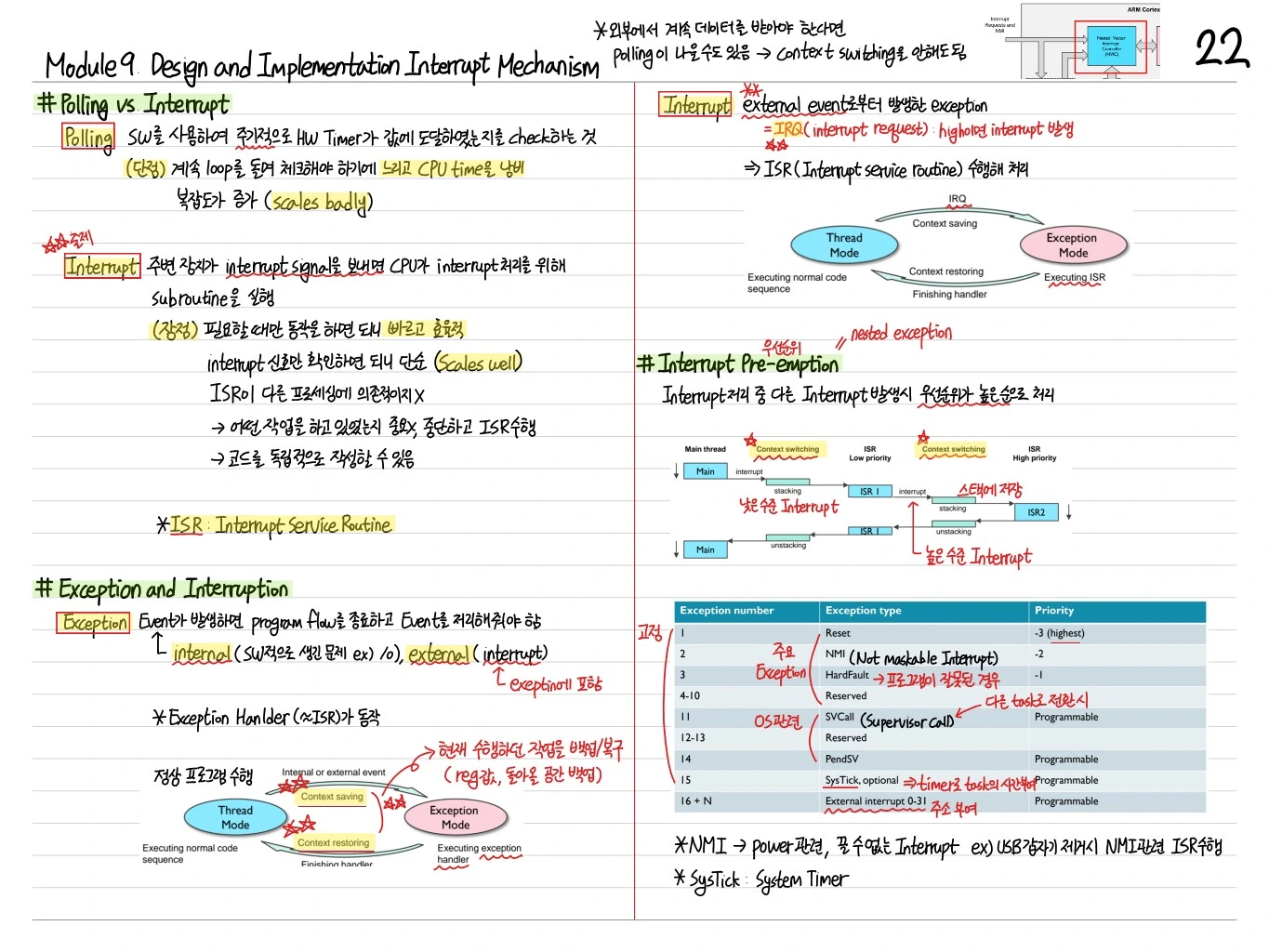
Interrupt Handling Sequence
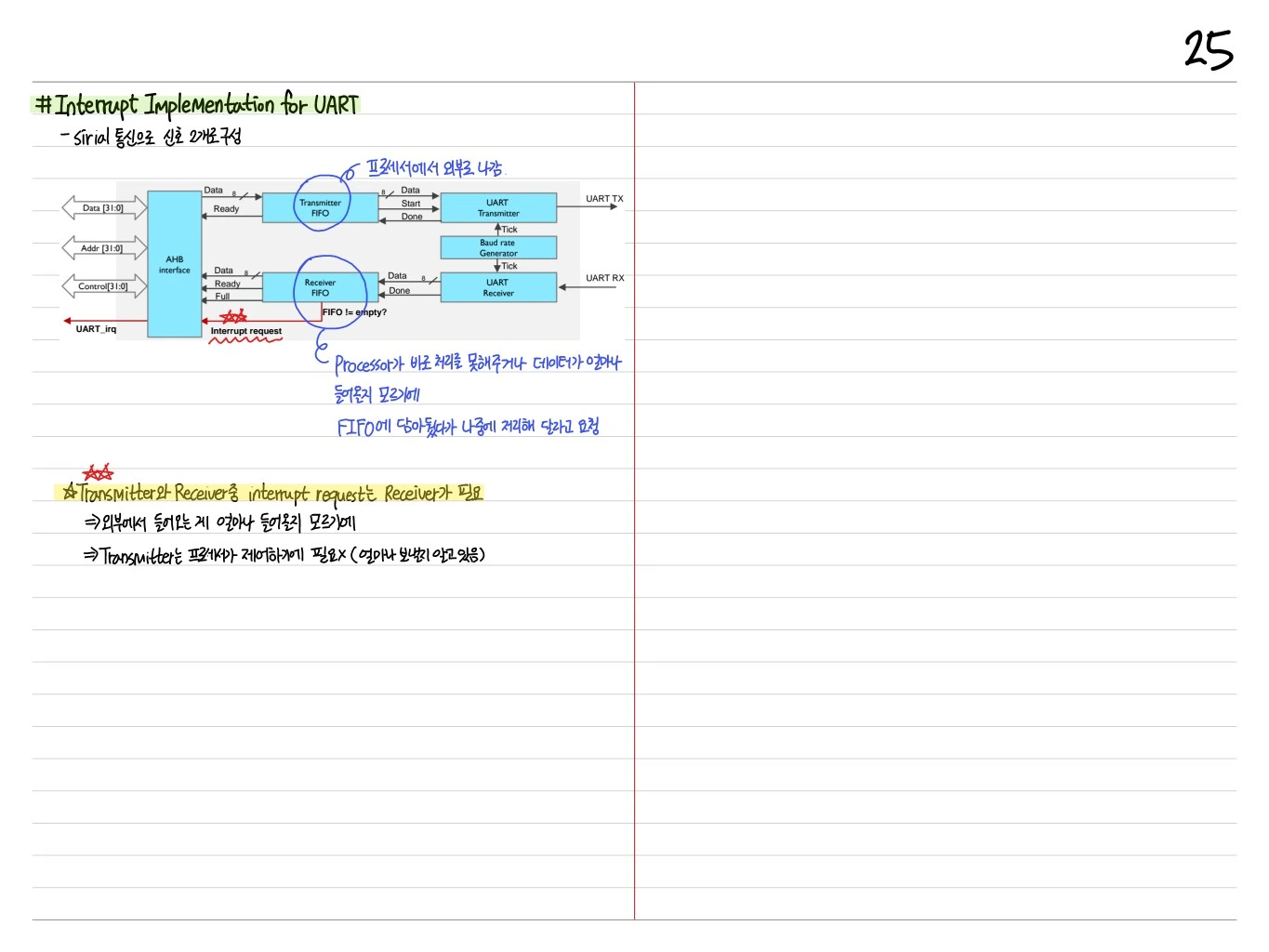
- External event (e.g. UART RX) → the peripheral asserts its IRQ signal
- The NVIC detects the IRQ and checks its priority
- If its priority is higher than the currently running code, it preempts
- Stacking: Push xPSR, PC, LR, R12, R3, R2, R1, R0 onto the stack (8 words)
- Vector fetch: Read the handler address from the vector table
- Run the handler (Handler mode, privileged)
- Exit:
BX LRorPOP {..., PC}— loads the EXC_RETURN value - Unstacking: Automatically restores from the stack frame and returns to the original code
Exception Priority
- Fixed priority: Reset (-3) > NMI (-2) > HardFault (-1)
- Configurable: All other exceptions
- Lower number = higher priority
The Cortex-M0 priority field is 2 bits → 4 levels. The Cortex-M3 uses 3~8 bits.
Preemption & Nesting
Main → IRQ_A handler running
      → higher-priority IRQ_B occurs
      → IRQ_A suspended (preempted), new stack frame pushed
      → IRQ_B handler runs
      → IRQ_B done → return to IRQ_A
      → IRQ_A done → return to Main
Frames pile up on the stack, so enough stack depth must be reserved.
Tail-Chaining
A Cortex-M optimization: when handling back-to-back IRQs, unstacking + restacking is skipped:
Main → IRQ_A → (IRQ_B pending as soon as it finishes)
                → skip the stack pop and call the IRQ_B handler directly
                → after IRQ_B, unstack only once → return to Main
→ Lower latency and power savings.
Late Arrival
If a higher-priority IRQ_B arrives while IRQ_A is still being stacked → the core branches to IRQ_B as soon as stacking completes (IRQ_A stays pending).
Interrupt Masking
PRIMASK
- bit 0: When 1, masks all configurable exceptions (except NMI and HardFault)
- Set with
CPSID I/CPSIE I
FAULTMASK (Cortex-M3 and above)
- When 1, masks everything except NMI
BASEPRI (Cortex-M3 and above)
- Masks IRQs with priority lower than this value
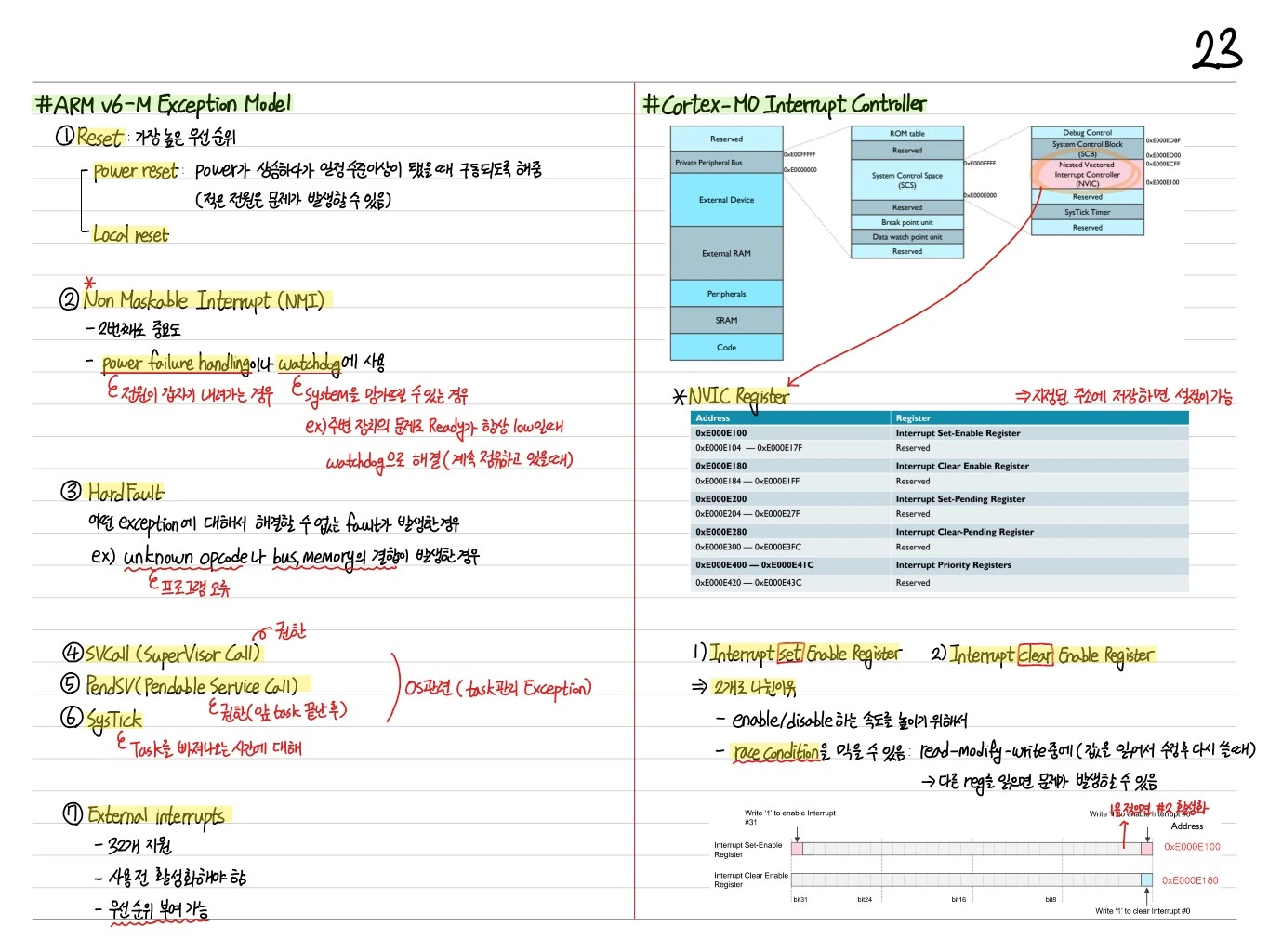
NVIC Registers
- ISER (Interrupt Set-Enable Register)
- ICER (Interrupt Clear-Enable)
- ISPR (Set Pending)
- ICPR (Clear Pending)
- IP (Interrupt Priority) — sets the priority of each IRQ
Example: enabling IRQ 5:
NVIC->ISER[0] = (1 << 5);Writing an Exception Handler
Handlers can be written in C. The compiler handles everything automatically according to the AAPCS (ARM calling convention):
void USART1_IRQHandler(void) {
    if (USART1->SR & USART_SR_RXNE) {
        uint8_t data = USART1->DR;
        // handle
    }
}
The handler address must be registered at 0x4C in the vector table (assuming IRQ 3). This is set up in the startup code (linker script).
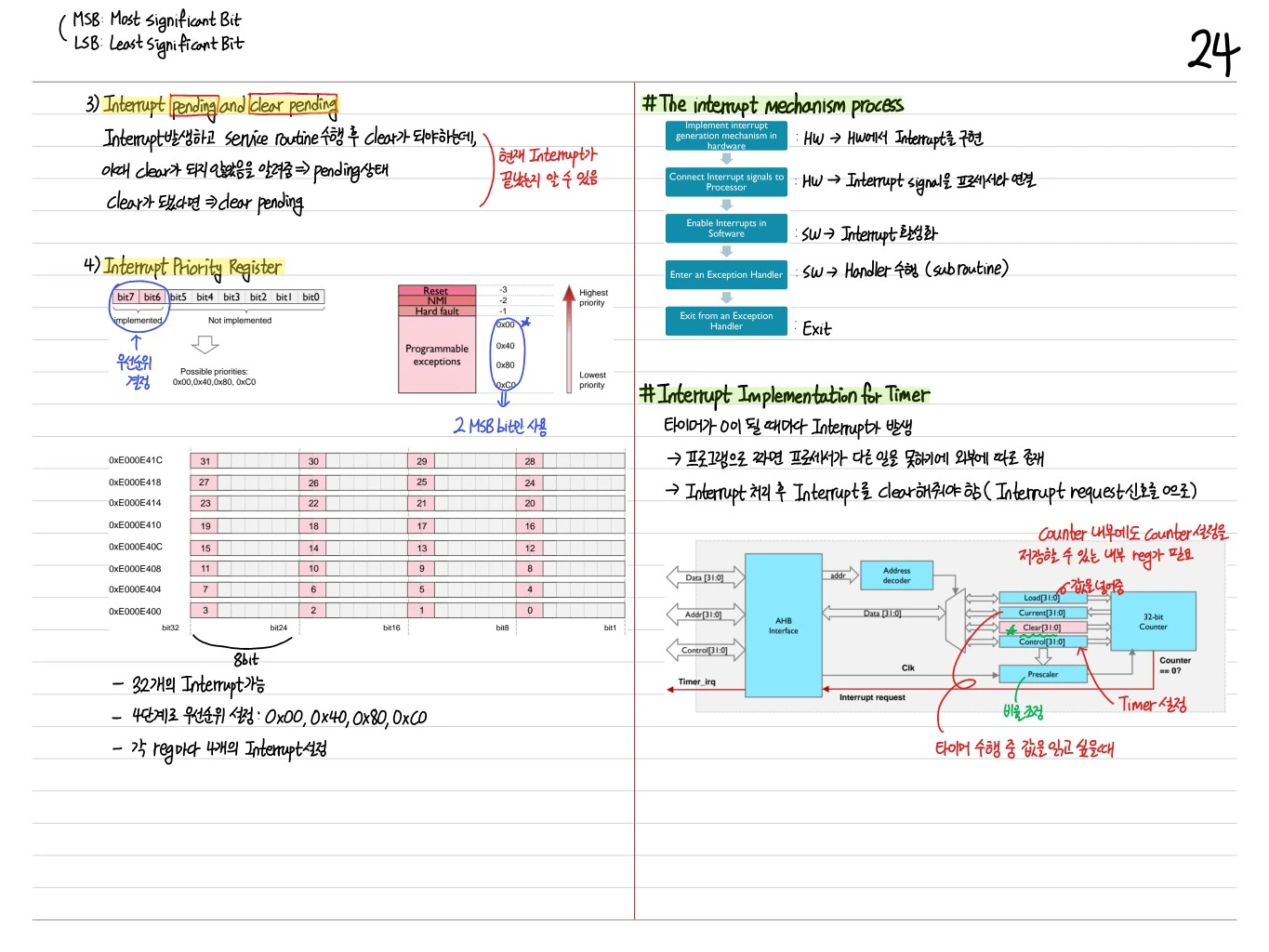
Summary
| Concept | Description |
|---|---|
| NVIC | Nested Vectored Interrupt Controller |
| Vector Table | Exception handler addresses starting at 0x00000000 |
| Priority | Lower number = higher priority |
| Preemption | A higher-priority IRQ preempts the running handler |
| Tail-chaining | Skips stacking when handling back-to-back IRQs |
| Late-arriving | Branches to a new IRQ that arrives during stacking |
| Masking | PRIMASK / FAULTMASK / BASEPRI |
By providing real-time responsiveness and priority-based preemption, the NVIC is the key reason the Cortex-M became the standard for real-time embedded systems.