Chapter 3: Datapath Functional Units Overview
This chapter studies the main functional units that make up a processor's datapath. It covers the core building blocks inside an ALU, such as the shifter, comparator, multiplier, divider, and counter, along with their design techniques.
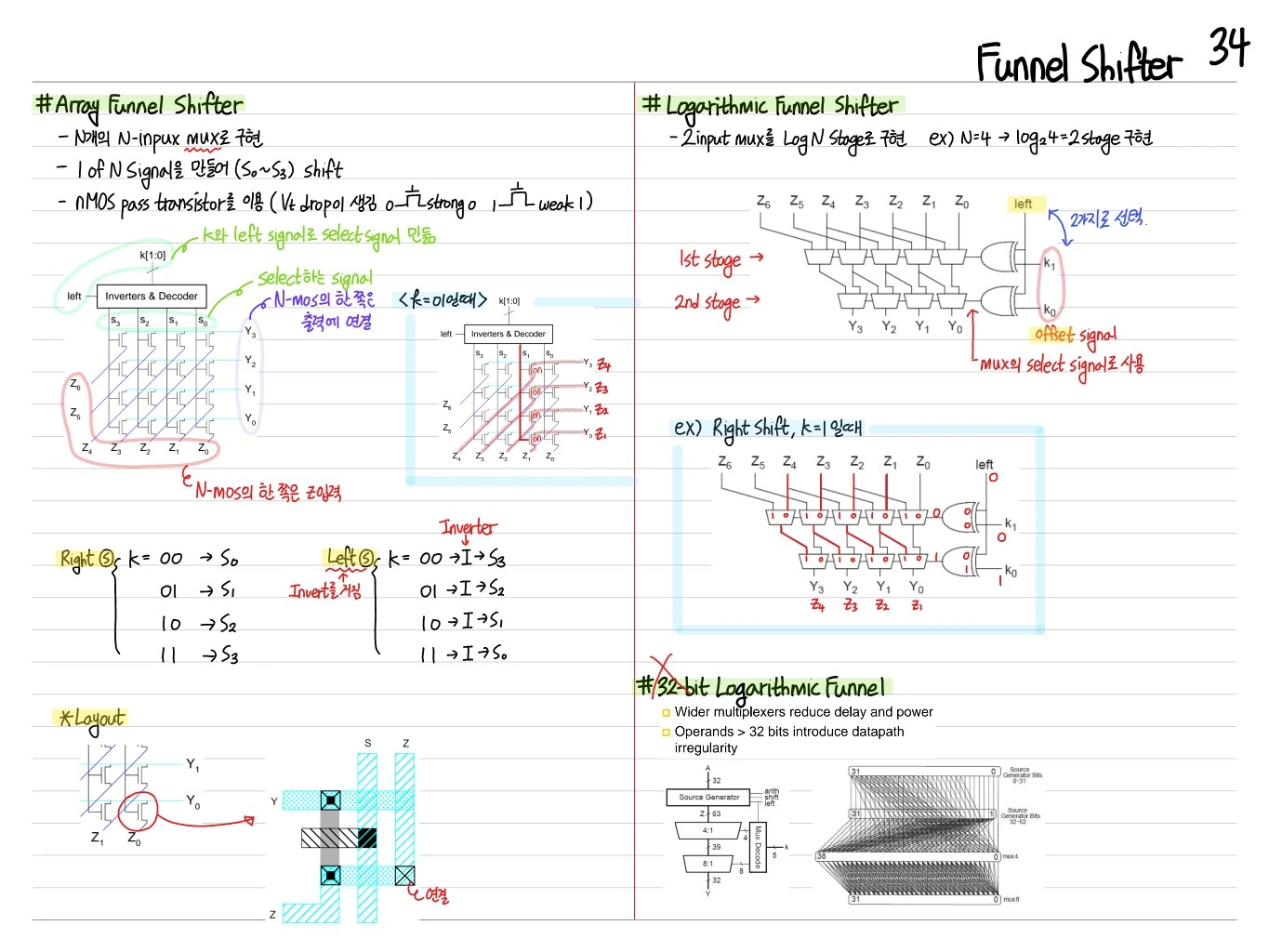
Shifter
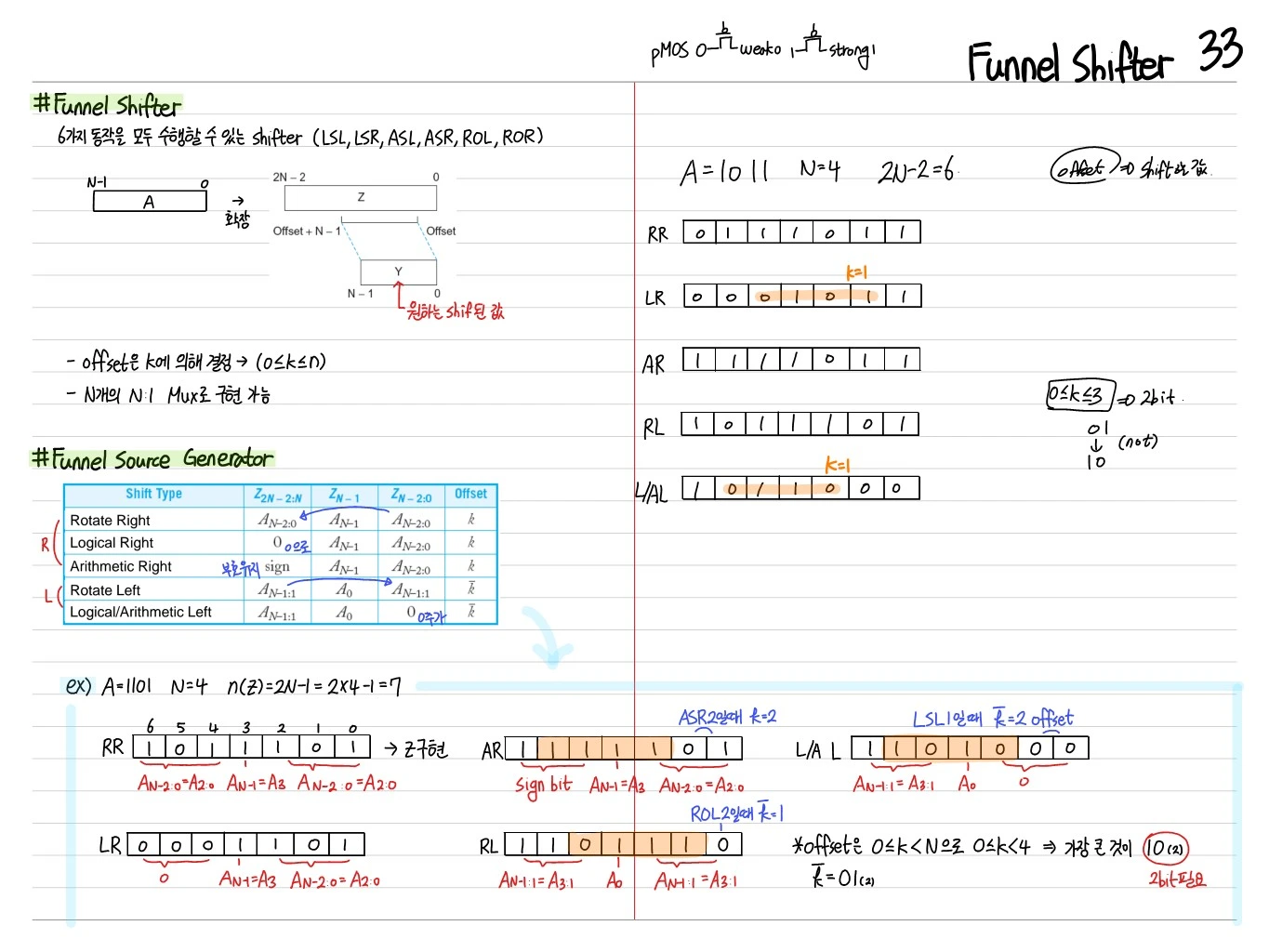
Shift operations are essential for fast approximations of multiplication and division and for bit manipulation. The main kinds:
- Logical shift (LSL, LSR): fills with 0
- Arithmetic shift (ASL, ASR): preserves the sign bit (signed division)
- Rotate (ROL, ROR): circular
- Rotate through carry: circular, including the carry bit
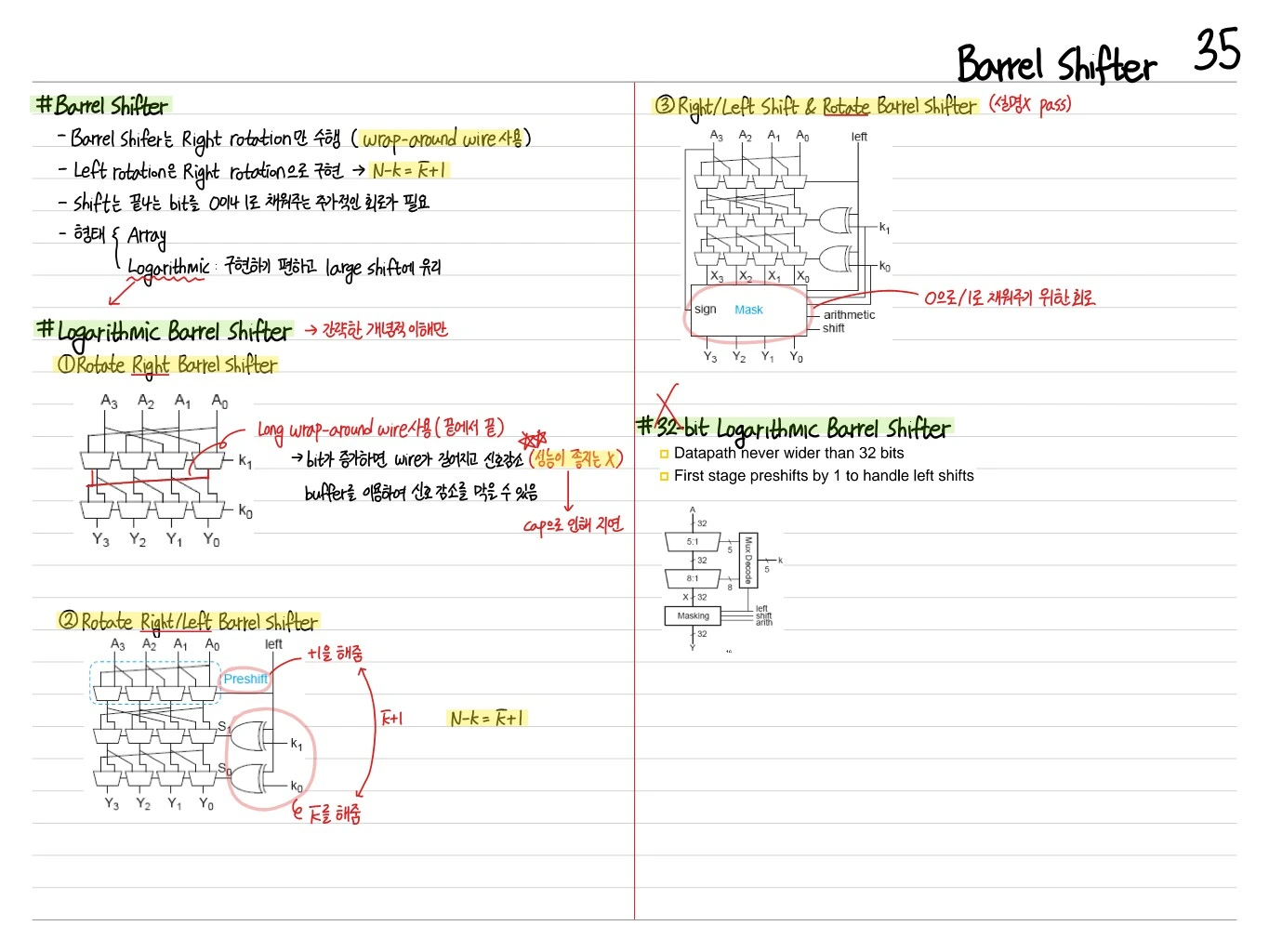
Barrel Shifter
An n-bit shifter that handles an arbitrary shift amount within 1 cycle. A signature unit of ARM.
- MUX tree structure: log n stages
- 8-bit, 16-bit, 32-bit … each stage either shifts or passes through
- Area: O(n log n), Delay: O(log n)
Comparator
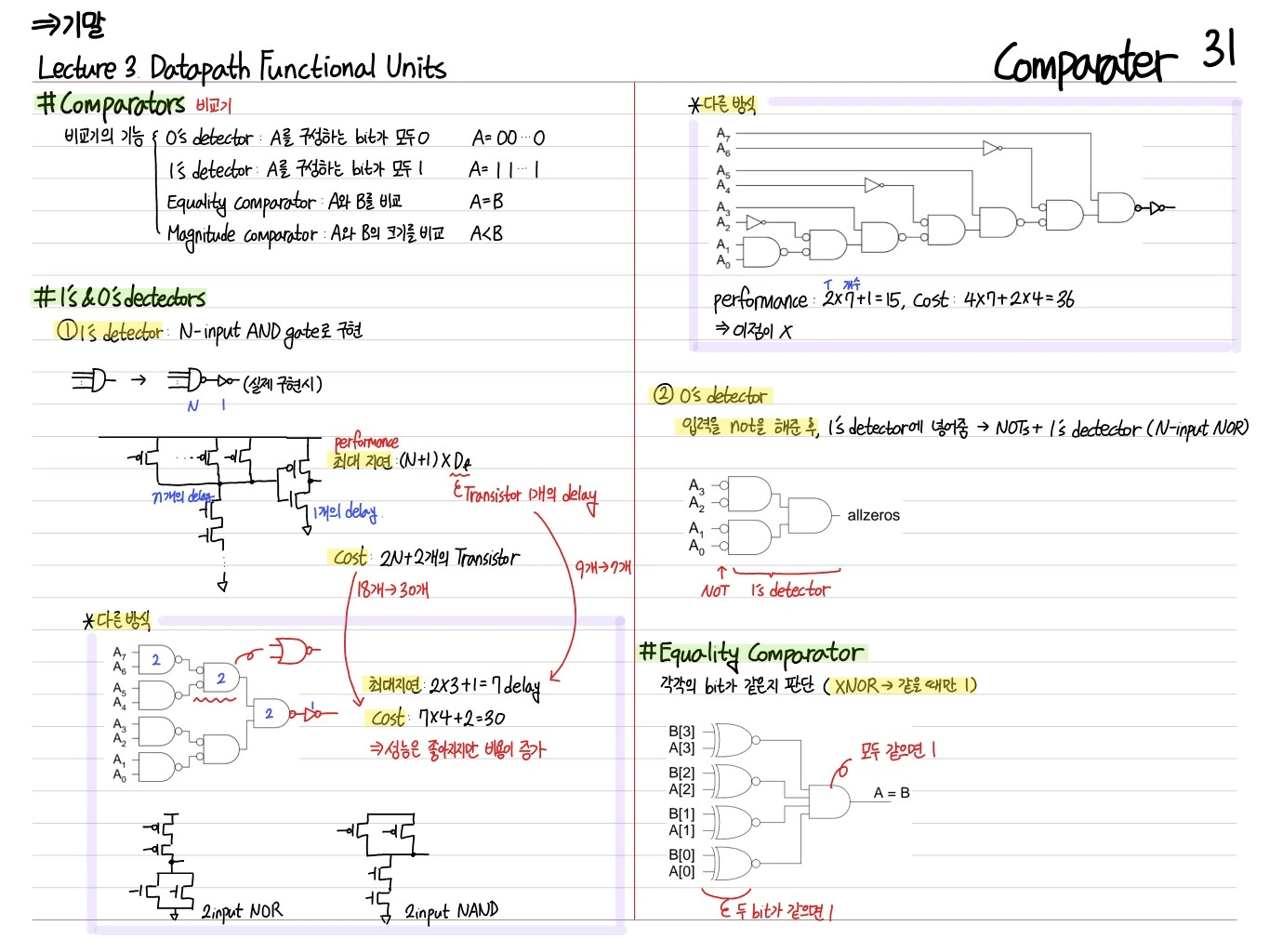
Compares two numbers A and B and decides A=B, A>B, or A<B.
Equality Comparator
That is, XNOR each bit, then combine with AND.
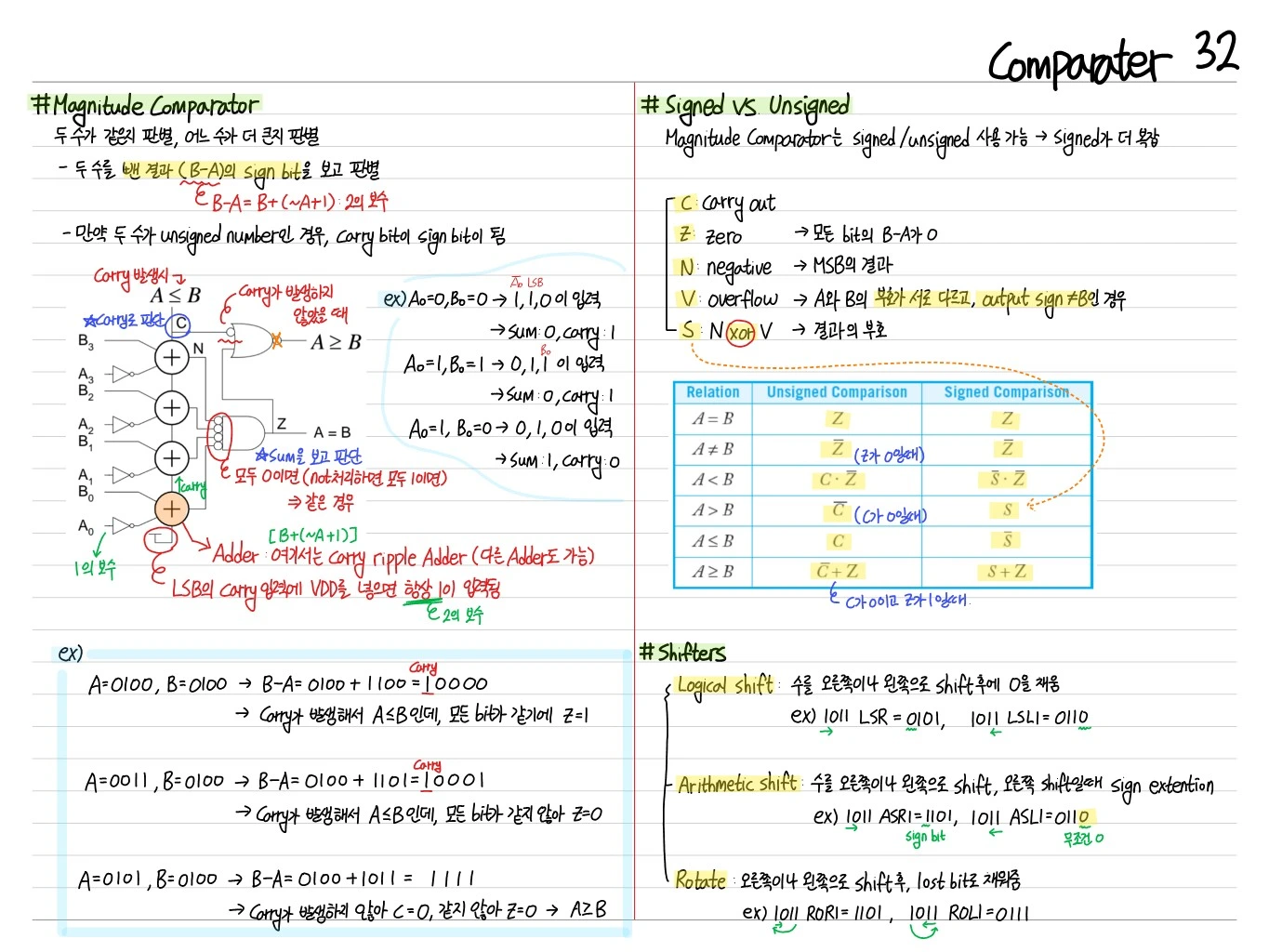
Magnitude Comparator
- Cascaded: compare from the most significant bit; if equal, move to the next bit
- Parallel: compare each bit pair, then use a priority encoder
Multiplier
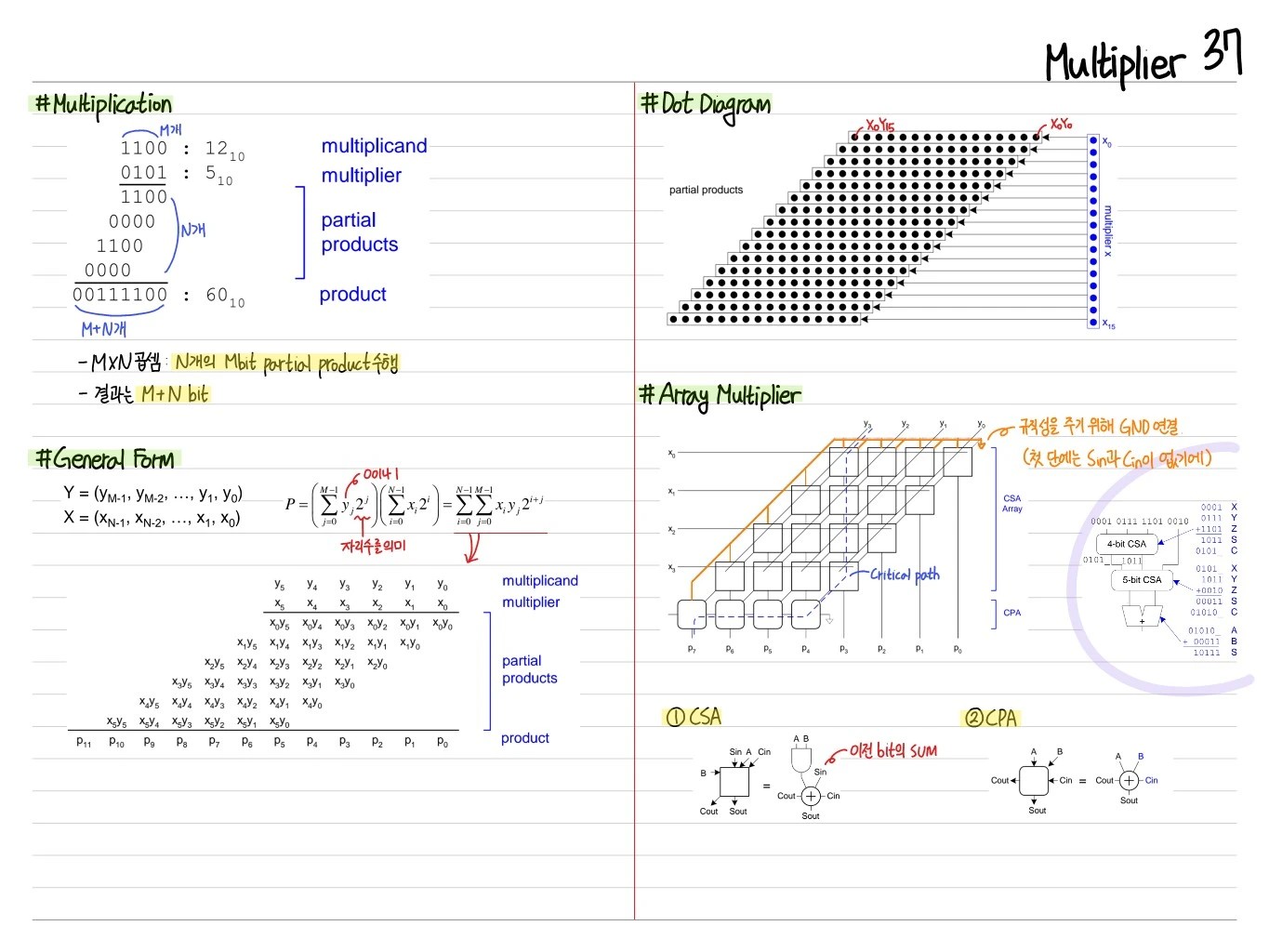
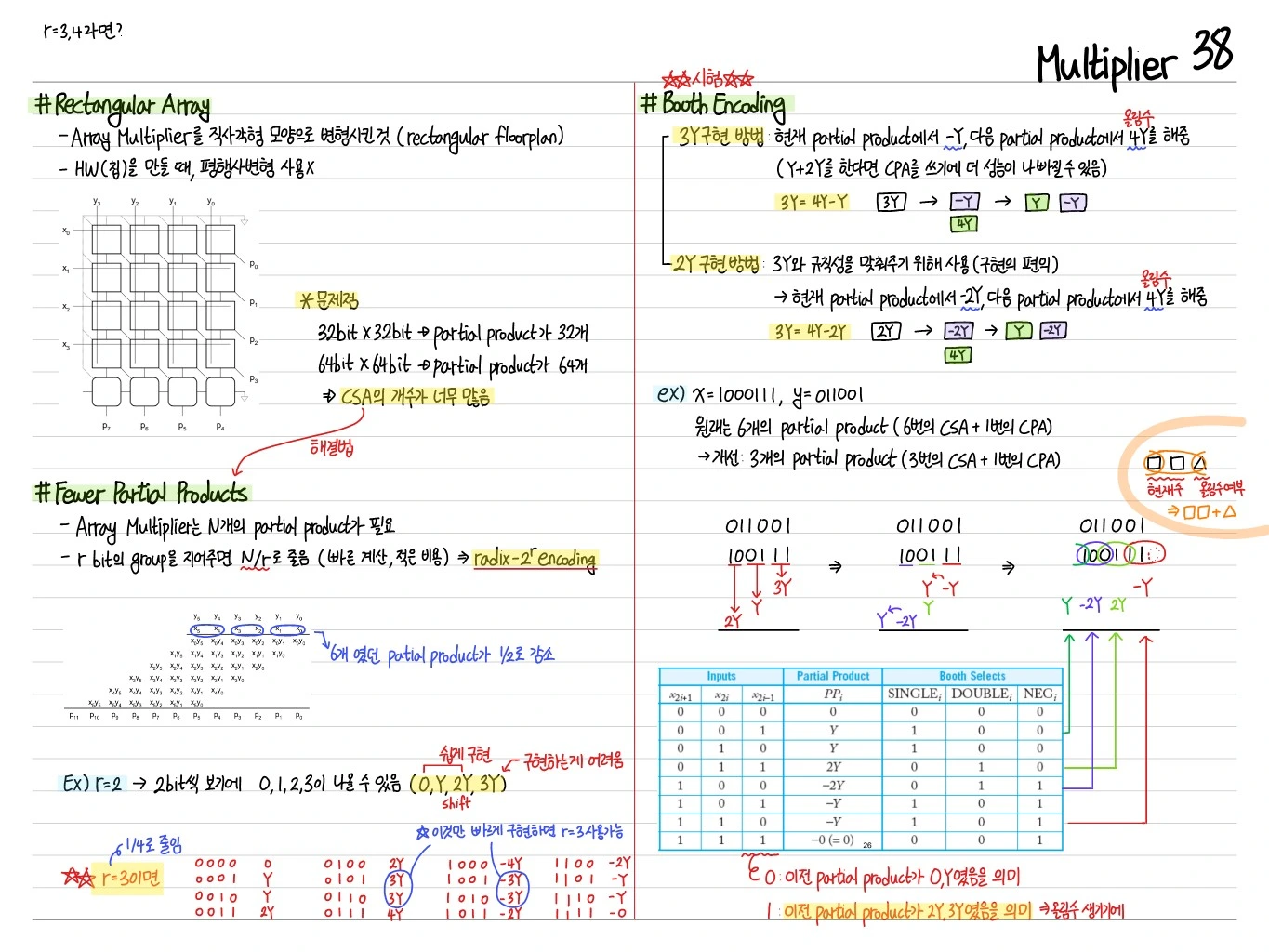
Array Multiplier
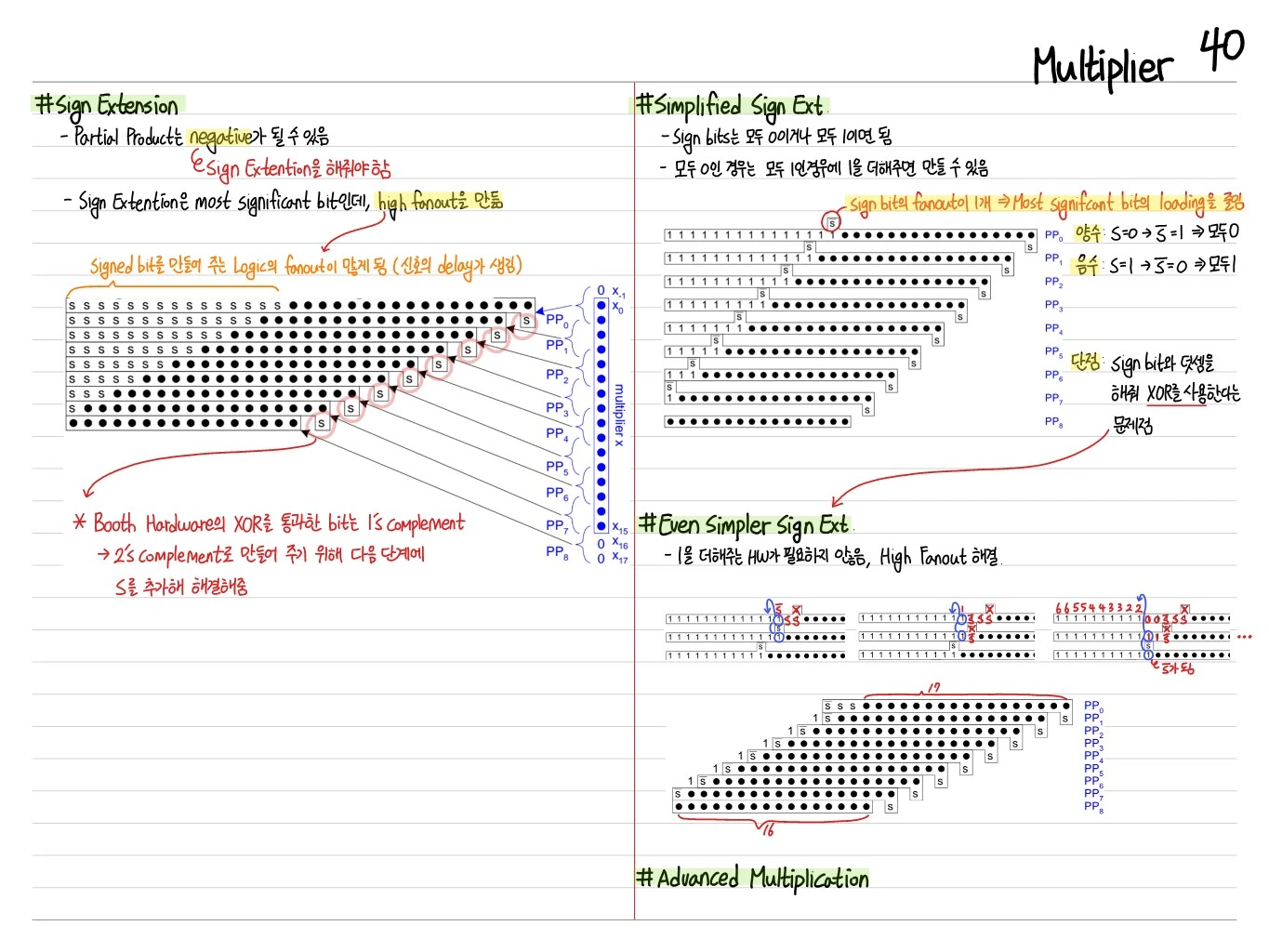
Generates every partial product in parallel and sums them with an adder tree:
   A3 A2 A1 A0
×  B3 B2 B1 B0
───────────────
4 partial products
   →  shift + add
Delay O(n), area O(n²).
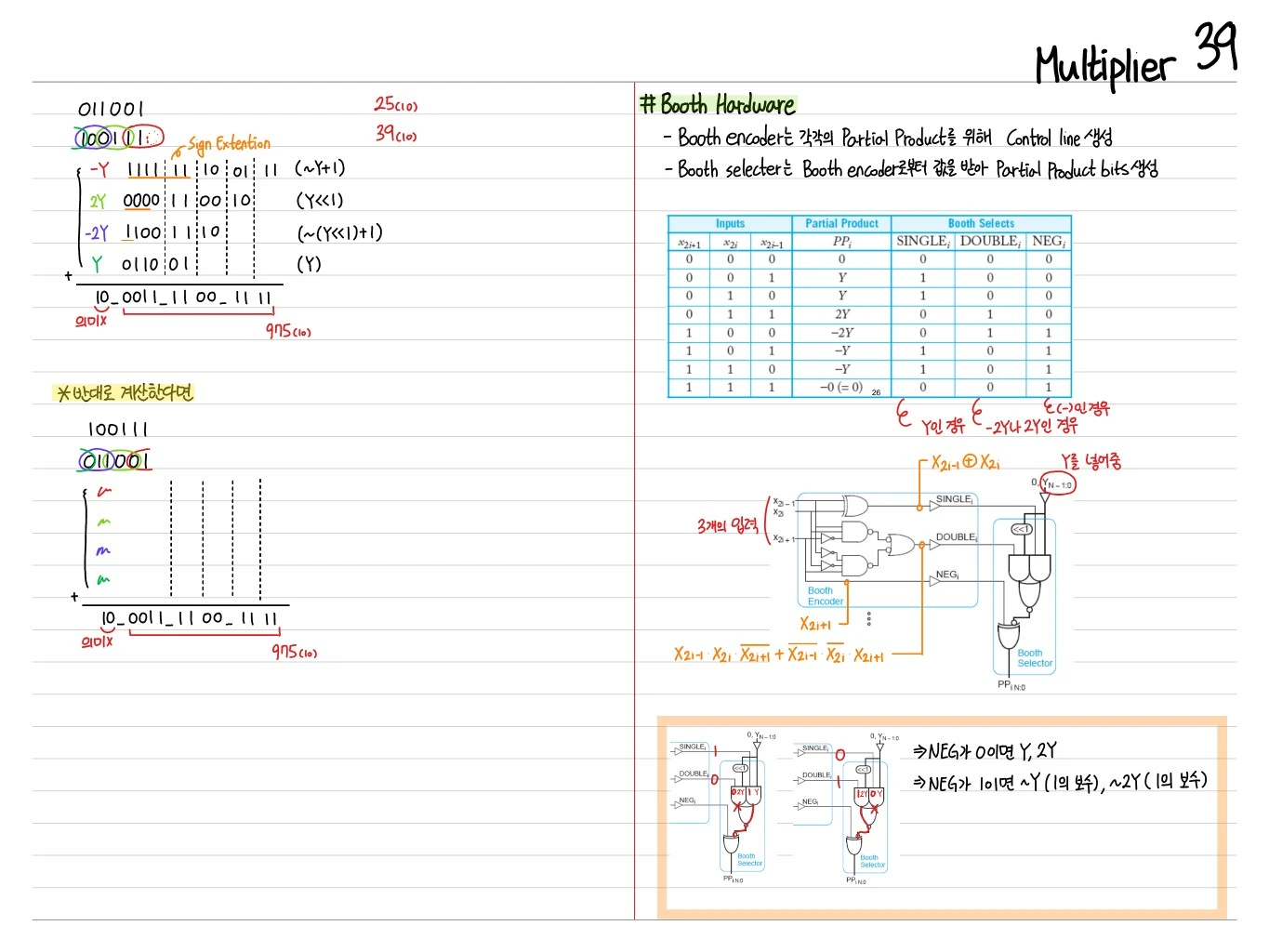
Booth Encoding
In signed multiplication, groups runs of consecutive 1 bits to reduce the number of partial products.
- Booth-2 (radix-4): groups 3 bits at a time, halving the partial products
- Booth-4 (radix-8): groups 4 bits at a time, cutting the partial products to 1/3
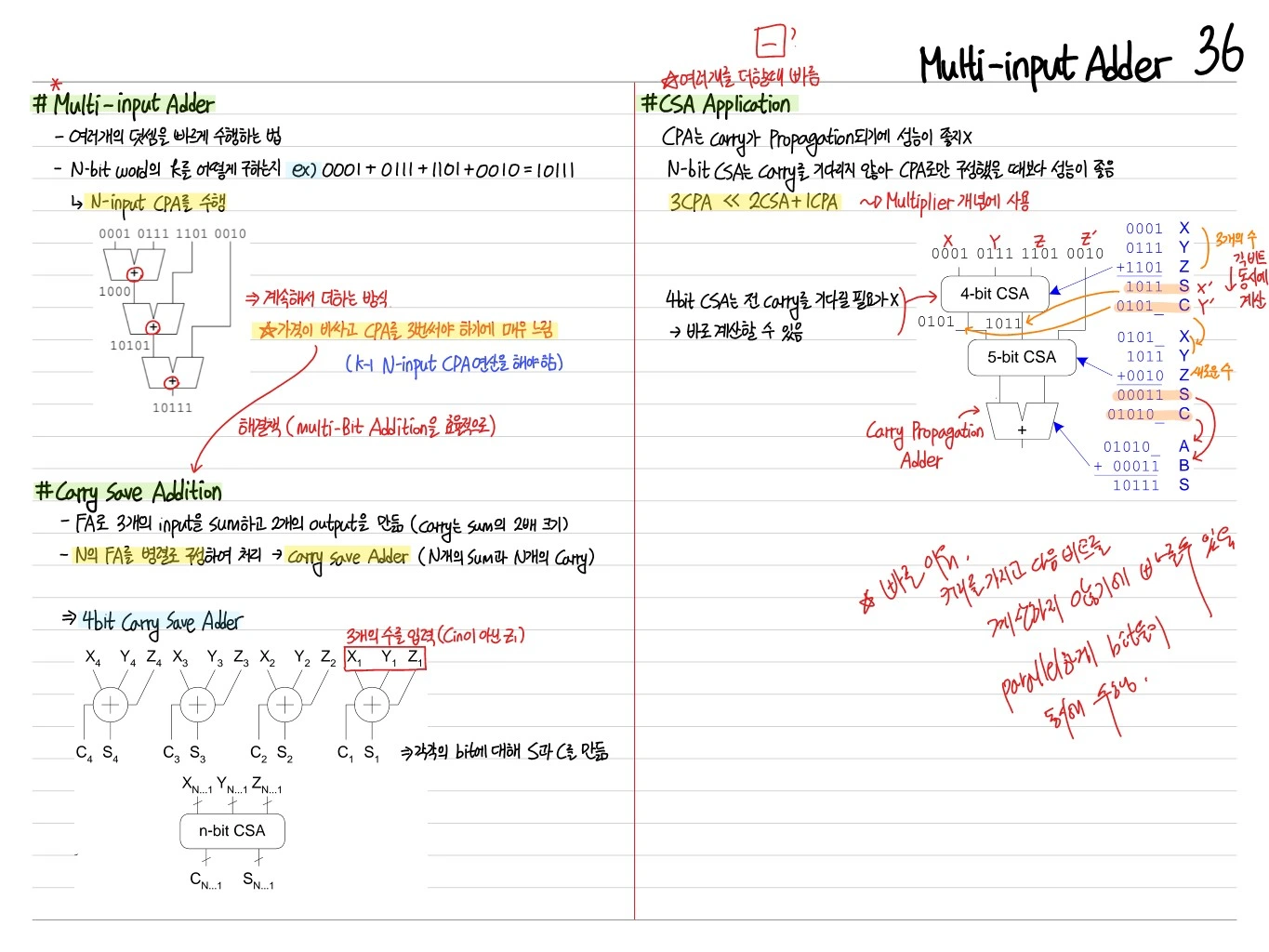
Wallace Tree Multiplier
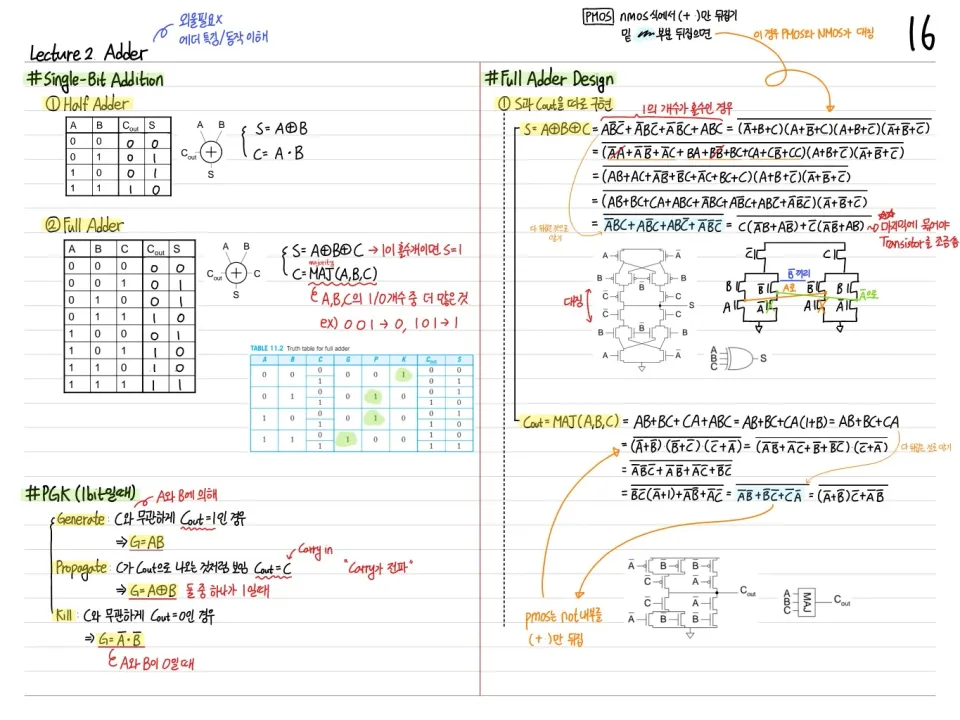
A reduction tree that compresses the partial products with CSAs (carry-save adders):
- Depth =
- The final two numbers are summed with a CPA
- The standard integer multiplier in modern CPUs
Dadda Tree
Similar to Wallace but uses slightly fewer adders. More area-efficient.
Divider
Division is far more complex than multiplication.
Restoring Division
- After subtracting, if the result is negative, restore the original value
- n-bit division: n cycles
Non-Restoring Division
- No restore step; the sign decides the next operation
- Faster, and the common modern implementation
SRT Division
- Redundant digit set (−2, −1, 0, +1, +2)
- Radix-4 and radix-8 SRT dividers → fewer cycles
- The Intel Pentium's famous FDIV bug was an error in the SRT lookup table
Counter
- Binary counter: n-bit ripple counter
- Synchronous counter: the same clock drives every flip-flop → less skew, higher frequency possible
- Johnson counter, ring counter: based on shift registers
Multiplexer / Demultiplexer
- 2:1 MUX =
y = s·b + s̄·a(AOI gate) - An n:1 MUX takes log n select signals
- Large MUXes are decomposed into a tree
Register File
- SRAM-based storage with multiple ports (multi-port)
- Typical RISC: 2 read ports + 1 write port
- Out-of-order processors: 8+ read ports, 4+ write ports, etc.
- Area grows with the square of the port count
Memory Arrays (SRAM/DRAM)
- SRAM: 6T cell, fast (0.5~1 ns), expensive, volatile
- DRAM: 1T1C cell, slow (tens of ns), cheap and dense
- SRAM for caches, DRAM for main memory
Summary
| Unit | Purpose | Key technique |
|---|---|---|
| Shifter | Shift/rotate | Barrel shifter (log n) |
| Comparator | Comparison | Parallel prefix |
| Multiplier | Multiplication | Booth + Wallace tree |
| Divider | Division | SRT (Radix-4/8) |
| Counter | Counting | Synchronous |
| MUX | Selection | Tree of 2:1 |
| RegFile | Storage | Multi-port SRAM |
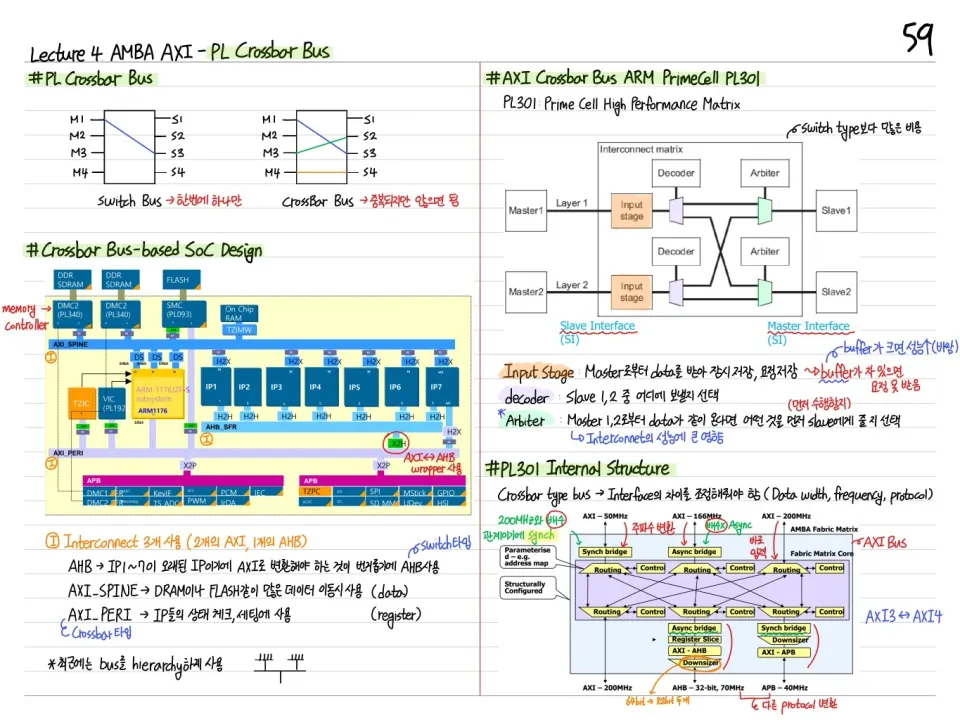
An ALU is a composite circuit that combines these functional units. Datapath performance is determined by the combination of their latency and throughput.