Key points in three lines
- Every RV32I instruction is 32 bits, and there are six formats: R, I, S, B, U, and J. The register numbers (rs1, rs2, rd) sit in the same bit positions in every format, and the sign bit of the immediate is always bit 31.
- The immediate bits look scrambled because that saves hardware. The bits were moved so that B shares as many positions as possible with S, and J with I. Counting multiplexer inputs in the immediate generator gives 70 for the RISC-V layout versus 98 for a naive layout that fills bits in order.
- I wrote an encoder and decoder in Python and checked them against the GNU assembler. All 6 hand-encoded instructions and all 5,000 random ones matched.
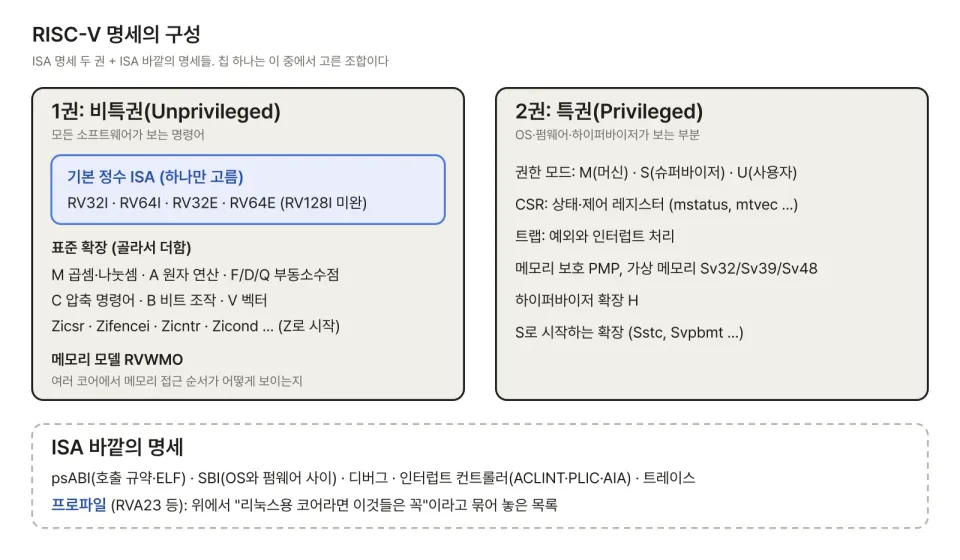
Part 1 drew the big map of RISC-V. From part 2 on, we go into the base integer ISA, RV32I. This post covers the "shape" of instructions: registers, instruction formats, and immediate encoding. What each instruction does comes in part 3 (arithmetic) and part 4 (branches and memory). Formats come first because, when you design a core, the decoder and the immediate generator come straight out of this format table.
1. Registers
RV32I has 32 integer registers of 32 bits (x0~x31) and a program counter, pc. In RV64I they all become 64 bits. This bit width is called XLEN.
| Register | ABI name | Use |
|---|---|---|
x0 |
zero |
Always 0. Writes are discarded |
x1 |
ra |
Function return address |
x2 |
sp |
Stack pointer |
x3, x4 |
gp, tp |
Global pointer, thread pointer |
x5~x7, x28~x31 |
t0~t6 |
Temporaries (a function call may overwrite them) |
x8, x9, x18~x27 |
s0~s11 |
Saved registers (a function must restore them) |
x10~x17 |
a0~a7 |
Function arguments and return values |
From the hardware's point of view, x0 is the only special register. ABI names and uses are a convention among software (more in part 6), so the hardware treats x1~x31 all the same. pc is not a general register, so instructions cannot read or write it directly. Only auipc, jal, jalr, and branches use pc.
The single rule that x0 is always 0 saves many instructions. The register copy mv a0, a1 is addi a0, a1, 0, negation neg a0, a1 is sub a0, x0, a1, and the do-nothing nop is addi x0, x0, 0. When building the register file, you do not need real flip-flops for entry 0; just make it "reads return 0, writes are ignored."
2. The Overall Layout of a 32-Bit Instruction
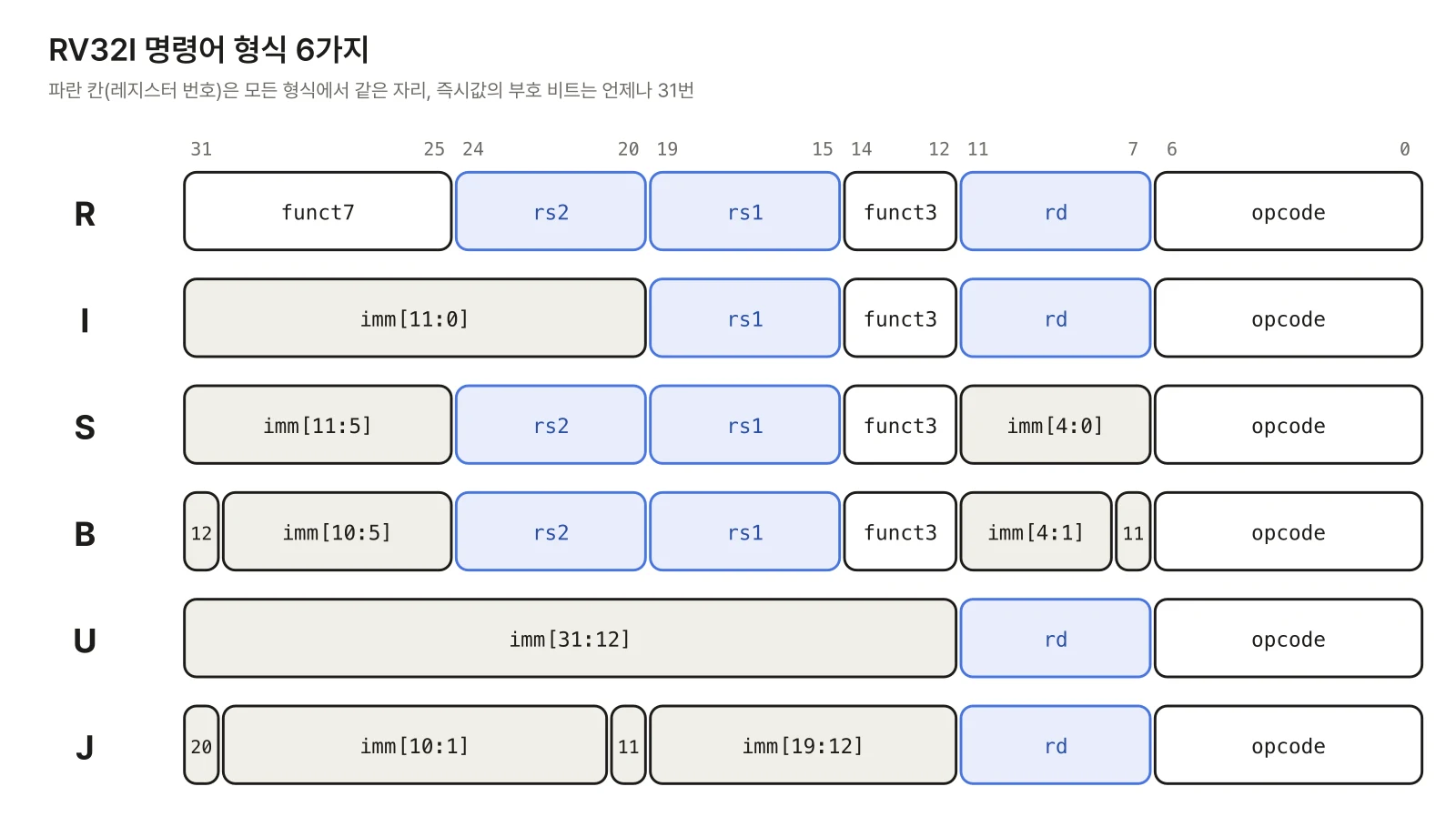
Start with the fields common to all formats.
| Field | Bits | Meaning |
|---|---|---|
opcode |
[6:0] | Instruction type (major class). The low two bits are always 11 |
rd |
[11:7] | Destination register number |
funct3 |
[14:12] | Distinguishes operations within the same opcode |
rs1 |
[19:15] | First source register number |
rs2 |
[24:20] | Second source register number |
funct7 |
[31:25] | Further distinction (R format only) |
As we saw in part 1, an instruction whose low two bits are 11 is a 32-bit instruction (anything else is a 16-bit C extension instruction). So of the 7 opcode bits, the 5 bits [6:2] are what actually distinguish the type. Values where [4:2] is 111 are reserved for instructions of 48 bits or longer.
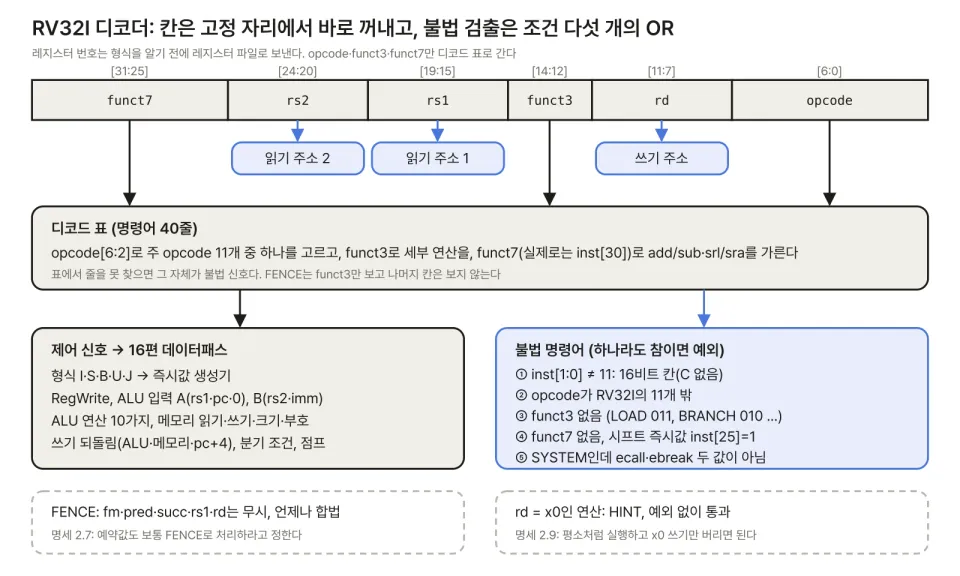
The key to this layout is that the register number fields are in the same place regardless of format. Before you know whether an instruction is R or S, you can send [19:15] and [24:20] straight to the register file as addresses. This is what lets a pipelined core do decode and register read in parallel in the same cycle. Some formats have no rs2 (I, U, J), but then the value read is simply not used. Reading needlessly is faster than figuring out the format first and then reading.
3. The Six Formats
| Format | Used for | Registers | Immediate |
|---|---|---|---|
| R | Register-register ops add, sub, sll … |
rd, rs1, rs2 | None |
| I | Immediate ops addi, loads lw, jalr |
rd, rs1 | 12 bits, imm[11:0] |
| S | Stores sw, sh, sb |
rs1, rs2 | 12 bits, in two pieces |
| B | Conditional branches beq, blt … |
rs1, rs2 | 13 bits (even), imm[12:1] |
| U | Upper 20 bits lui, auipc |
rd | imm[31:12] |
| J | Jump jal |
rd | 21 bits (even), imm[20:1] |
In effect there are four formats, R, I, S, and U, and B and J are variants of S and U. B has rs1, rs2, and a 12-bit field like S, but because it is a branch distance it only uses multiples of 2; J has a 20-bit field like U, but because it is a jump distance it only uses multiples of 2. That is why the specification introduces B and J as variants of S and U.
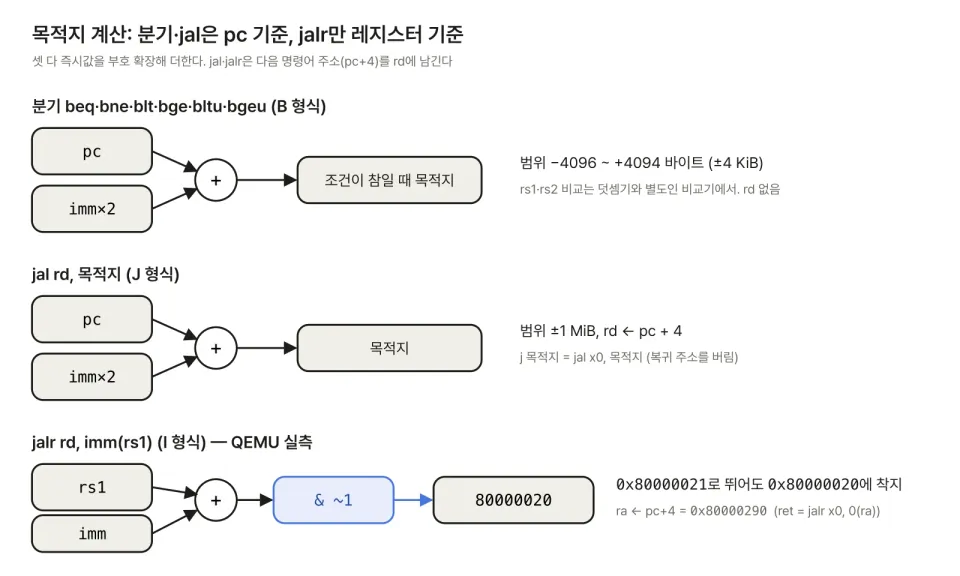
Targets are always multiples of 2 because of the C extension. With 16-bit instructions, instructions sit on 2-byte boundaries. So imm[0] is always 0, and instead of storing it, that bit is used to double the range. Branches reach ±4KiB and jal reaches ±1MiB. A core without C support raises an instruction address misaligned exception when the target is not a multiple of 4 (the checklist in part 1).
4. Why Are the Immediate Bits Scrambled?
Look at B and J in the figure and the order of the immediate bits is strange. B has imm[12] at the far left and imm[11] at the right end (bit 7), and J runs imm[20], imm[10:1], imm[11], imm[19:12]. It is awkward for humans to read. From the hardware's point of view, though, the reason is clear.
The immediate generator is the circuit that takes the 32 instruction bits and produces the 32-bit immediate for the format. Each output bit is a multiplexer that decides "which instruction bit to pick, depending on the format." If the same immediate bit comes from the same instruction bit across formats, the multiplexer has fewer inputs. RISC-V moved the bits to follow this rule.
| Immediate bit | I | S | B | U | J | Distinct sources |
|---|---|---|---|---|---|---|
| imm[0] | inst[20] | inst[7] | 0 | 0 | 0 | 3 |
| imm[4:1] | inst[24:21] | inst[11:8] | inst[11:8] | 0 | inst[24:21] | 3 |
| imm[10:5] | inst[30:25] | inst[30:25] | inst[30:25] | 0 | inst[30:25] | 2 |
| imm[11] | inst[31] | inst[31] | inst[7] | 0 | inst[20] | 4 |
| imm[19:12] | inst[31] | inst[31] | inst[31] | inst[19:12] | inst[19:12] | 2 |
| imm[30:20] | inst[31] | inst[31] | inst[31] | inst[30:20] | inst[31] | 2 |
| imm[31] | inst[31] | inst[31] | inst[31] | inst[31] | inst[31] | 1 |
A few things stand out in the table.
- imm[10:5] is inst[30:25] in all four formats. So it has only two sources (the instruction bits, or U's 0).
- For imm[4:1], B uses the same position as S, and J the same as I. Since B does not store imm[0], S's inst[7] slot is free, and imm[11] was put there. Thanks to that, B's imm[4:1] and imm[10:5] line up exactly with S.
- J works the same way. J's imm[11] was put in I's inst[20] slot (imm[0] in I), so imm[10:1] lines up with I's inst[30:21]. imm[19:12] is inst[19:12], the same as U.
- imm[31] is always inst[31]. Because the sign bit is fixed in one place, sign extension can start before the format is fully decoded. No multiplexer is needed either (1 source).
I counted the effect myself. For each output bit, I gathered the sources across the five formats (I, S, B, U, J) and took the number of distinct sources as the multiplexer input count (the constant 0 also counts as one input). For comparison I defined a "naive layout" that uses the same bit fields but fills the immediate in order from the low bit up: B puts imm[12:1] in order into S's fields, and J puts imm[20:1] in order into inst[31:12].
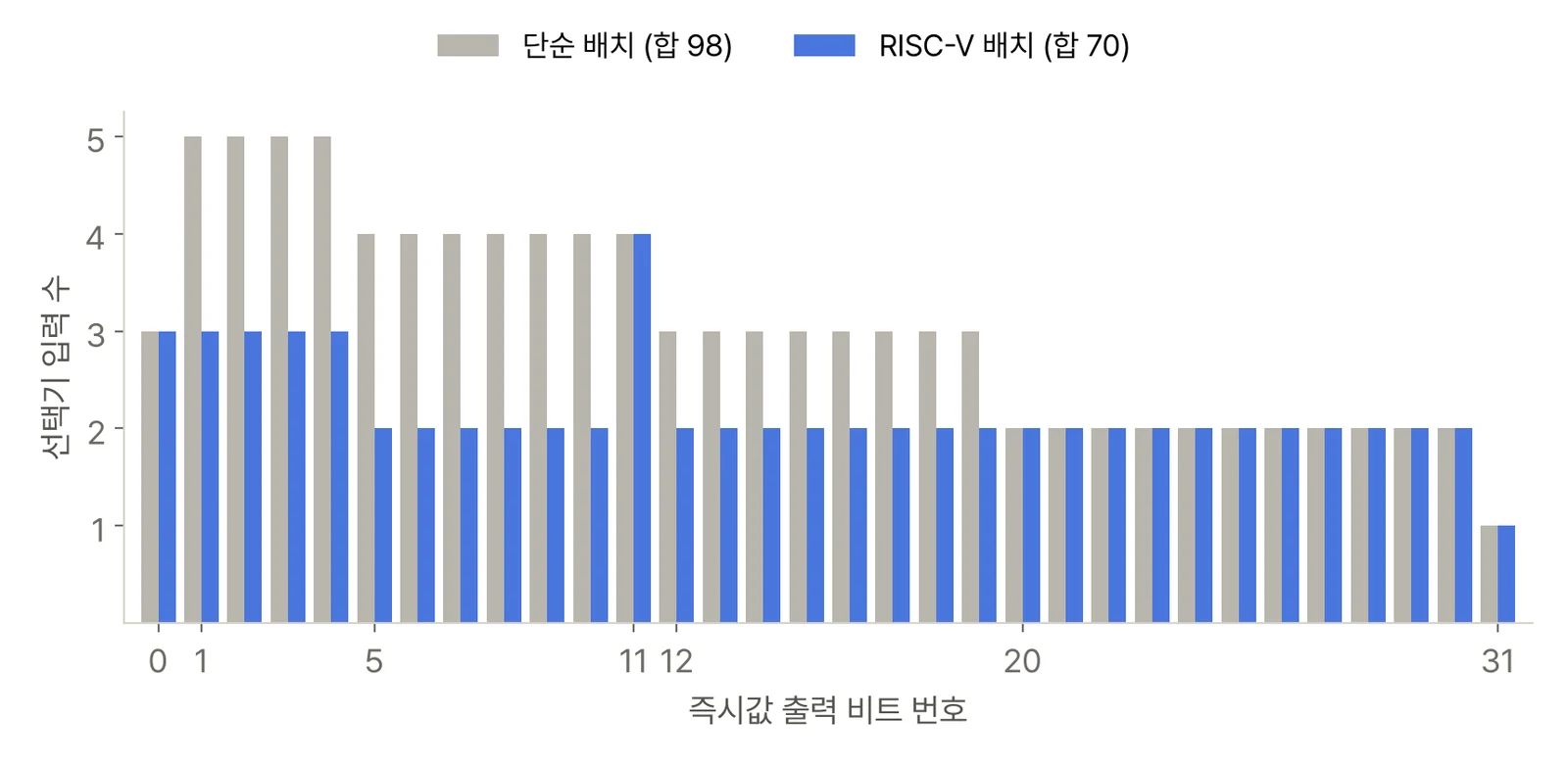
The RISC-V layout had 70 inputs in total, with the widest multiplexer at 4 inputs (imm[11]). The naive layout had 98, with the widest at 5 inputs. The difference is largest in the low bits. In the naive layout, imm[1] of B and J is offset by one position from S and I, so almost every bit from imm[1] to imm[11] gains one more source. Fewer multiplexer inputs mean less area and also a shorter path through the immediate generator. That path easily ends up on the critical path of the decode stage.
5. Encoding by Hand
The best way to learn the formats is to fill in the bits yourself. I picked one instruction from each of the six formats, encoded it by hand, and compared it with the value produced by the GNU assembler (riscv64-elf-as).
addi x5, x6, -20 (I format). Written as a 12-bit two's complement value, -20 is 1111 1110 1100 (0xFEC). Concatenating rs1=6 (00110), funct3=0, rd=5 (00101), and opcode=OP-IMM (0010011) gives the following.
imm[11:0]      rs1   f3  rd    opcode
111111101100  00110 000 00101 0010011
= 0xfec30293
beq x1, x2, -16 (B format). Written in 13 bits, -16 is 1 1111 1111 0000. Here imm[12]=1, imm[11]=1, imm[10:5]=111111, imm[4:1]=1000, and imm[0] is not stored. Place these in B's field order.
[12] [10:5]  rs2   rs1   f3  [4:1] [11] opcode
 1   111111 00010 00001 000 1000   1   1100011
= 0xfe2088e3
The branch distance is relative to the address of the branch instruction itself. So in the assembler I wrote it as a distance from the current location (.), as in beq x1,x2,.-16.
| Instruction | Format | Hand-computed | GNU as |
|---|---|---|---|
add x3,x4,x5 |
R | 005201b3 |
005201b3 |
addi x5,x6,-20 |
I | fec30293 |
fec30293 |
sw x7,8(x2) |
S | 00712423 |
00712423 |
beq x1,x2,.-16 |
B | fe2088e3 |
fe2088e3 |
lui x10,0x12345 |
U | 12345537 |
12345537 |
jal x1,.+2048 |
J | 001000ef |
001000ef |
jal x1,.+2048 is a fun one. 2048 is the value with only imm[11] set. In the J format imm[11] sits at inst[20], so the result is 0x00100000, with only bit 20 of the 32-bit value set, plus the opcode and rd: 0x001000ef.
6. Hands-On: Writing an Encoder and Decoder and Checking Them Against the Assembler
A few hand calculations are not enough, so I wrote an RV32I encoder and decoder in Python and checked them. The machine was a Mac M1 Max, and the reference was GNU binutils (riscv64-elf-as and objdump, installed with GCC 16.2). The immediate part of the decoder is a direct transcription of the table above.
def decode_imm(fmt, w):
    b = lambda hi, lo: (w >> lo) & ((1 << (hi - lo + 1)) - 1)
    if fmt == 'I': return sext(b(31, 20), 12)
    if fmt == 'S': return sext(b(31, 25) << 5 | b(11, 7), 12)
    if fmt == 'B': return sext(b(31, 31) << 12 | b(7, 7) << 11
                               | b(30, 25) << 5 | b(11, 8) << 1, 13)
    if fmt == 'U': return sext(b(31, 12), 20) << 12
    if fmt == 'J': return sext(b(31, 31) << 20 | b(19, 12) << 12
                               | b(20, 20) << 11 | b(30, 21) << 1, 21)
sext(v, n) sign-extends an n-bit value. The test went like this. I randomly picked 5,000 instructions from 34 RV32I instructions representing the six formats (excluding shift-immediates, FENCE, and system instructions), with registers and immediates also chosen at random within their ranges (seed fixed at 2). Each instruction was built once with my encoder and once by writing it as an assembly statement and running it through GNU as, and the 32-bit values were compared. Then I read the values produced by GNU as back with my decoder to see whether the original register numbers and immediates came out.
| Test | Count | Matched |
|---|---|---|
| Hand encoding | 6 | 6 |
| Random encoding (my encoder = GNU as) | 5,000 | 5,000 |
| Random decoding (read back with my decoder) | 5,000 | 5,000 |
The same method applies when the decoder moves into hardware: compare against a reference model (GNU as here, later an instruction set simulator such as Spike) with random inputs. Transcribe even one table wrong and hundreds of the 5,000 fail immediately, so mistakes are hard to hide.
7. Design Checklist: What the Decoder Must Get Right
An RV32I decoder determines the format from opcode bits [6:2]. RV32I uses nine major opcodes.
| opcode[6:0] | Name | Format | Instructions |
|---|---|---|---|
0110111 |
LUI | U | lui |
0010111 |
AUIPC | U | auipc |
1101111 |
JAL | J | jal |
1100111 |
JALR | I | jalr |
1100011 |
BRANCH | B | beq bne blt bge bltu bgeu |
0000011 |
LOAD | I | lb lh lw lbu lhu |
0100011 |
STORE | S | sb sh sw |
0010011 |
OP-IMM | I | addi slti sltiu xori ori andi slli srli srai |
0110011 |
OP | R | add sub sll slt sltu xor srl sra or and |
On top of these come FENCE (MISC-MEM, 0001111) and ECALL/EBREAK (SYSTEM, 1110011) (part 4). Things that are easy to miss when building the decoder:
| Item | Rule |
|---|---|
| Unlisted opcode | Any opcode not listed above raises an illegal instruction exception |
| Unlisted funct3 | E.g., funct3 011 for LOAD (RV32 has no ld), and 010/011 for BRANCH, are illegal |
| funct7 | For OP, anything other than 0000000 and 0100000 (sub, sra) is illegal (without the M extension) |
| Shift immediates | RV32I slli/srli/srai have a 5-bit shift amount. If inst[25] is 1, it is a reserved value; treat it as illegal |
jalr |
Illegal if funct3 is not 000 |
| All zeros, all ones | The instructions 0x00000000 and 0xffffffff are defined as illegal by the specification, to catch jumps into erased memory |
| rd = x0 | An operation that writes its result to x0, such as addi x0, x5, 3, is not illegal but a HINT. It must do nothing and move on without an exception |
| Field extraction | Extract rs1, rs2, and rd from their fixed positions before determining the format. Take the immediate's sign straight from inst[31] |
The second-to-last row is a common mistake. If you treat "instructions that write x0 are useless, so illegal," perfectly valid programs will stop with exceptions on encodings the specification reserved as hints for future extensions. nop itself is addi x0, x0, 0.
Summary
- RV32I has 32 registers of 32 bits and a
pc. The only register the hardware treats specially isx0, which is always 0. - Instructions are 32 bits, in six formats: R, I, S, B, U, and J. rs1, rs2, and rd are always in the same place, so decode and register read can happen at once, and the immediate's sign is always inst[31].
- The immediate bits were moved so that B shares positions with S, and J with I. This cut multiplexer inputs from 98 in the naive layout to 70.
- The hand-written encoder and decoder matched GNU as on all 6 (by hand) and all 5,000 (random) instructions. The checklist above sums up the decoder's illegal instruction and HINT rules.
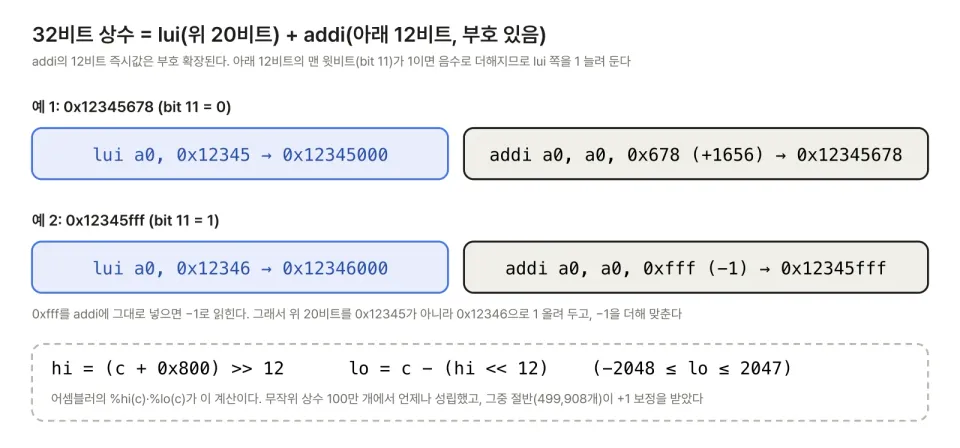
Next post: Part 3 looks at RV32I's integer operations. It follows by hand what the add, logical, shift, and compare instructions compute, how slt and sltu differ, and how to combine lui/auipc with addi to build 32-bit constants and addresses (including the +1 correction caused by sign extension).
References
- The RISC-V Instruction Set Manual, Volume I: Unprivileged Architecture, Version 20240411. Chapter 2 RV32I (2.1 Programmers' Model, 2.2 Instruction Formats, 2.3 Immediate Encoding Variants, 2.9 HINT Instructions), 1.5 Base Instruction-Length Encoding. https://github.com/riscv/riscv-isa-manual
- D. Patterson, A. Waterman, The RISC-V Reader: An Open Architecture Atlas, 2017. Chapter 2 (RV32I)
- D. Harris, S. Harris, Digital Design and Computer Architecture: RISC-V Edition, Morgan Kaufmann, 2021. 6.4 Machine Language, 7.3 Immediate Extension
- RISC-V ELF psABI (register ABI names). https://github.com/riscv-non-isa/riscv-elf-psabi-doc