Chapter 6: Multiprocessor Overview
As single processors hit the limits of clock frequency, multiprocessor architectures that use many processors in parallel became the mainstream of computer architecture. This chapter covers shared memory / message passing, cache coherence, synchronization, clusters, and interconnect topologies.
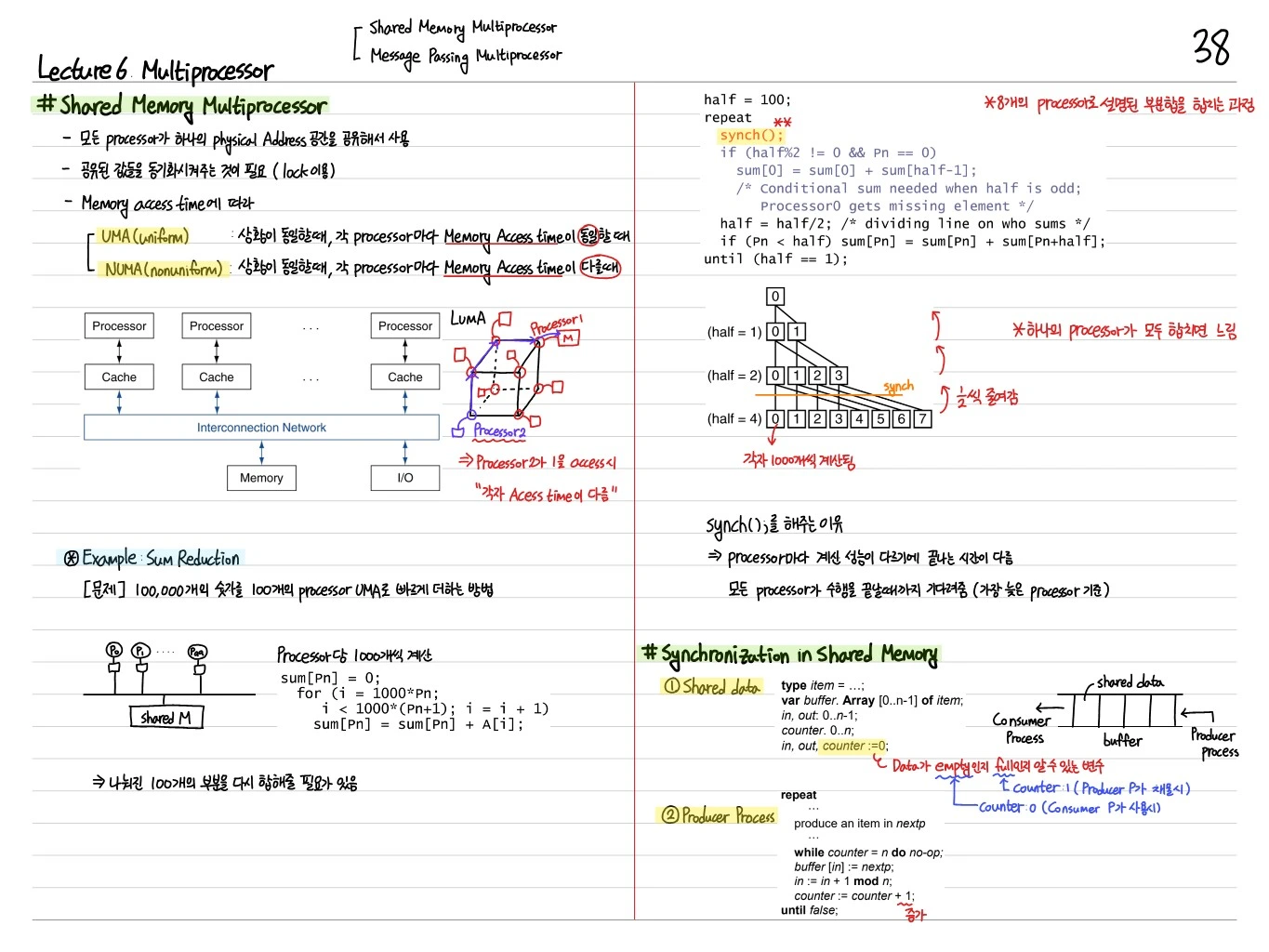
Shared Memory Multiprocessor
[P1]──[Cache]──┐
[P2]──[Cache]──┼──[Interconnection Network]──[Memory]
[P3]──[Cache]──┘- UMA (Uniform Memory Access): every processor has the same memory access time
- NUMA (Non-Uniform Memory Access): memory close to a processor is fast to access, distant memory is slow
- Memory access times differ as well
Example: Sum Reduction
Code in which 100 processors sum 100,000 numbers:
sum[Pn] = 0;
for (i = 10000*Pn; i < 10000*(Pn+1); i = i + 1)
    sum[Pn] = sum[Pn] + A[i];
/* now add the sub-sums */
half = 100;
repeat
    synch();
    if (half%2 != 0 && Pn == 0)
        sum[0] = sum[0] + sum[half-1];
    /* Conditional sum needed when half is odd */
    half = half/2;  /* dividing line on who sums */
    if (Pn < half)
        sum[Pn] = sum[Pn] + sum[Pn+half];
until (half == 1);
Why synchronization is needed: a race condition occurs when several processors read and write the same variable at the same time.
Synchronization in Shared Memory
Example: the producer-consumer problem
Shared data
int counter = 0;
int buffer[BUFFER_SIZE];
int in = 0; int out = 0;

/* Producer */
while (counter == BUFFER_SIZE) ;  // do nothing
buffer[in] = next_produced;
in = (in + 1) % BUFFER_SIZE;
counter++;

/* Consumer */
while (counter == 0) ;  // do nothing
next_consumed = buffer[out];
out = (out + 1) % BUFFER_SIZE;
counter--;
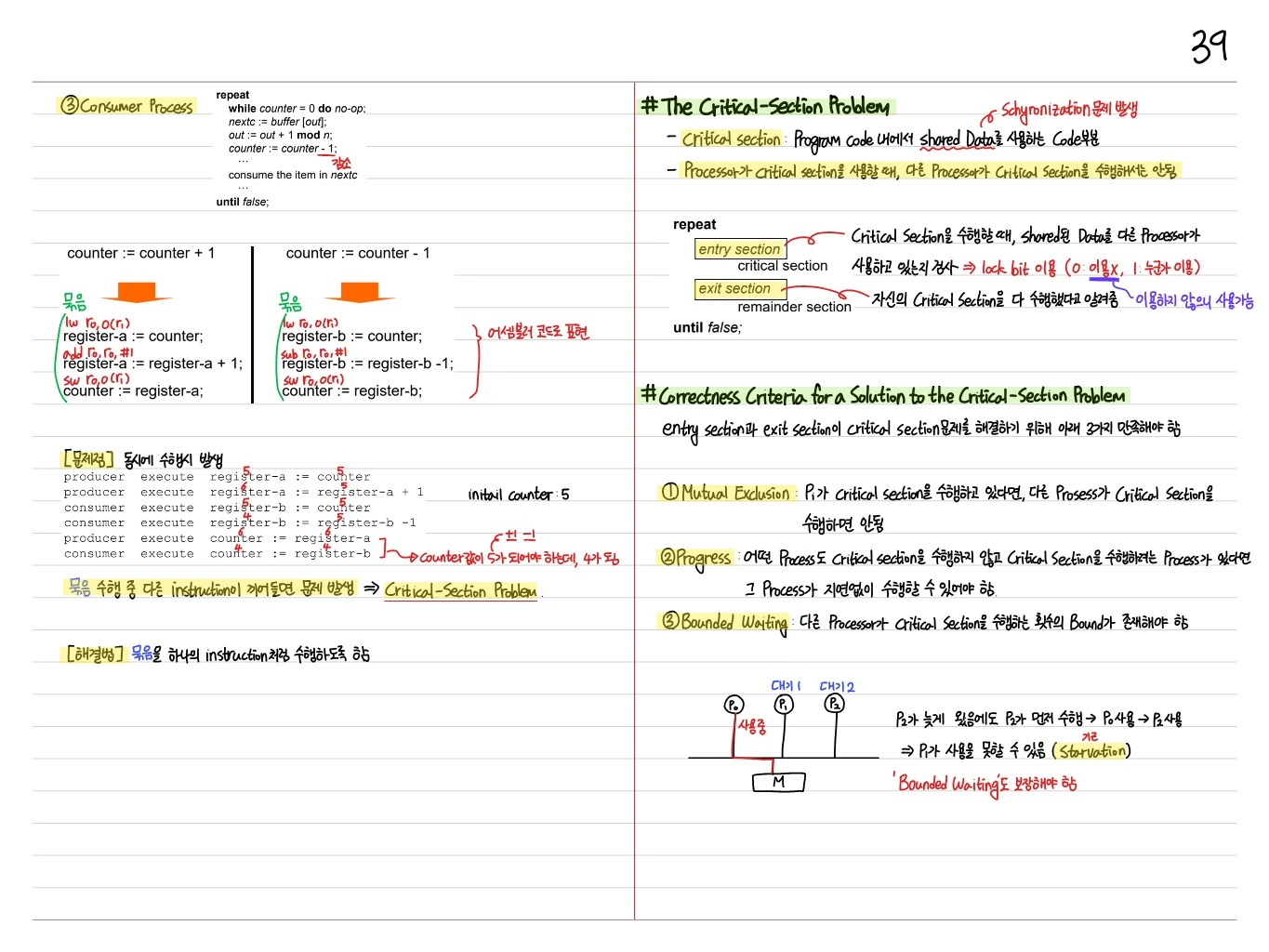
If counter++ and counter-- are not atomic, a race condition occurs.
Example: counter++ = register1 = counter; register1 = register1 + 1; counter = register1;
If two processors interleave, an update can be lost → the critical section problem.
The Critical-Section Problem
repeat
    Entry Section
       critical section  ← only one processor enters at a time
    Exit Section
       remainder section
until false;
Correctness Criteria for a Solution
- Mutual Exclusion: only one processor can be in a critical section
- Progress: if a processor wants to enter the critical section, it can eventually enter
- Bounded Waiting: a processor trying to enter the critical section must get in within finite time (prevents starvation)
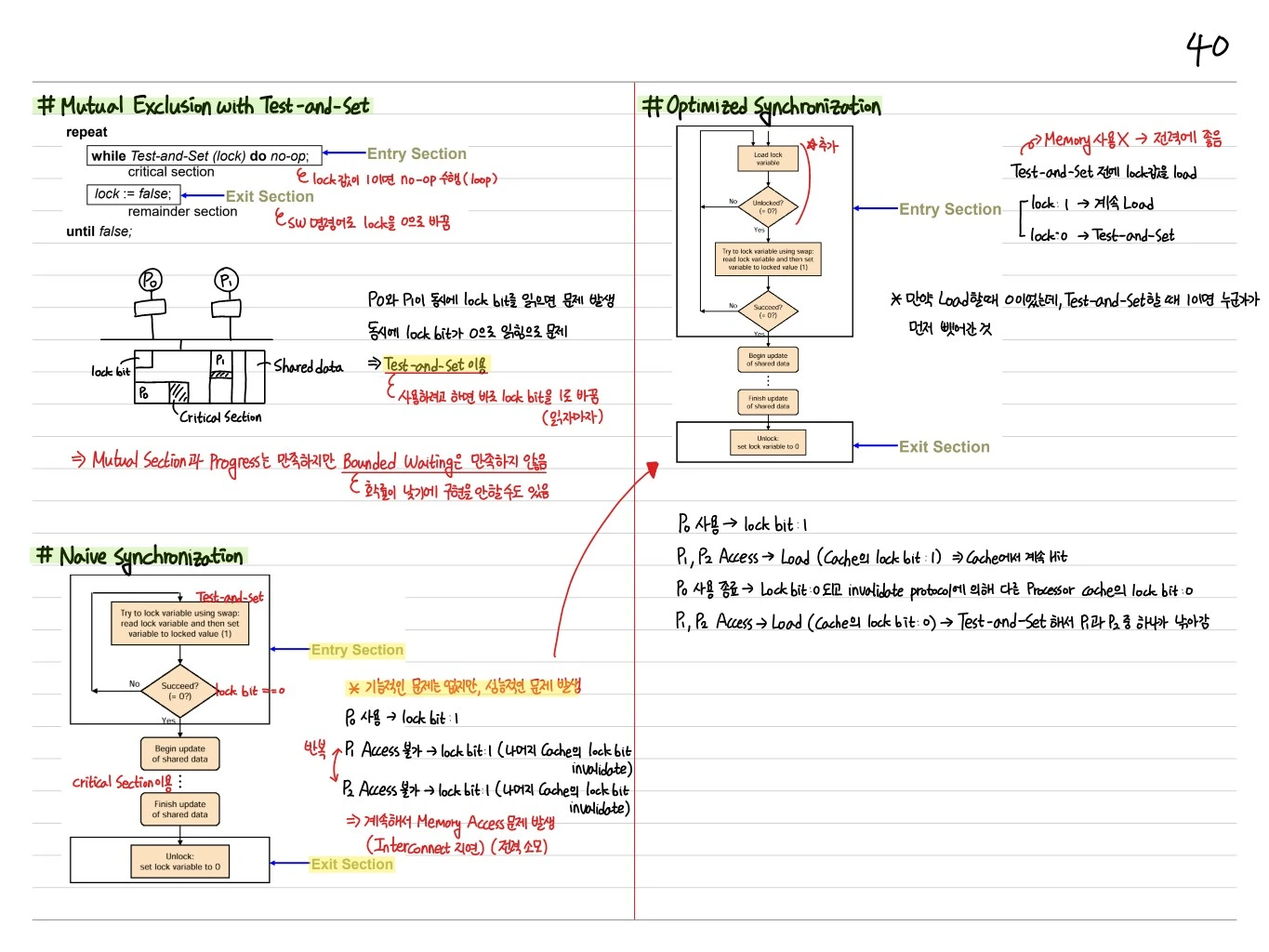
Mutual Exclusion with Test-and-Set
repeat
    while Test-and-Set(lock) do no-op;   // Entry Section
        critical section
    lock := false;                       // Exit Section
       remainder section
until false;- If the lock value is 1, execute a no-op (loop, busy-wait)
- A software instruction sets the lock back to 0
Problem when P0 and P1 read the lock bit at the same time
Both read the lock bit as 0 at the same time, which is the problem. Test-and-Set prevents this as an atomic operation (the moment a processor tries to use it, the lock bit is set to 1 right as it is read).
→ It satisfies mutual exclusion and progress, but not bounded waiting (since the probability is low, it may be left unimplemented).
Naive Synchronization vs Optimized Synchronization
Naive (Test-and-Set in a loop)
Try to lock variable using swap:
    read lock variable and then set
    variable to locked value (1)

Succeed? (= 0?)
    Yes → Begin update, Finish update, Unlock (set lock variable to 0)
    No  → loop
It is functionally correct, but it has a performance problem:
- P0 in use → lock bit: 1
- P1 cannot access → lock bit: 1 (invalidates the lock bit in the other caches)
- P2 cannot access → lock bit: 1 (invalidates the lock bit in the other caches)
→ Memory accesses keep happening (interconnect delay, power consumption).
Optimized Synchronization (Load-first)
- No memory traffic → good for power
- Load the lock value before Test-and-Set
lock: 1→ keep loadinglock: 0→ Test-and-Set
If the load returned 0 but Test-and-Set returns 1, someone else grabbed it first.
- P0 in use → lock bit: 1
- P1, P2 access → load (lock bit in cache: 1) → keep hitting in the cache (no memory access)
- P0 finishes → lock bit becomes 0, and the invalidate protocol makes the lock bit 0 in the other processors' caches
- P1, P2 access → load (lock bit in cache: 0) → Test-and-Set, and one of P1 and P2 grabs it
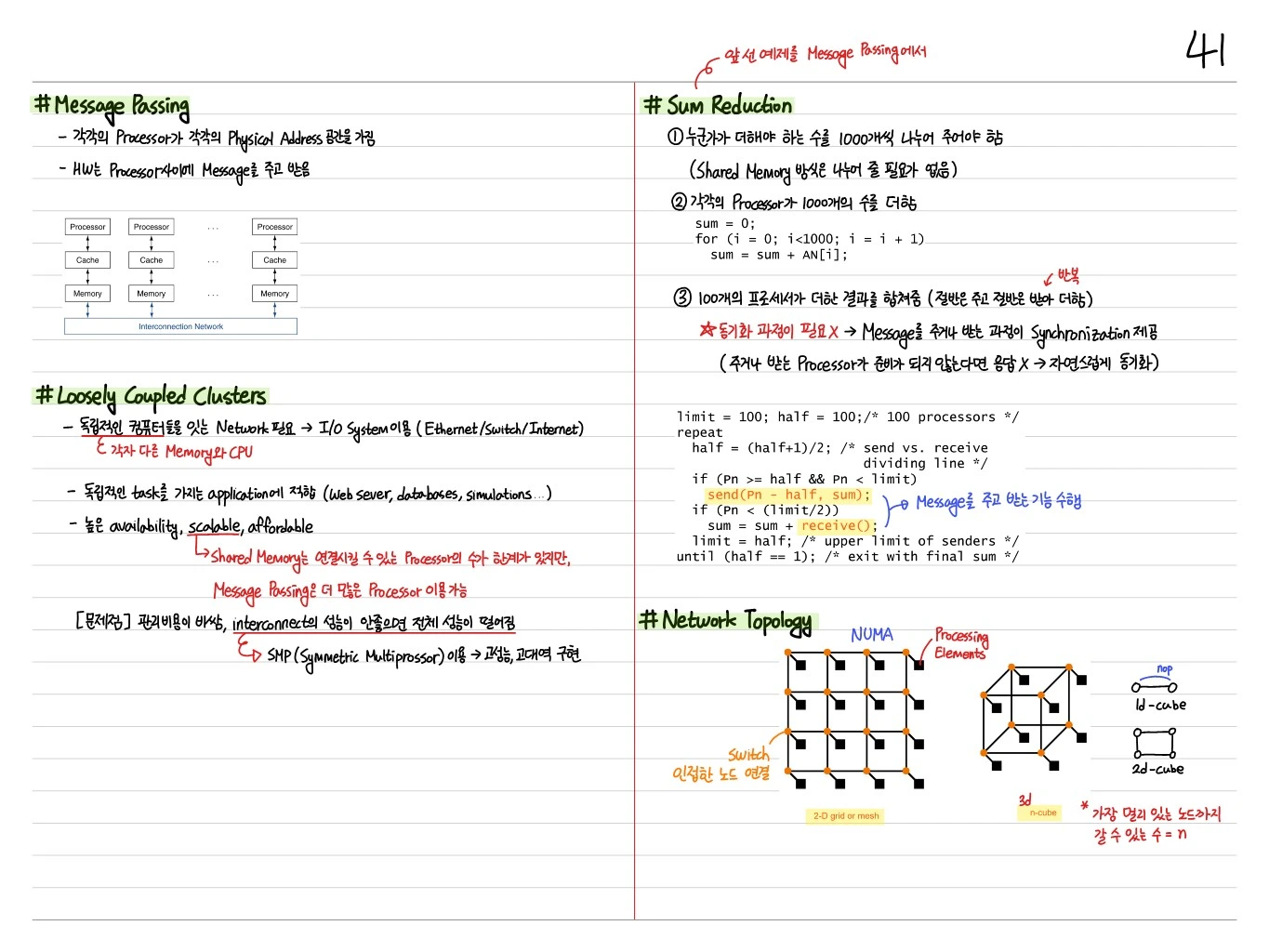
Message Passing
- Each processor has its own physical address space
- The hardware sends and receives messages between processors
[Processor]─[Cache]─[Memory]  ...  [Processor]─[Cache]─[Memory]
          └──────── Interconnection Network ────────┘
Loosely Coupled Clusters
- Requires a network connecting independent computers → uses the I/O system (Ethernet/switch/Internet)
- Each has its own memory and CPU
- Suited to applications with independent tasks (web servers, databases, simulations …)
- High availability, scalable, affordable
→ Shared memory has a limit on how many processors can be connected, while message passing can use more processors.
[Drawbacks]: management is expensive, and if the interconnect performs poorly, overall performance drops → use SMP (Symmetric Multiprocessor) → high performance, high bandwidth.
Sum Reduction in Message Passing
- ① Someone has to hand out the numbers to add, 1000 at a time (with shared memory there is no need to distribute them)
- ② Each processor adds its 1000 numbers
- ③ The results of the 100 processors are combined (half send, half receive and add) — repeat
- No explicit synchronization step needed → sending or receiving a message provides synchronization (if the sending or receiving processor is not ready, there is no response → synchronization happens naturally)
limit = 100; half = 100;  /* 100 processors */
repeat
    half = (half+1)/2;  /* send vs. receive dividing line */
    if (Pn >= half && Pn < limit)
        send(Pn - half, sum);
    if (Pn < (limit/2))
        sum = sum + receive();
    limit = half;  /* upper limit of senders */
until (half == 1);  /* exit with final sum */
Network Topology
Example NUMA topology
[Switch]─[Switch]─[Switch]─[Switch]
   │        │        │        │
[Switch]─[Switch]─[Switch]─[Switch]
   │        │        │        │
  ...
2-D grid or mesh, 3-D n-cube (hypercube), and so on.
- Multiple processing elements (PEs) connected by switches
- Number of hops to reach the farthest node = (n-cube)
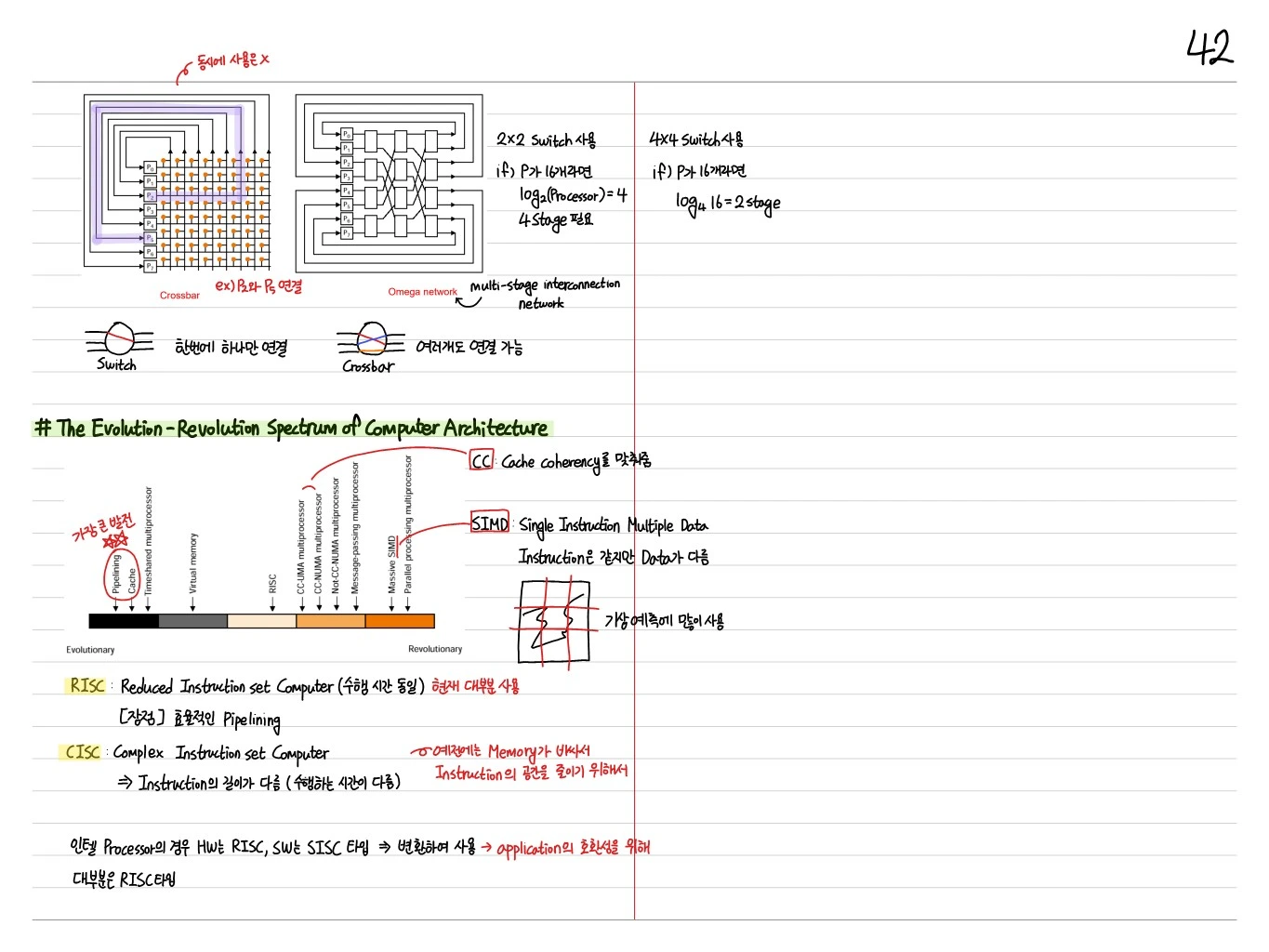
Crossbar & Multi-Stage Interconnection Network
Crossbar
Can connect several pairs at once. Example: P0 and P3 can be connected.
Omega Network (Multi-stage interconnection network)
- With 2×2 switches: for 16 processors, → 4 stages needed
- With 4×4 switches: for 16 processors, → 2 stages
Switch (connects only one pair)
Crossbar (can connect several pairs)
The Evolution-Revolution Spectrum of Computer Architecture
Evolutionary ────────────────────────────→ Revolutionary
Pipelining → Cache → Timeshared → Virtual → RISC → CC-UMA → CC-NUMA → Not-CC-NUMA → Message-passing → Massive SIMD → Parallel processing- Biggest advances: pipelining, caches
- CC (Cache Coherency): keeps the caches coherent
- SIMD: Single Instruction Multiple Data — same instruction, different data (used most for prediction)
RISC vs CISC
- RISC (Reduced Instruction Set Computer): uniform execution time, used by most processors today. Advantage: efficient pipelining.
- CISC (Complex Instruction Set Computer): instructions have different lengths (and different execution times). It came from a time when memory was expensive and instruction space had to be minimized.
→ Intel processors are RISC-style in hardware and CISC-style in software, translating between them → for application compatibility. Most processors are RISC-style.
Summary
| Concept | Description |
|---|---|
| Shared Memory MP | All processors share the same memory space (UMA/NUMA) |
| Message Passing MP | Each has its own memory and communicates by messages (cluster, HPC) |
| Cache Coherence | Keeps values consistent across multi-level caches |
| Synchronization | Atomic operations via Test-and-Set / load-first |
| Network Topology | Crossbar, Omega, 2D mesh, n-cube |
| SIMD | One instruction processes many data at once (the basis of GPUs) |
Multiprocessors are the theoretical foundation of all the parallel computing that followed: multi-core CPUs + GPUs + clusters.